
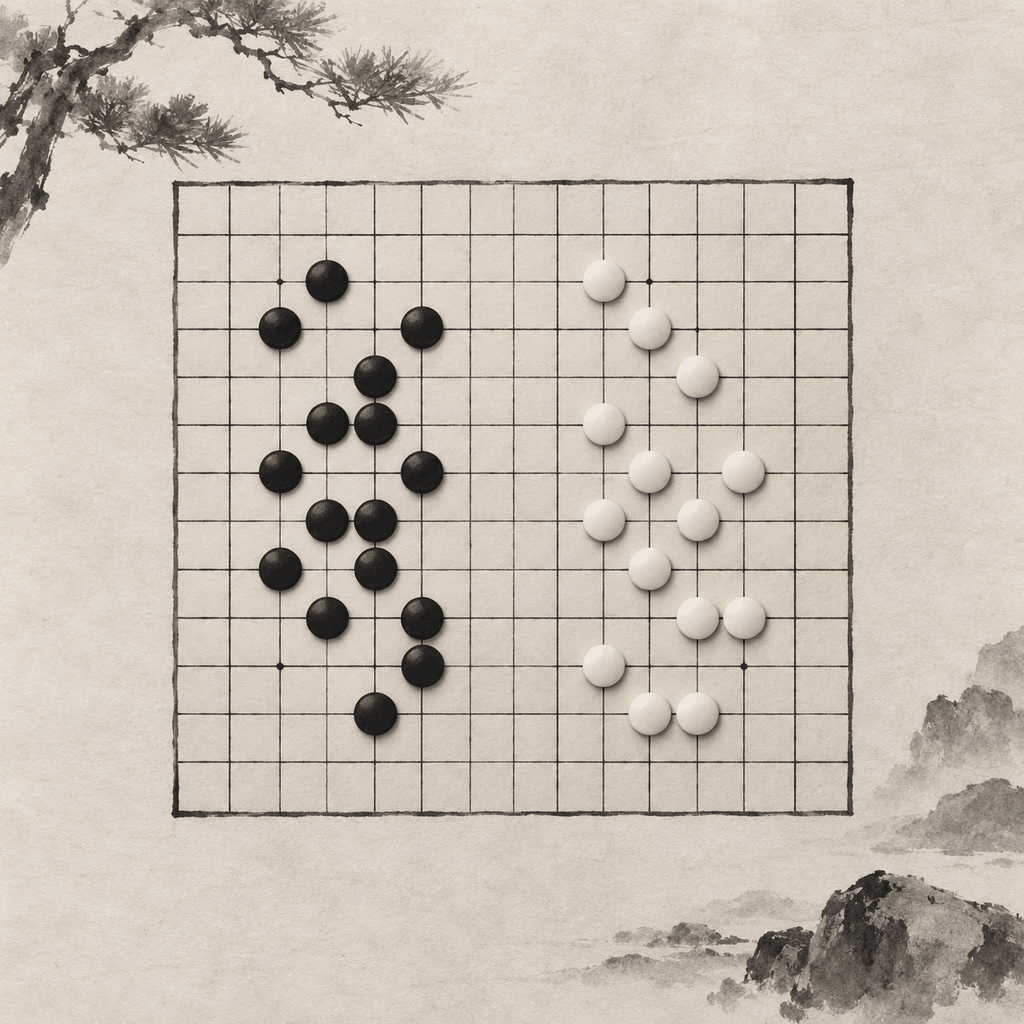
It is the last game of a five-game match, and you can see a reliable path to a draw. The challenger is still looking for a win. The champion can accept the balance on the board. Why does half a point make the same position look different to each of them?
Where the half-point comes from
In a five-game match, a win earns one point; a draw gives each player half a point. The challenger takes the title by reaching three points. If the challenger finishes the five games short of three, the reigning champion keeps it. At 2.5–2.5, the title stays where it is. That condition is set before play begins, and it changes how each side values a draw.
Two sets of results make the difference plain. One win and four draws give the challenger three points, enough to take the title. Shunsuke Kamiya did just that at the 59th championship in 2021. A champion with one win and three draws has 2.5 points after four games; there is no need to play the fifth. Kamiya retained the title with that record at the 62nd championship in 2024.
How often Japan’s title matches end in draws
The All-Japan Renju Meijin Championship has been held annually since 1962, apart from a cancellation in 1974. Regional qualifiers run in parallel. They award seven places in the ten-player Class A league; the previous year’s top three receive the other places as seeds. The league plays a single round robin, and only its winner earns the right to challenge the reigning champion. A seed goes straight into the league. Everyone else must first qualify through a region.
Count the results of the title matches from 1962 through 2025: across 63 editions, with none held in 1974, 42 included at least one draw—about two-thirds. That count comes from published win-draw-loss results for each match; it excludes years for which only final standings, not scores, were published. Treat a draw as an occasional interruption, and the scoring becomes hard to understand. Draws recur throughout the five-game ledger, changing what each player needs before the last game begins.
The same records offer a number especially relevant to the champion. In 27 of the 63 editions—about 43 percent—the reigning champion finished on exactly 2.5 points. That is enough to keep the title, whether the match stops after four games at 2.5–1.5 or runs the full five and ends 2.5–2.5. Not every match approaches that boundary. At the 63rd championship in 2025, Kamiya went three wins, no draws and no losses against Wang Qingqing. The rules permit a champion to retain the title on a tie; the board can produce something quite different.
The challenger must find a win
Suppose the first four games are all draws. Each player has two points. In the last game, the challenger must win to cross the threshold; the champion needs only another draw. This is not an invented account of a real match. It simply puts the remaining game in view. One player can guide a balanced position to its natural end. The other still has to find a way to change it.
Move back one game. If the first three are draws, the challenger has 1.5 points and two games left. Two wins would do it, but so would a win and a draw. After every game, the remaining routes narrow. By the middle of a match, the choice between pressing for a win and containing the position depends partly on games not yet played. The result of the game in front of you is only part of the calculation.
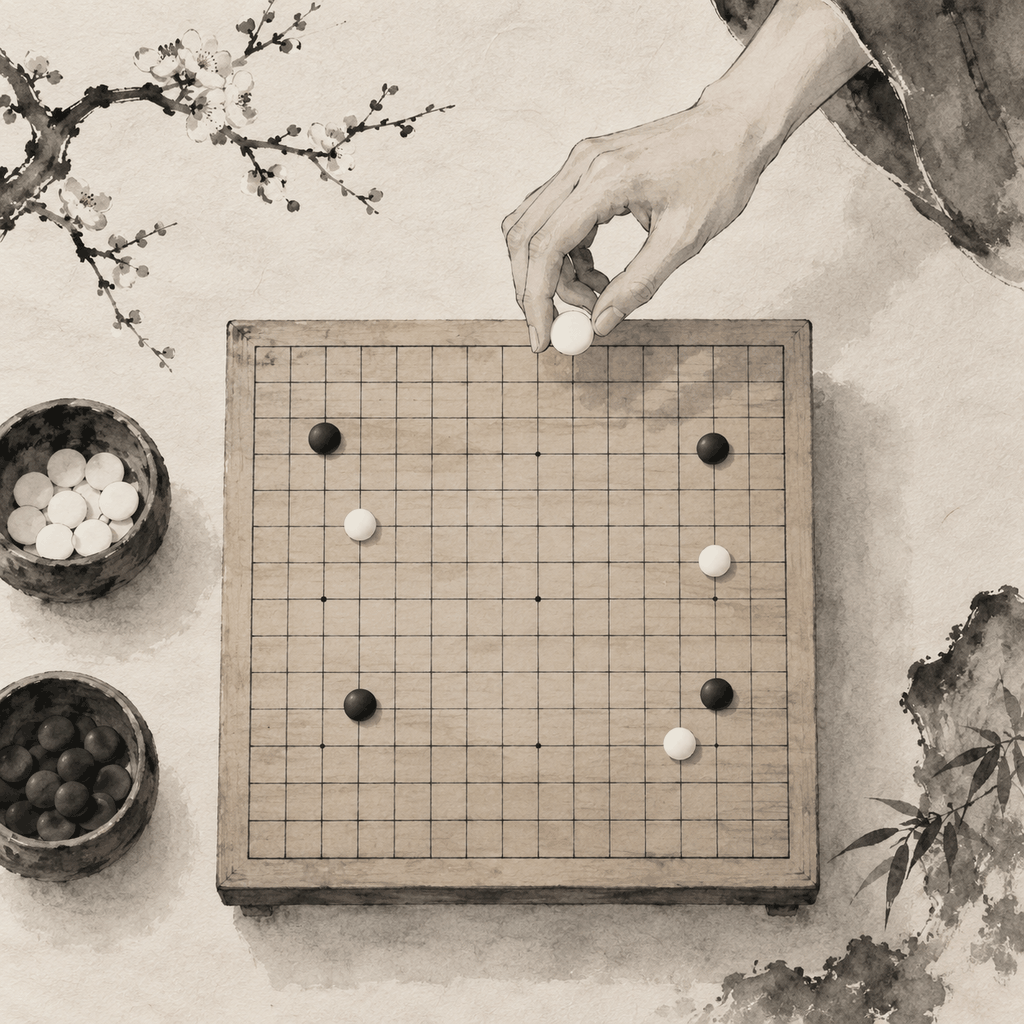
The same draw carries different costs
Imagine an unsettled position. Both players see a safe line that preserves the balance and a line that presses for a win but is harder to control. If a draw is enough for the champion to retain the title, the safer line has an appeal. If a draw leaves the challenger short of three points, the challenger has to weigh the risk of playing on.
No stone on the board is marked “half a point.” You see its effect in the choices: one player can reduce complications while the other may need to preserve them, even when both read the position the same way. Before calling a move cautious or risky, check how many games have been played and what each player has scored. Both are judging what the move could mean for the rest of the match.
That is why a draw changes weight from one game to another. At the start, it gives each player half a point. Near the end, it may determine who must win next. The championship records show that draws are a regular result in Renju. Opening rules address a different problem: they let an opponent decide whether to take over a side, so the player who first places a black stone cannot claim the first-move advantage without challenge. Whether a game ultimately produces a winner still depends on the choices made on the board.
The same draw comes at a different cost to each player.
How Taraguchi-10 offers the chance to swap
Taraguchi-10 builds choices into the opening. Black’s first stone goes on tengen, after which the opponent may swap sides. White’s second stone must go within the central three-by-three area, and the opponent may again swap. Black’s third is confined to the central five-by-five area, with another opportunity to swap; White’s fourth must be played within the central seven-by-seven. As the stones move outward from the center, the assignment of Black and White can repeatedly be reconsidered.
After the fourth move, there are two ways to arrange the fifth. In one, the opponent first has the option to swap. Black then places the fifth stone within the central nine-by-nine area, and the opponent may swap again before White plays a sixth stone anywhere. In the other, Black proposes ten mutually non-symmetrical locations for the fifth stone. White chooses one, then places the sixth stone anywhere. Either route gives the opponent a say in the opening they will play.
The placement limits and swap options address the advantage of moving first. Through the opening four moves, the question of whether to take a side keeps returning to the opponent. The fifth offers a further chance to swap or choose a location. None of this guarantees a draw. It repeatedly tests the first-move advantage. In a five-game title match, that pursuit of balance meets two players who may need very different results.
Taiwan’s path to the title match
The 18th Taiwan Gomoku Meijin Championship, held in 2026 by the Taiwan Gomoku Association, uses Taraguchi-10 throughout. It has three stages: qualifiers, a round-robin league and a title match. The southern and northern qualifiers each send three players to the six-player league. Qualifying consists of five Swiss-system rounds, with a base time of 30 minutes and a 30-second increment per move. The same opening rules apply from the first stage.
The southern qualifier took place on October 9, 2026, at the training center in front of the high-speed rail station in Kaohsiung’s Zuoying District. Eight players entered. Li Kunning, a sixth dan, won all five games and finished first with ten points. The northern qualifier followed on October 18 at Qipin Space in Taipei’s Xinyi District, with seven entrants. Lin Huangyu, an eighth dan, also won all five games and placed first with ten points; Huang Yanhua, a fourth dan, finished second, and Zhang Yifeng, a fifth dan, third. Each event awarded three places in the league.
The six league players contest a five-round single round robin, with a base time of 60 minutes and a 30-second increment per move. The winner earns the right to challenge. The title match changes to five games, with a base time of 120 minutes and the same 30-second increment. Published tournament coverage lists Lin Shuxuan, an eighth dan, as the defending champion. The schedule and time controls change from qualification to the title match. Taraguchi-10 and the five-game scoring rule remain part of the decisions at the board.
Read a draw in the context of the match
When you watch a title game, start with the games already finished and each player’s score. Then ask what room a draw in the current game would leave. If the challenger still needs a win, a balanced position carries its own pressure. If the champion can afford a draw, adding complications has a clear cost. You need not guess at either player’s thoughts. The score tells you what each faces.
The next time you play, pause at a position you could hold in balance. First ask where a draw would leave the match. Then decide whether to look for a winning line. In that brief moment before the white stone comes down, you may feel the weight of every game still to play.