
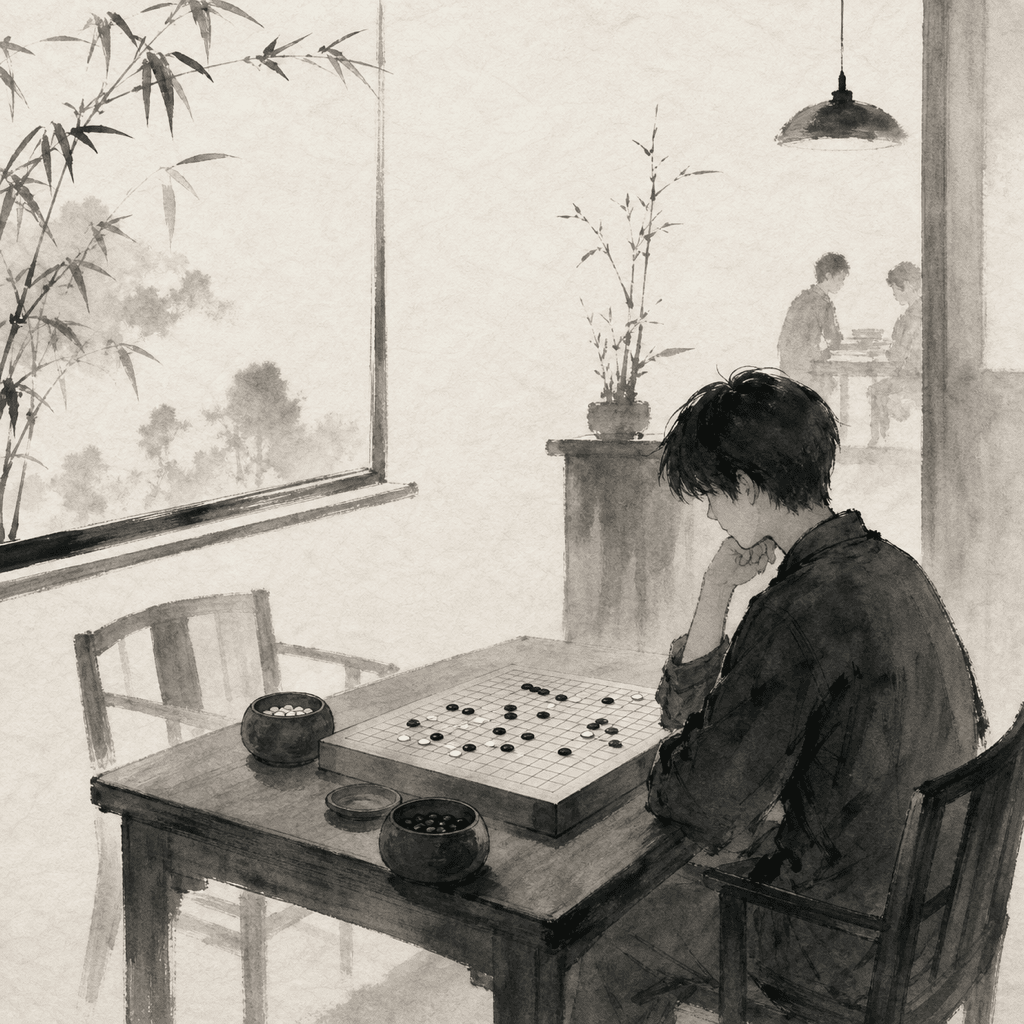
You might think the hardest part of an online tournament is the internet connection. Often, the real tension comes from something else: a child sits in front of a screen, with the room around them at once too quiet and too loose, and the game feels as if it has been lifted out of the tournament itself. The 2026 World Renju and Gomoku Youth Cup will be played online on vint.ee, yet players are asked, whenever possible, to gather at clubs in their own countries, with a responsible coach present. It is a small detail, but it carries real weight.
Online Does Not Mean Scattered
On Renju.net, the event is listed as the World Renju and Gomoku Youth Cup 2026, with Tallinn, Estonia, as the location and July 24 to July 30, 2026, as the dates. The playing platform is vint.ee. Players and coaches communicate through Zoom, while spectators watch on Twitch. On the surface, it is a standard online international tournament.
But one sentence in the event notes deserves a closer read: players should gather at their national clubs and be with the responsible coach. This is not an attempt to turn an online event back into an over-the-board one. It is a way of putting a layer of order back around scattered screens. A child is not facing a casual online game opened on a whim, but a match with a schedule, arbiters, and a sense of team.
That is also where youth events differ from adult online play. Adults can often rely on self-discipline. Children need the room itself to remind them: this is not practice, not chat, not something to try again next game. The round has begun.
The Club Turns the Screen Back Into a Venue
Whether a board feels like a tournament board is not decided only by where the stones land. It also depends on the quiet before the round, the soft reminder from someone nearby, the coach glancing at a watch, and the few minutes after a loss when you cannot simply disappear. The club preserves these details.
At home, a child can easily treat the game as another stretch of screen time. A sip of water, standing up, turning around to speak, each small act cuts the continuity of the game. At the club, the chair, the table, the camera, the check-in, the waiting all say the same thing: this game must be played through.
A sense of order is the chassis of a youth tournament.
There is nothing flashy about this arrangement, but it is refined. It is like a well-polished wooden board: it does not call attention to itself; it simply makes it easier to keep your attention on the game. A good online tournament does not always need a busier interface. Sometimes it only needs to make competition calm, modern, and credible again.
Taraguchi-10 Makes the Opening Matter
This Youth Cup uses Taraguchi-10 rules, counts for rating, is classified as an International Competition, and will be played as a Swiss tournament with a time control of 30 minutes plus 5 seconds per move. For young players, this is not a lightweight entertainment room. It is a clear competitive frame.
The point of Taraguchi-10 is that opening choice itself carries responsibility. You cannot slide through on familiar patterns alone, and you cannot treat the first phase as a warm-up. After tengen, the development, restrictions, and choices quickly push the player toward real judgment.
Suppose your opponent leaves space and you want to seize an open three. It looks natural. But if your next move allows a double-three threat, the position hardens at once. The most common youth-tournament mistake is not a failure to calculate. It is treating a loose opening move as something the middlegame will later repair.
A Coach in the Room Is Not a Second Player
The presence of a responsible coach, as noted in the event arrangements, can be misunderstood as a kind of help. It is the opposite. The coach first creates boundaries: when to enter Zoom, when to confirm the equipment, when to stay quiet, and when to accept the result.
A good coach does not reach into the game. The coach is more like the wall of the playing hall, helping the child understand what may be done and what may not. For a young player, that boundary can matter more than another complicated line of analysis.
This is especially true in an online international event, where fairness is built from many small actions. The camera is on. The room is visible. The coach is accountable. Communication is unified. No single step is dramatic, but together they make the opponent believe the game deserves to be taken seriously.
Thirty Minutes Plus Five Seconds Tests Rhythm
A time control of 30 minutes plus 5 seconds per move is well suited to observing young players. It is not short; there is enough time to calculate critical points. It is not long either; it does not allow endless delay. Time pressure brings habits into view.
I have noticed that many young players lose their rhythm most easily in winning positions. They already have a four-in-a-row point, then notice the outline of an open three on the other side. They start checking and rechecking, until the 5-second increment becomes a lifeline. A mature rhythm means slowing down before the critical move and not wasting time on ordinary ones.
Beside the Offline Team Worlds, the Youth Cup Is a Bridge
In the same Renju.net event index, the 2026 Gomoku Team World Championship takes a very different shape: Yerevan, Armenia, August 15 to 19, 2026, Swap 2 rules, a round-robin format, and a time control of 120 minutes plus 30 seconds per move. That is the full atmosphere of an over-the-board team event.
Put the two tournaments side by side, and the difference is clear. The Team World Championship emphasizes long time controls, face-to-face play, team seats, and the pressure of the venue. The Youth Cup uses an online platform to lower the barrier to international participation, while club gatherings keep the skeleton of the playing hall intact. It is not a reduced version of an offline event. It is a bridge.
The value of a bridge is that more children can step onto it. Not every family can afford long-distance travel, and not every young player is ready to sit inside an international playing hall. The online Youth Cup gives them a more reachable international experience, without giving up the restraint and seriousness a tournament should have.
Beyond the Registration Date, Prepare the Habits
The event page lists July 20, 2026, as the registration deadline, and the results table is still empty. The organizers include RIF, vint.ee, and the Estonian Renju Union. The chief arbiter is Ando Meritee, and Ants Soosõrv is responsible for pairing and event management. The information is clear enough. What remains is preparation.
Preparation is not only registration, an account, a connection, and equipment. The finer preparation is helping a child get used to playing quietly under other people’s eyes, to waiting before the round, and to reviewing a loss instead of immediately closing the page. Playing strength matters, of course. But tournament habits often decide whether that strength can fully appear.
A good tournament first helps you sit steady.
If you are following this event, you can check the rules, schedule, and platform details on the World Renju and Gomoku Youth Cup 2026 event page, and follow updates through the news and event index of the Renju International Federation. Find a quiet evening and play one 30-minute-plus-5-second game with your child. Do not hurry to win. First, learn to make the game feel like a tournament.