
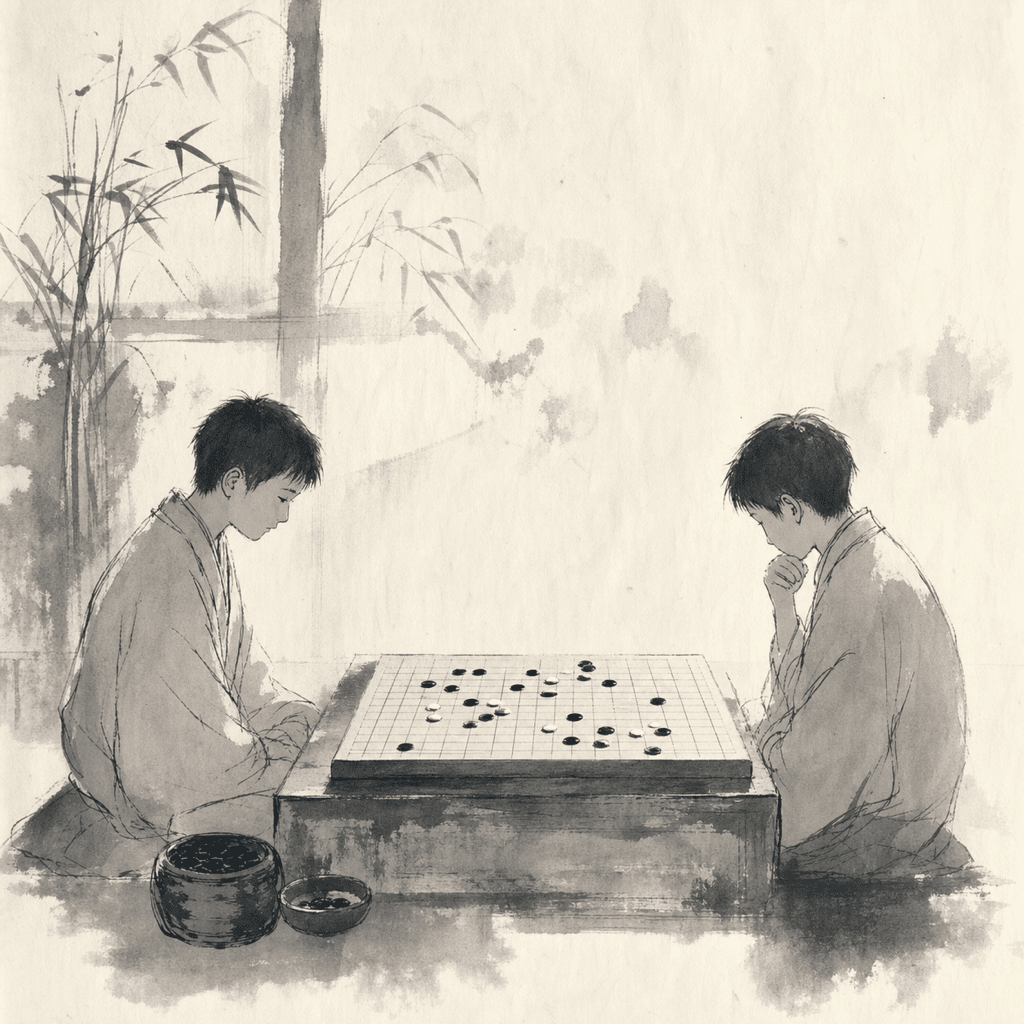
You can look at a medal table and remember who stood on top. You often forget how the games got there. The Dalian youth championship has just ended, and what is worth keeping is not only a number like “10 golds, 9 silvers, 9 bronzes.” It is how young players, under the Taraguchi-10 rule, dealt with opening choices, time pressure, and postgame review. Medals go into the archive. Feel for the game keeps growing.
Beyond Medals, Look First at the Pressure
Public information before the 2026 World Youth Gomoku Championship said it would be held in Dalian from July 5 to 9, organized by the Renju International Federation, with about 150 players from six countries and regions. China fielded 97 players. A public post-tournament summary said Chinese juniors won 10 golds, 9 silvers, and 9 bronzes, and swept gold, silver, and bronze in the two major blitz groups. It is a handsome result. But if you stop at handsome, you miss the part with texture: in every game, these players had to compress the variations they had memorized into real countdowns, real eye contact, real stones clicking on the board.
The moving thing about junior games is rarely their perfection. They are tense, sometimes a little raw. But because they are raw, you can see the instant a choice is made. That, by itself, is enough reason to watch.
Taraguchi-10 Makes the Opening More Than Memory
Both the standard event and the blitz event used the Taraguchi-10 competition rule. For beginners, that fact is more worth pausing over than the medal table. The point of the rule is not to make the game obscure. It is to reduce the advantage of simply knowing fixed openings, and to make both sides start judging earlier.
Under this rule, a young player cannot rely only on a familiar first impression. You may see a very natural shape near tengen, but still have to consider what can be swapped, selected, and extended afterward. A restrained-looking move may be saving space for move seven or move nine. When watching, you do not need to ask right away, “Is this the strongest opening?” Ask something smaller first: which side does this move make it easier to form an open three, and which side does it make it harder to defend two lines at once? Make the question smaller, and the game becomes clearer.
What the rule changes is the weight of choice.
Blitz Tests Not Fast Hands, but Less Hesitation
Blitz is easily mistaken for “whoever moves faster wins.” But in Gomoku, the real speed is not in the hand. It is in the ability to delete useless branches. When you see a four-in-a-row, your first response cannot simply be to block. You also have to confirm whether, after the block, your opponent has already prepared a double-three.
Two habits are especially exposed in junior blitz: being pulled along by an opponent’s repeated threats, and choosing the safest defense even when a counterattacking point exists, simply because time is short. The first slowly suffocates you. The second hands over the initiative. So the homework blitz leaves behind is specific. It is not “get faster.” It is to train common shapes until they can be recognized at once: can a blocked three become alive, is there a four-in-a-row after the open three, is the blocking point unique? Speed is quietness after training.
Junior Tempo Often Hides in One Unhurried Move
Adult players’ games are often steadier. Junior players more readily write their intentions onto the board. When they are eager to attack, the stones run forward in a line. A truly mature move, by contrast, may land off to the side and look like a detour. Suppose Black already has one obvious three. If White stares only at that line, White may miss the connecting point on the other side. Black’s next move may not be a four-in-a-row, but a quiet reinforcement that turns both sides into possible launch points. The move makes no noise. It is delicate.
When you watch junior games, pay attention to that kind of “not yet.” It shows a player beginning to move from single-point calculation to managing the whole position: not only asking whether this move can win, but whether the next round will let me keep asking questions.
After the Result, Review Leaves More Than Celebration
A medal is an outcome. Review is an entrance. Much of the value of a junior tournament happens afterward: a player returns to a room, a training table, or a computer, brings back one move, and asks why it went unseen at the time.
Review should not look only for the losing move. Wins must be taken apart, too, because wins often contain luck hidden by the score: the opponent failed to find a double-three, blocked the wrong four-in-a-row, or one of your own open threes was not actually valid. Review a win honestly enough, and the next loss will not feel so sudden.
This is also the hardest and most worthwhile thing for young players to practice. The game is over, but the emotion remains. Whether you can put that emotion aside and return calmly to the board is another kind of match.
If you know how to review, neither winning nor losing is wasted.
Public Records Need Gentle Checking, Too
For this tournament, pre-event information appears in a local Dalian report, which mentions the dates, scale, and rules. A post-event summary appears on a public Renju-related page. These materials are enough to sketch the outline of the event, but they should not replace complete game records and round-by-round results. For background on the Taraguchi-10 rule, you can also compare the Renju International Federation tournament page. Public reporting by the Japan Renju Society on the 2026 youth championship groups can be found on the Japan Renju Society website. When writing a tournament lookback, restraint matters: state what can be verified, and leave blank what cannot.
That blank space is not cold. On the contrary, it keeps young players’ effort from being buried under exaggerated narrative, and it returns the reader’s attention to the games themselves. A modern tournament record should be like a polished board: it does not steal the light, but it can hold every stone.
Next Time You Watch Juniors, Start With Three Small Things
First, watch the opening choice without rushing to memorize a conclusion. Especially under Taraguchi-10, early stones often carry a sense of mutual probing; you can note which side first gains potential threats in two directions. Second, watch how the time changes. After a long think on one move, do the next few moves become hurried? That often shows what the player has just calculated, or that the player is retreating from a wrong judgment. Third, listen for revision during review. A junior who can say, “Here I thought it was an open three, but in fact this move stopped it,” is saying something more valuable than “I made a mistake.” When the language becomes finer, the game becomes finer, too.
The youth championship is over, but these games can still be watched. Find one. Play it out slowly. Try following only one line: how an open three appears, how a double-three grows larger, how the first choices near tengen shape what comes later. Sit with one game quietly.