
You sit down to start a game, and your opponent’s first stone lands, almost inevitably, in the exact center. It looks like habit, maybe even ritual. But that move is doing real work: symmetry, distance from the edge, and first-move pressure all arrive at once. Understand it, and next time you will not just be “playing along.”
Tengen Divides the Board Four Ways
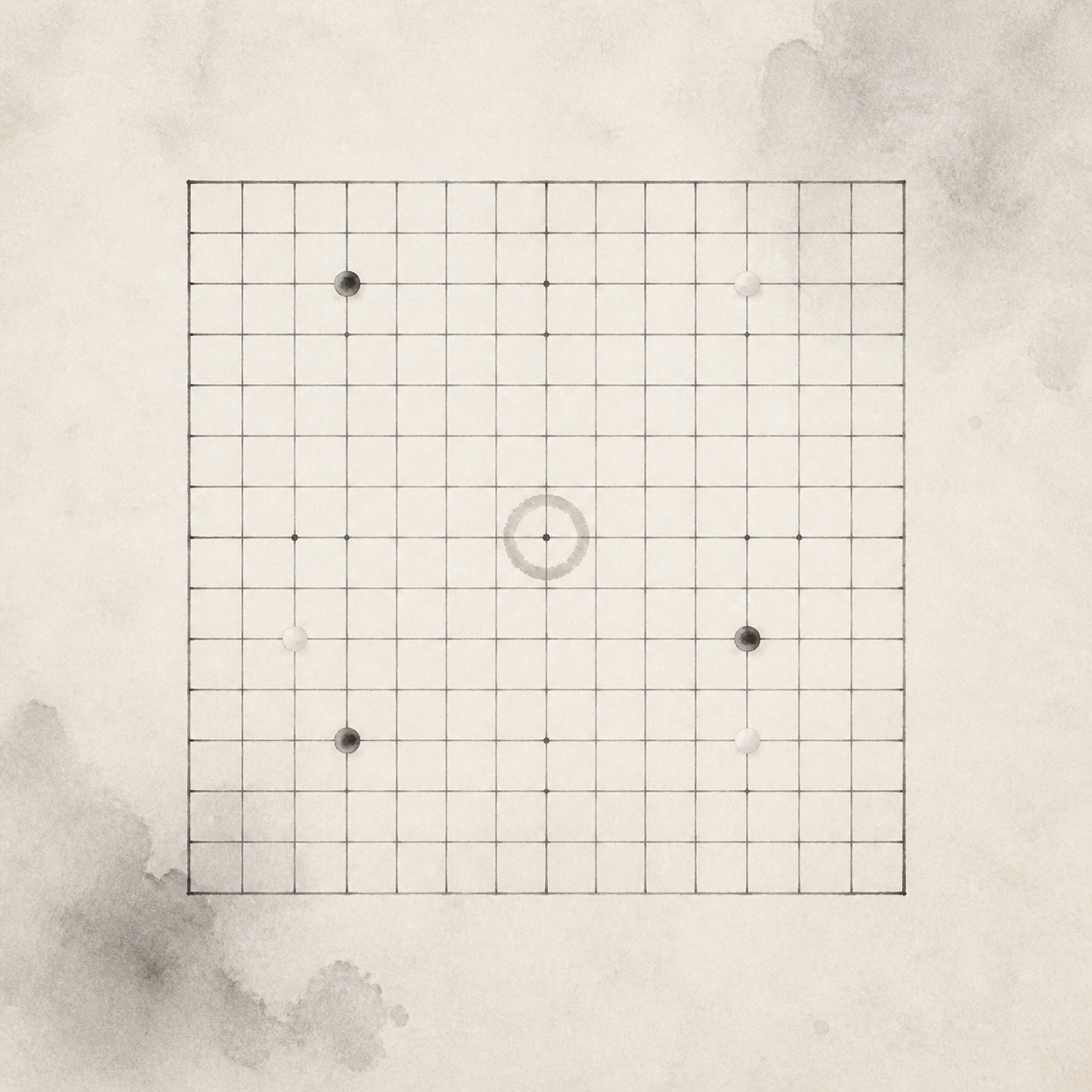
Tengen is the intersection at the exact center of the board. A standard Gomoku board is 15 by 15, and the center point sits the same distance from each edge. When Black plays there, the horizontal, vertical, and two diagonal lines all open naturally.
RenjuNet’s introductory rules put it plainly: in Renju, the first move is played in the center, and stones are placed on intersections. The rule fixes the coordinates first. It also asks both players to begin reading the game from the same spatial center.
Farther From the Edge Means More Room
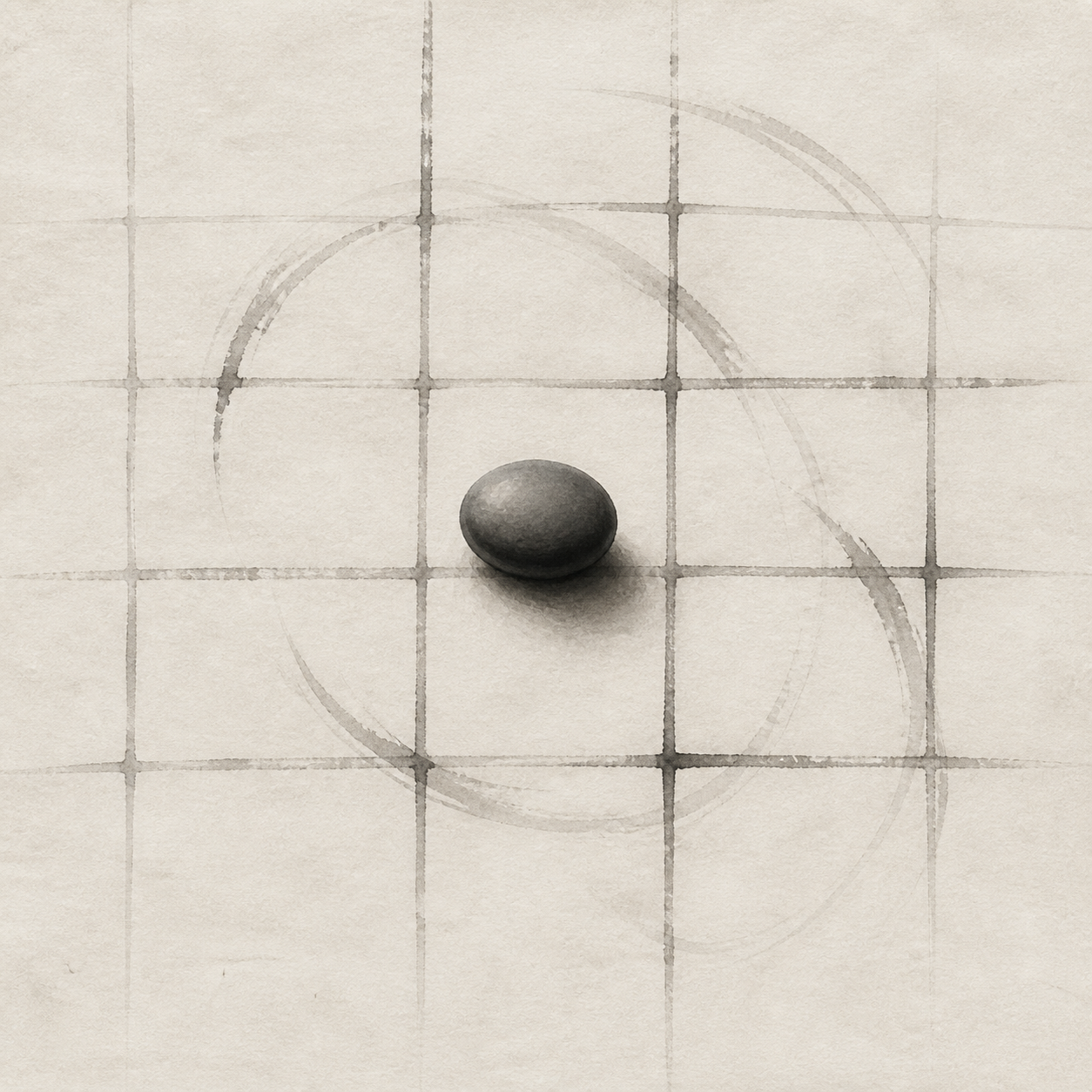
The center has one plain advantage: it is far from the edge. Gomoku is won by making five in a row. When any line is cut short by the boundary of the board, the threats that follow become narrower. Put the first stone near an edge, and the number of usable directions drops immediately.
Imagine Black’s first stone on the third line near the side. White can turn attention back to the middle, and Black’s original stone will need extra moves just to reconnect with the main battlefield. Tengen has no such burden. From move one, it sits where the game is most likely to meet.
The Center Is Harder to Ignore
Researchers have taken Gomoku’s first-move advantage seriously for a long time. The computational game theory notes collected by David Eppstein mention that Allis and others proved a first-player win for free-style Gomoku under the usual conditions. A central opening magnifies that pressure, because Black has more ways to connect the next stone.
For White, the move after tengen is rarely something you can simply ignore. If White plays too far away, Black can use the second move to build a two-stone relationship in the middle. If White plays close, the game quickly becomes a local fight. Tengen’s value is that it forces White to declare an attitude from the first turn.
Tengen keeps the choices open in four directions.
Open Threes and Double-Threes Grow Better in the Middle
The key word in an open three is open: both ends still have room to extend. When three stones in a line are already connected, or can be made connected, and neither end is blocked, the opponent often has to answer at once.
A central stone more easily becomes the skeleton of an open three. Black can play down-right from tengen, then add a stone up-left, and both ends of that diagonal still have space. Put the same shape near the edge and one end soon runs into the side of the board. The threat gets shorter.
A double-three depends even more on space. One move has to create two open-three directions at the same time. A horizontal line and a diagonal, or a vertical line and a diagonal, can work together. Around tengen, the intersections are dense, and the possible routes of combination are more numerous.
Different Rules Handle Tengen Differently
Renju requires the first move to be played at tengen so the opening coordinates are fixed, then uses forbidden moves to restrain Black. Those forbidden moves limit Black’s double-three, double-four, overline, and related shapes. The central opening, in other words, is not allowed to expand into an unchecked one-sided sprint.
This Chinese rules summary lists differences among free-style Gomoku, Gomoku-Pro, Swap, Swap2, and Renju openings. Some rules specify tengen directly. Others let the players swap colors or choose positions. The core problem is the same: Black moves first, and the best location is too comfortable.
That is why opening requirements can look different from platform to platform. In free-style rules, an opponent’s first move at tengen is usually a matter of experience. In Renju, it is part of the rule text. In swap rules, the first player must also consider whether the position being offered is one the opponent will want to take over.
A Tengen Opening Can Expose Your Habits
Tengen is strong, but it will not play the rest of the game for you. A common mistake is for Black to begin in the center, then spend the second and third moves forcing along a single line. White blocks both ends in sequence, and Black has quietly handed over the tempo.
A sharper approach starts by watching White’s first stone. If White plays close to tengen, Black has to judge where two potential lines can form. If White plays far away, Black can first take a point that connects with the center while also expanding to the other side. The center gives you choices. You still have to read them.
Use a Small Tengen Check Next Game
When you face tengen, look at three things first: how far that stone is from the edge, whether White’s first move has cut off a main line, and whether Black’s next move can serve two directions at once. Once you have checked those three, the position usually becomes much clearer.
Tengen is common because it uses the board’s space more completely than almost any other first move. Next time you open, try a game from the center, then watch closely how the second move changes all four directions.