
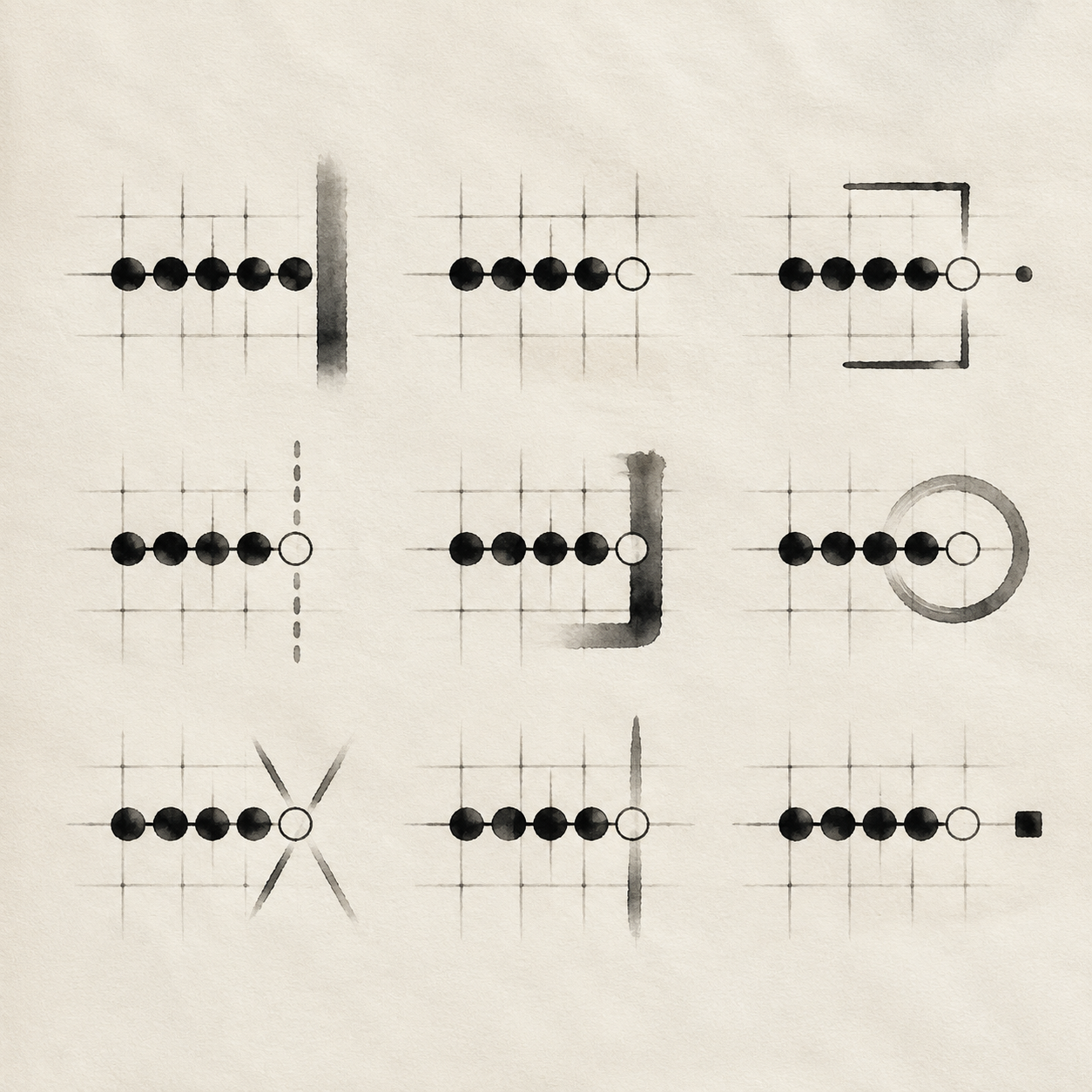
You are playing on one platform. Black places a fifth stone, five points form a line, and the system immediately declares a win. On another platform, the same position continues, or is even ruled invalid. The problem often lies in the rule name: freestyle, standard, Renju, and Caro are all called Gomoku, yet each draws a different boundary around how many stones in a row count as a win. Understand these four boundaries, and you can tell whether a line on the board means the game is over or only that the position has become dangerous.
Why can the same line produce different conclusions?
Imagine a horizontal line with six stones of the same color. Under the usual definition of freestyle, the line contains five consecutive stones, and six also satisfies the condition of “five or more,” so the player who made the move generally wins immediately. Under the common 15×15 standard rules, six in a row is an overline and cannot be treated as a win; the game continues.
This is not a referee changing the standard in the middle of a game. It is the winning condition changing from “at least five stones” to “exactly five.” The stones have not moved, but the rules’ interpretation of the end of the game has changed.
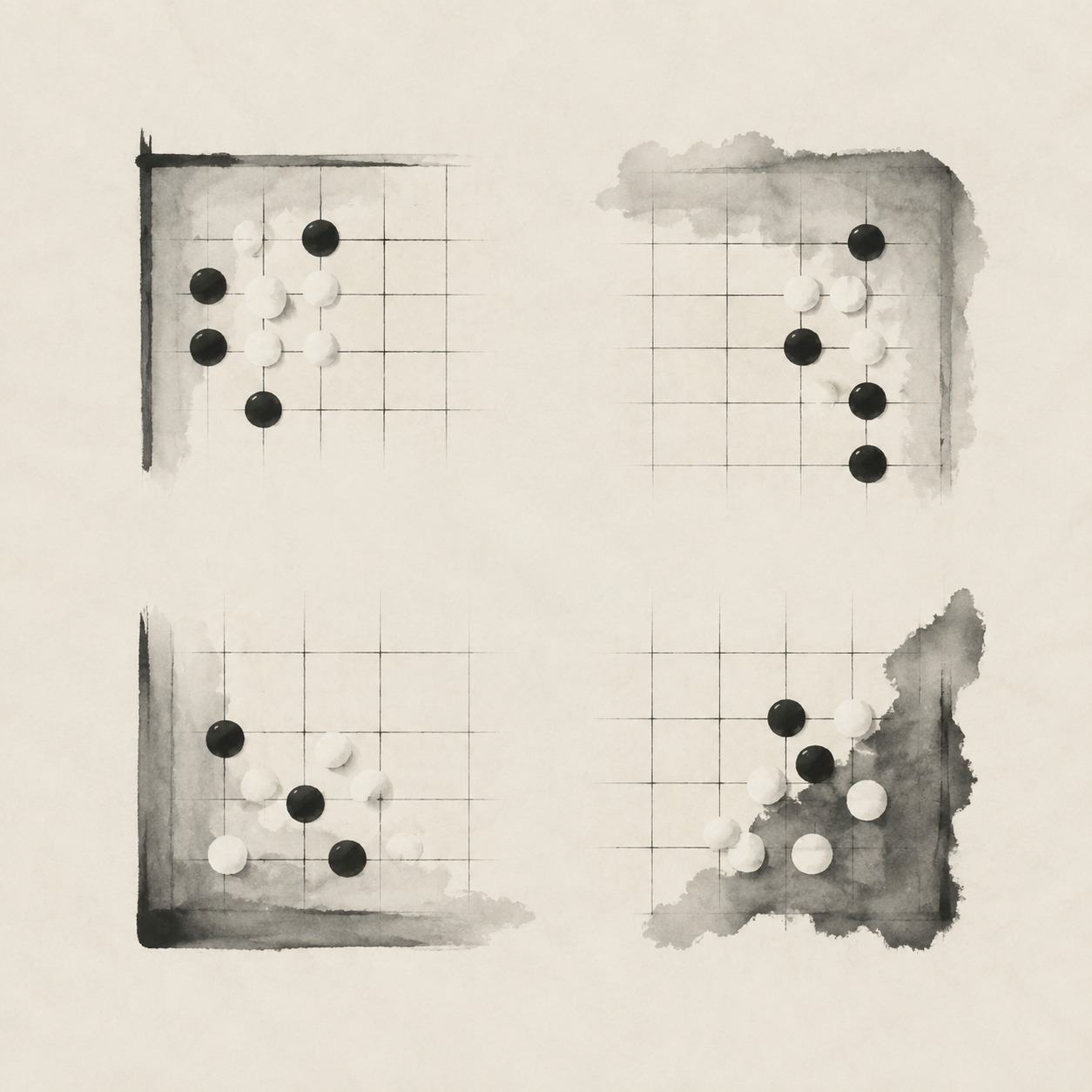
Freestyle: Once five in a row appears, the result is settled
Gomocup’s detail-information page describes freestyle as a broad set of basic rules: players take turns placing stones, and the first player to form five or more consecutive stones wins. The phrase “or more” is crucial: six or seven in a row remain valid winning shapes.
For example, Black has four connected stones, and White has not blocked either end. Black places one more stone and forms six in a row. Under freestyle, the game usually does not check whether six has “exceeded the target,” because the threshold for victory is at least five stones. Board size, whether swaps are allowed at the opening, and how a server handles simultaneous lines still depend on the specific tournament or platform.
Wikipedia’s overview of Gomoku likewise describes the standard objective as forming five consecutive stones, but different online implementations may retain freestyle’s more permissive judgment. When you see the general name “Gomoku,” checking the rules page is more reliable than guessing from the board’s name.
Standard: Exactly five in a row on a 15×15 board
Gomocup’s rules connect standard with a 15×15 board and emphasize exactly five consecutive stones as the winning shape. Both ends of a five-in-a-row may be open, or one end may be blocked; as long as the consecutive segment is exactly five stones long, it usually satisfies the winning condition.
Suppose Black has four stones in a horizontal row and places one on the right, forming exactly five. Black wins. If that move extends the same direction to six in a row, standard usually treats it as an overline, which does not count as a win; the platform may require play to continue or, depending on its own end-of-game handling, announce a different result.
In Gomoku, the rules decide the winning length before the stones do.
Renju: The first player faces additional boundaries
Renju retains the goal of making five in a row but adds forbidden-move restrictions for Black. The Renju entry on Wikipedia lists three core forbidden moves: Black making a double-three, a double-four, or an overline. These shapes usually result in an immediate loss for Black, even if White has not yet made five in a row.
A “double-three” can be imagined as one Black move creating two lines that can each develop into an open three; a “double-four” creates two four-in-a-row threats with one move. The judgment depends on the exact shape. A closed three, a blocked four, and whether the same stone is being counted twice at an intersection can all change the conclusion, so the number of stones alone is not enough.
Renju also has dedicated opening restrictions. Common rules begin with a prescribed structure for the first three moves near the center point and use a swap choice to limit the first player’s advantage; international competitions and online rooms may adopt different opening protocols or board sizes. The cited rules describe Renju’s basic system, but a specific game should still be governed by the tournament regulations.
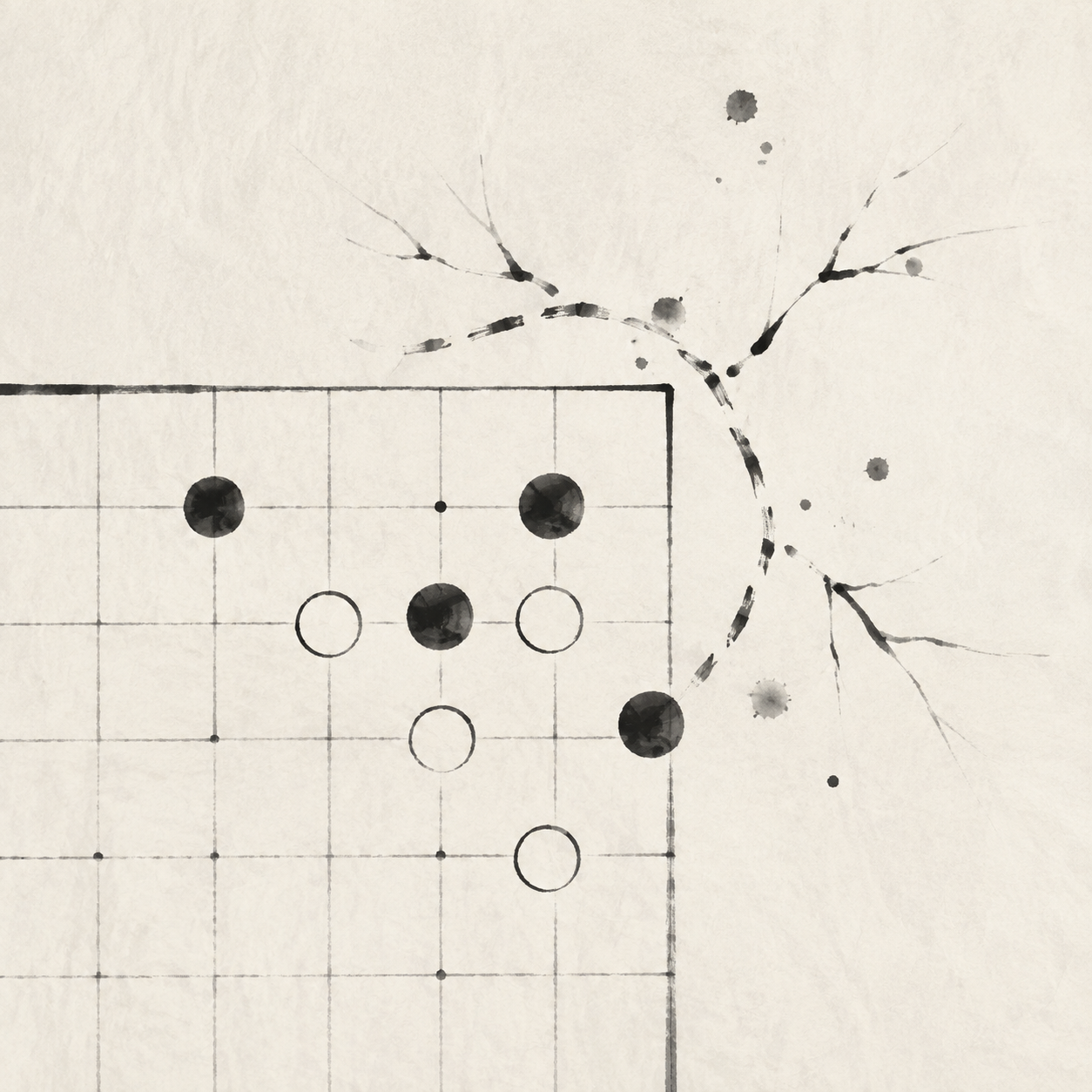
Caro: Five in a row is not enough if both ends are blocked
Caro often tightens the winning condition: the player must make exactly five consecutive stones, and neither end of that line may be closed by the opponent’s stones or by the board edge. Thus, six in a row usually does not count as a win; nor does a five-in-a-row blocked at both ends.
For example, Black forms five stones in a straight line, with a White stone immediately adjacent on the left and another on the right. Black has not won under the Caro rules. If only one end is blocked and the other remains open, many Caro variants will recognize the five-in-a-row. Whether the board edge is equivalent to a block, and whether an overline can continue to serve as a threat, may still vary by platform.
Caro changes the familiar feel of the game: you need to watch not only the length of a line but also the air at both ends. A move that has already ended the game under freestyle may, in Caro, merely force the opponent to respond, or even require you to keep searching for a second line.
The opening label is not enough; the fine print is the answer
The four rule sets can be understood in the same checklist: freestyle usually accepts five in a row or more; standard usually requires exactly five; Renju adds restrictions on Black’s double-threes, double-fours, and overlines, along with specific opening rules; Caro usually requires exactly five with neither end blocked. Each adds another layer to the boundary between winning and not winning.
These summaries are useful for identifying rule families, but they should not be treated as legal language that every platform follows forever. Gomocup’s pages are aimed at competition programs and rule descriptions, while Wikipedia is useful for checking terminology and common definitions. A particular app may also add forbidden-move toggles, swap rules, board-size settings, timeout judgments, or special handling for overlines.
Before playing, make one quiet check: read the rules beside the room name, looking especially for conditions such as “overline,” “exactly five,” “forbidden moves,” and “both ends blocked.” Then make the first move. When you see five in a row, ask one question first: does this position count as at least five, exactly five, or are there also restrictions on Black’s forbidden moves and on the line’s endpoints?
Before placing a stone, confirm how this game defines a win.