
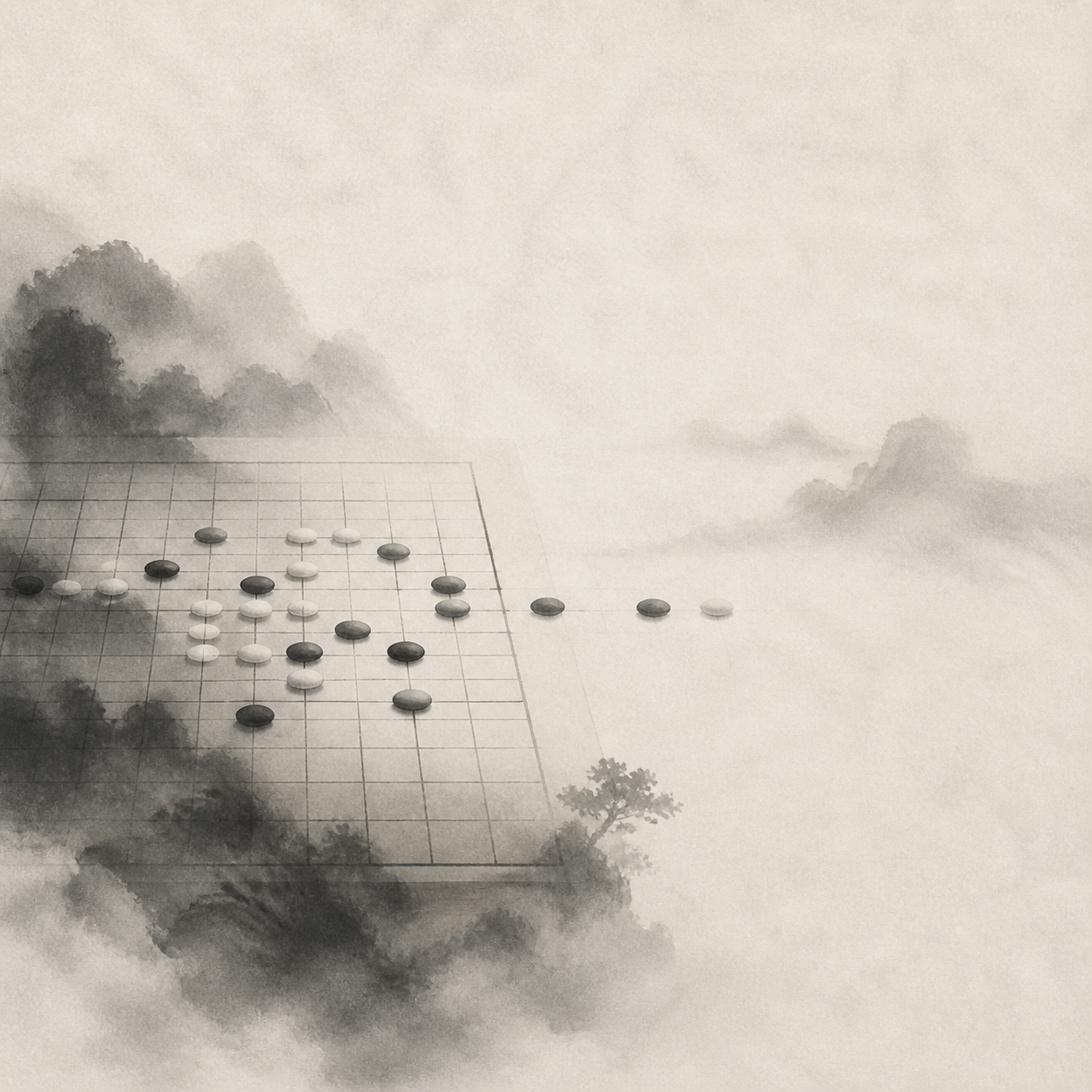
You have just connected six black stones in a row, and the verdict is that you lost. The first time you meet a forbidden move in Renju, it can stop you cold: how can the longest line on the board be bad news?
Start with “six or more”
The RIF Renju rules define OVERLINE as an unbroken row of six or more stones of the same color. The important word is “unbroken.” If there is an empty point in the middle, it is not one continuous overline.
Picture a horizontal row: black black black black black black. Six stones touching each other make an overline. But black black black empty black black, though it contains six black stones on the same row, is split by the empty point. Under the rules, you read it in segments.
A longer line means something else in Renju
Many players bring ordinary Gomoku intuition into Renju: if five in a row wins, surely six is even safer. That instinct is right in freestyle rules, where Gomocup describes freestyle as a win by five or more stones in a row.
But Gomocup also separates freestyle, standard, Renju, and caro into different rule families. Standard rules usually require “exactly five.” Renju adds forbidden moves for Black. Change the rules, and you have changed the law of the board.
The line gets longer. The rule gets narrower.
Why Black loses by making an overline
Renju’s forbidden moves apply only to Black. RenjuNet is blunt in its explanation of forbidden moves: these limits are meant to balance the first-player advantage. White does not have the same restrictions.
The RIF rules add an important detail. White wins if Black makes an overline, a double-four, or a double-three without at the same time forming a five-in-a-row. In other words, when Black stretches the line to six, the referee first asks: did this move also create a legal five?
Why White can win with an overline
Make the same six-stone line with White, and the ruling changes. The RIF rules state that the first player to complete five in a row wins; for White, an overline also counts as a win.
That can feel awkward at first. The shape is the same, but the result is not. Renju is deliberately asymmetric: Black moves first and accepts restrictions; White moves second and keeps more freedom in how a line may extend.
The easy mistake: overfilling after a four-in-a-row
In real games, you most often stumble into an overline not because you meant to make six, but because you overfill after a four-in-a-row. Say Black already has black black black black horizontally, and both ends can be extended. You focus on “one more move makes it,” while missing that the other end is already connected to another black stone.
Before you place the stone, count the target line in both directions. How many consecutive black stones are on the left? How many on the right? With this move added, does the total reach six? The count feels slow, but it can save the whole game.
The boundary between an overline and exactly five
What Black wants in Renju is exactly five consecutive stones. Black black black black black, cut off at either end by an empty point, a white stone, or the edge of the board, may be a legal five. Black black black black black black enters overline territory.
The overline belongs with double-threes and double-fours
If all you remember is “six loses,” the overline will seem like a strange exception. Put it back into the Renju system, and it sits with double-three and double-four as part of Black’s forbidden moves.
Black begins at tengen and naturally reaches the initiative more easily. Forbidden moves remove certain overpowering attacking shapes, giving White enough room to defend and counterattack. The overline limits Black’s path for extending a five. Double-threes and double-fours limit Black’s path for creating multiple threats at once.
A three-step check for real games
First, confirm the rules. Freestyle, standard, Renju, and caro draw the winning line differently. Asking before the game is easier than arguing during the review.
Second, be alert only when Black moves. A White overline is usually a winning signal; a Black overline triggers the forbidden-move question. That asymmetry is the central feel of Renju.
Third, count both ends before you play. Check every direction that might make five: horizontal, vertical, and both diagonals. Once you have practiced it, the count becomes reflex.
Black wins at five, and often loses at six.
The overline gives Renju one more layer of restraint: you must win, but you may not stretch the line past the border. In your next game, try one narrow practice goal—before Black completes five, always count to the sixth stone.