
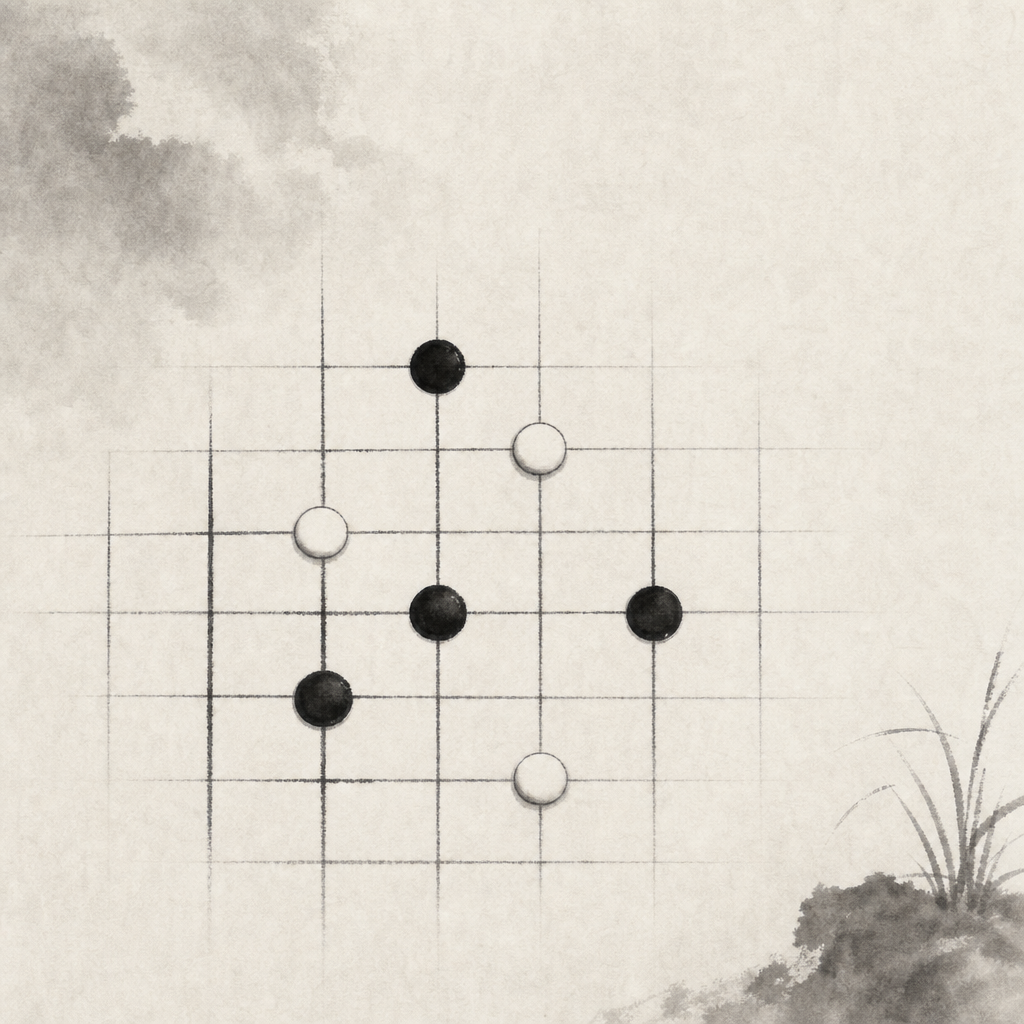
You see four stones already lined up. Then your next move is ruled a “forbidden move.” It is a disorienting moment: isn’t this just Gomoku? Why did the winning line suddenly change? Renju begins in that confusion. It still asks you to make five in a row, but it places the first-player advantage inside a finer set of rules. You do not need to memorize a referee’s handbook first. Once you see why Black is constrained, the game becomes calmer, stricter, and more elegant.
Renju Is Still Five in a Row. It Is Not Ordinary Gomoku.
Renju is played on a 15×15 grid of intersections. Black moves first. The players alternate. The goal is still to make five consecutive stones horizontally, vertically, or diagonally. That skeleton looks much like familiar Gomoku, so the game does not feel foreign at first glance.
The difference lies in who may win, and how. In ordinary Gomoku, five in a row is usually a direct win. Renju, in order to reduce Black’s first-move advantage, gives Black forbidden moves. White is not bound by those restrictions. The board may look quiet; the rules are shifting the weight underneath.
Gomoku Is More Direct. Renju Asks for More Judgment.
In one sentence: Gomoku leans toward “who makes five first,” while Renju asks Black to make five within limits. This is not a question of which game is better. The center of gravity is simply different.
- Board: Gomoku is often played on boards of different sizes; standard Renju uses a 15×15 grid of intersections.
- First move: Both games usually have Black move first; Renju acknowledges Black’s advantage and restrains it by rule.
- Black’s forbidden moves: Ordinary Gomoku generally has none; in Renju, Black may not play double-three, double-four, or overline.
- White’s limits: Gomoku is usually symmetrical; in Renju, White has no such forbidden moves.
- Overline result: An overline by Black is a forbidden move; under RIF rules, an overline by White may count as a win.
- Learning focus: In Gomoku, you first learn lines and defense; in Renju, you also learn whether a move is legal.
Black’s Forbidden Moves Are the Door Into Renju
Black moves first, and that naturally makes it easier to seize the initiative. Renju does not simply give White an extra turn. Instead, it says Black may not use certain overly powerful shapes to win or to build an unavoidable net.
For a beginner, start with three categories: double-three, double-four, and overline. They sound technical, but on the board they all point to the same idea: one move creates too many threats at once, or goes beyond exactly five.
This is a learning route, not a full referee code. Formal play depends on rule texts such as the Renju International Federation official rules for the finer cases. For a new player, building shape intuition first is usually steadier.
Renju’s beauty grows inside restraint.
Double-Three Opens Two Roads at Once
A double-three occurs when Black’s move creates more than one “three” through the stone just played. In the RIF way of thinking, a “three” must be able to develop into a straight four or an open four, and it must not already be a direct five.
Think of it as a fork in the road. Black places a stone at the crossing point. Horizontally, an open three appears; diagonally, another open three appears. White can answer only one side on the next move, while the other may become a four. That is why the double-three is forbidden.
Double-Four Creates Two Threats That Must Be Answered
A double-four is more direct. If Black’s move creates more than one “four” through the stone just played, and each four is pressing toward five, White usually cannot stop both.
For example, Black fills the center, making a horizontal four-in-a-row and a vertical four-in-a-row as well. White can block one line; the other may become five on Black’s next move. Renju treats this as too powerful for Black and makes it a forbidden move, preserving room for reply.
An Overline Is Not a Win for Black
An overline, under common rules, means six or more stones of the same color in an unbroken row. In ordinary Gomoku, many players treat “six in a row” as a win. Renju does not, at least not for Black.
If Black makes an overline, it is a forbidden move and cannot win the game. White has no such restriction; under RIF rules, White’s overline may be treated as a victory. That asymmetry is one of the clearest ways Renju parts company with ordinary Gomoku.
A Beginner Can Learn Renju in Three Steps
First, look at the board with ordinary Gomoku eyes: find five-in-a-row threats, block fours, recognize open threes. Without that foundation, forbidden-move judgment becomes isolated memorization.
Second, practice forbidden moves only on Black’s turns. When you see a strong move, do not play it immediately. Check the four directions one by one. Double-three, double-four, and overline are all judged around the stone just played.
Third, turn to formal rule texts and practical problems. You will discover how fine the boundary cases can be: some threes look open but cannot legally become straight fours; some fours seem to be two separate lines, but the crossing relationship needs a more precise reading.
First ask what is legal. Then ask what is sharp.