
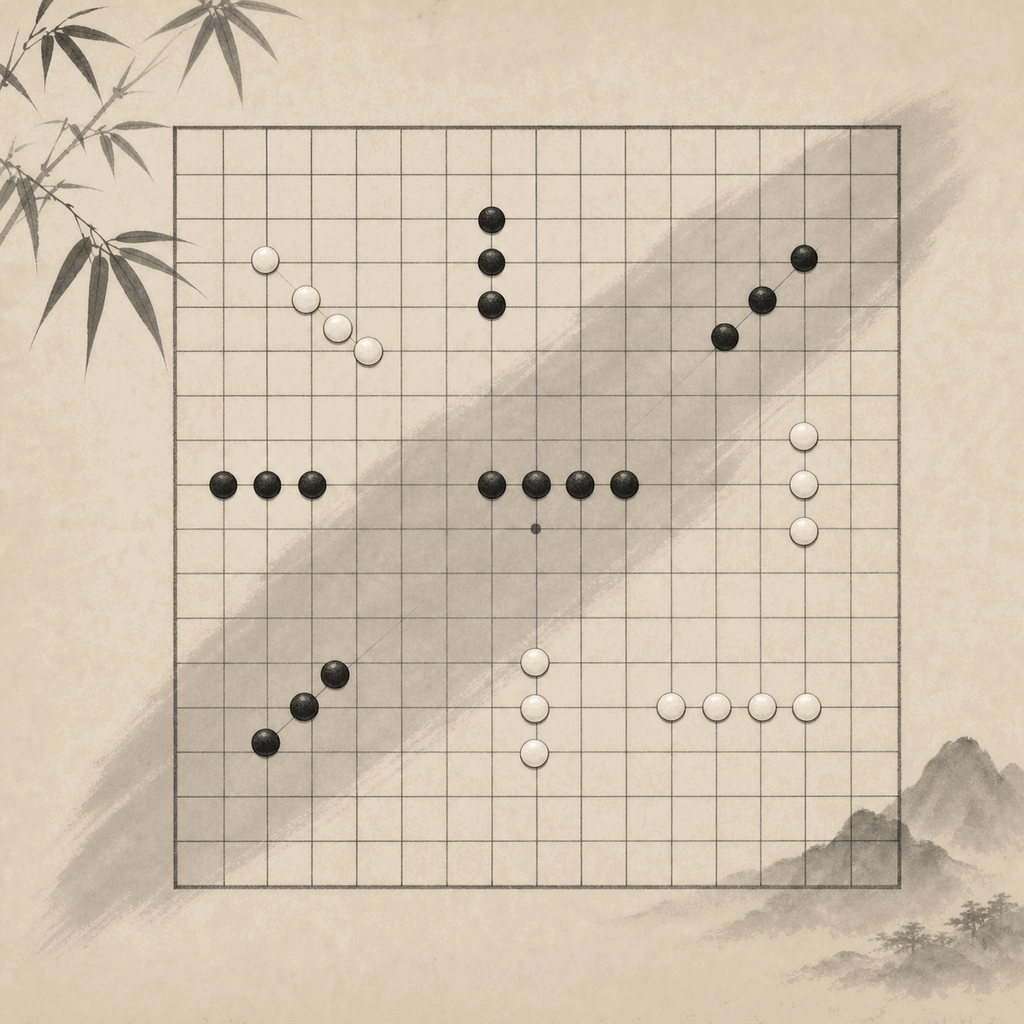
Gomoku's rules fit in one sentence: the first player to line up five stones wins. But for a beginner, winning usually has less to do with being out-calculated than with a handful of personal habits. None of them is fatal on its own. Stacked together they become a repeating way to lose. These seven are the ones I have watched most often.
Trap 1 · Opening on the edge of the board
The centre of the board is always worth the most. A player who puts the first stone against the edge or in a corner is treating the board as a set of squares. Gomoku is a game of directions, not squares. From the centre a single stone can take part in lines running in 8 directions; from a corner, only 3. Five directions fewer means every move afterwards is played under pressure.
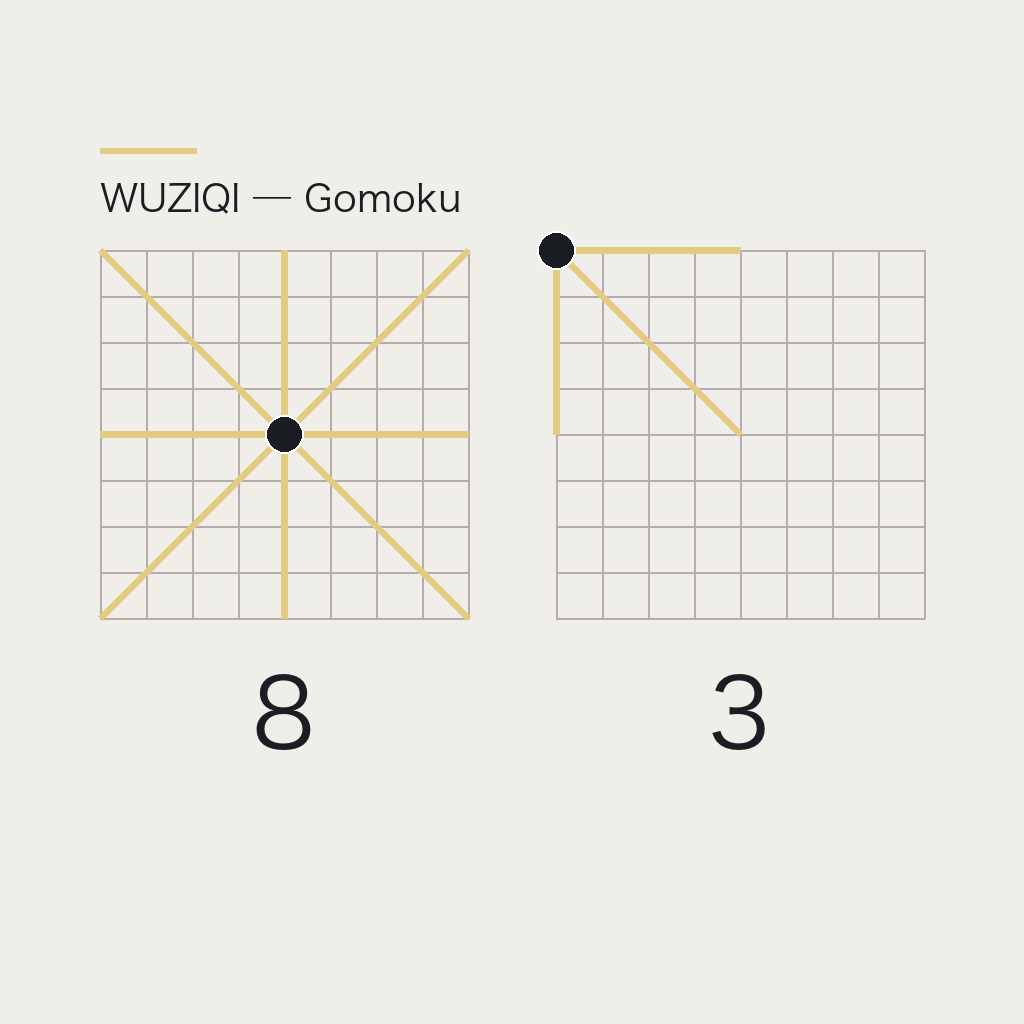
The fix is simple: play the first stone on the centre point of the 15×15 board, or on one of the four intersections next to it. This habit will not win the game on its own, but it puts you in a position where you have choices from the very first move, and that compounds through the rest of the game.
Trap 2 · Rushing a four and forgetting the open three
Many beginners reach three in a row and immediately go for the fourth. The problem: if the fourth stone can be blocked from one end, which is a simple four, the opponent blocks it and your attack stops there.
An open three is different. Both ends are free, the opponent has to answer, and only 2 squares work as a block. You keep the initiative and can extend again next move. Attacking starts when "I have three in a row" becomes "I have an open three."
"An open three is the attack. A simple four is a performance."
Trap 3 · Watching only your own attack
Every move in Gomoku does two jobs at once: improve your position, and keep the opponent's position from improving. The most common way beginners lose is not being out-calculated. It is looking up from their own chain to find the opponent already has an open four.
The fix is a small reflex: pause for 3 seconds before each move. Check whether the opponent has a two or a three anywhere, then decide whether to extend your own shape or shut theirs down. It slows you down at first. After two or three games it becomes automatic.
Trap 4 · Blocking an open three without checking for a double
The dangerous shape is not a single open three. It is a double three, one move that creates two independent open threes at once. You can only block one side, so the opponent wins on the next move. By the time a beginner notices a double three, it is usually one move before it lands, which is already too late.
When the opponent has a key point that looks able to develop in two directions (two separate three-lines each missing one stone, for example), block that intersection itself rather than one of the completed threes. Block the point, not the line.
Trap 5 · Extending an open three into a dead one
The beginner's impulse: "I have three, add another." Which end you add it to matters. If the direction you extend into already holds an opponent stone or runs into the edge, the three becomes blocked at both ends and its power drops to zero. That is worse than not extending, because you have converted a threatening move into a wasted one.
So check both ends before extending an open three, and prefer the direction away from opponent stones and away from the edge. If both sides are constrained, do not extend at all; build another shape instead. A dead three is worse than no move there.
Trap 6 · Wasting the first three moves of the initiative
Black has the first-move advantage in standard Gomoku, but that advantage has a shelf life. The most common way beginners waste it: the first stone on the centre point is right, then moves two and three land far away from it, as if opening a second front. Neither side builds a threat, and the initiative goes back to White.
Black's first three stones should connect to each other, forming a two, a three, or a V shape. Do not rush to claim territory. Build the chain of threats first, so the opponent is defending from their second move onward.
Trap 7 · Reviewing only after you lose
The review that pays is not the one you do after the loss. It is the one you do during the game. Beginners tend to fix their eyes on the stone they just played, then look back afterwards to ask which move put the opponent ahead. By then the shape of the game was already settled.
"Lift your eyes off the stones every three moves. That habit is worth more than memorising any tactic."
Turning the seven into reflexes
Looking back at all seven, they share one thing: none of them is about being out-calculated. They are about forgetting that the opponent is calculating too. The gap between a strong player and a beginner is often not depth of reading, but assuming on every move that the opponent will find the hardest reply.
Turning that into muscle memory takes 30 to 50 games, fewer than most people expect. Play two a day and ask yourself what the opponent is doing each time, and within a week the direction of your moves starts to mean something.