
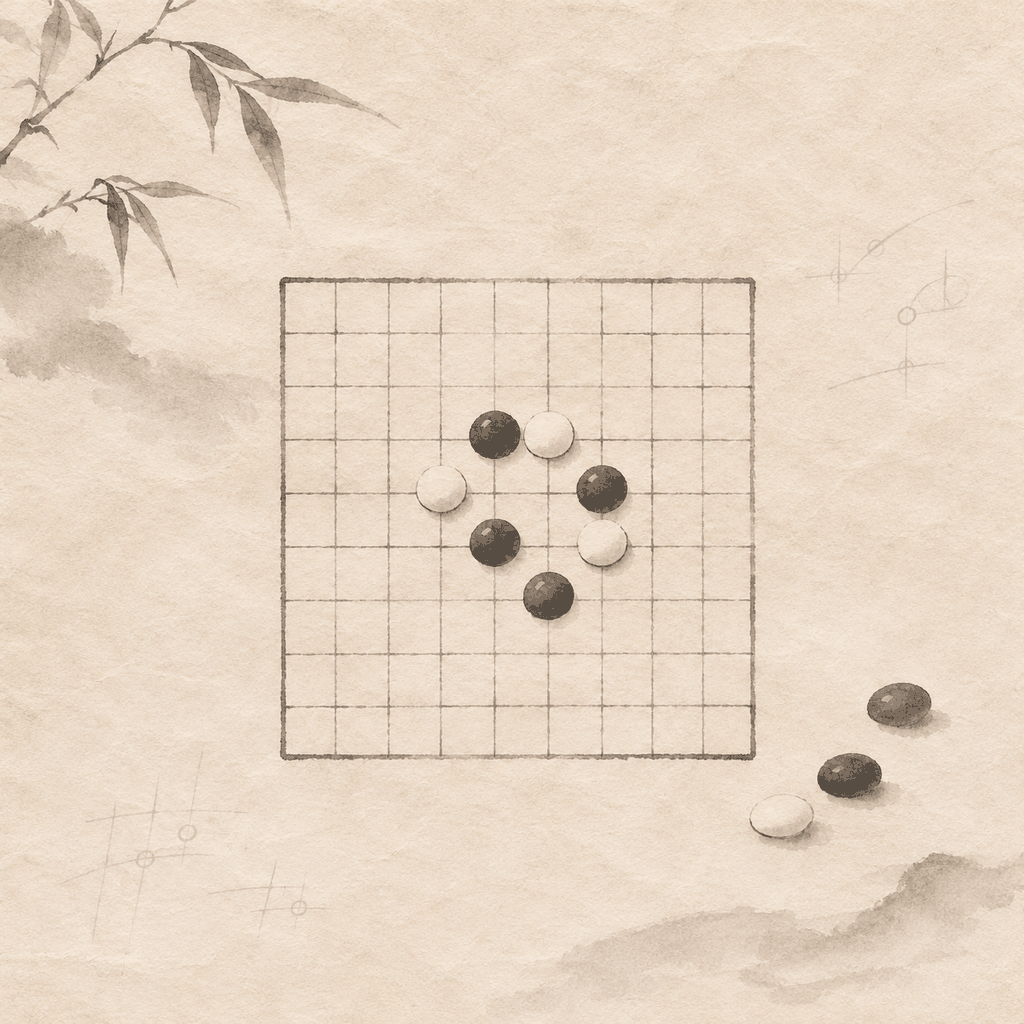
You think you’ve won. Your open three is right there, and your opponent seems to have no choice but to block. Then you place your stone and discover a four-in-a-row on the diagonal. By the time you defend it, your planned win no longer works. You spot the move in review, only to miss something similar in the next game.
Seeing the pattern is not the same as calculating the line
An open three gives you a possible attack, not a finished calculation. Where will your opponent block? Can they make a four-in-a-row after blocking? Those answers belong to the same line of thought. If you consider only your next move, the game can quickly depart from your plan.
When you review a loss, stop at the move where you thought you were close to winning. Write down what you intended to play, then put your opponent’s strongest defense on the board. Following that defense is often more revealing than replaying the final losing move.
The beginner’s guide from Lijing Renju Classroom places calculation at the heart of Gomoku play. You need depth, but you also need to consider replies in different directions. The horizontal line and both diagonals may all matter at once.
A puzzle lets you pause the game and calculate
The Republic of China Renju Association’s Gomoku teaching site describes these puzzles as positions taken from games or deliberately composed to contain a clever way to win. They can train your calculation and test your playing strength. Each one narrows your attention to a single position: whose turn is it, and how can that player win?
First, check what the puzzle asks you to do. That tells you which variations to examine. Once you find a winning line, ask whether your opponent has a stronger defense. Checking each move in turn gives you time for the calculation you might skip during a game.
Know whether the puzzle limits the line or the moves
A win-finding puzzle does not always prescribe how you must win. When it does impose a restriction, the site lists common forms: continuous-four wins (VCF), continuous-threat wins (VCT) and VC2 wins. Read the restriction first, or you may find a winning line that does not answer the question.
Move-limited puzzles ask you to win within a set number of moves. Common examples include a four-move five-in-a-row win and a two-move four-three win. Showing that the position is eventually winning is not enough: the sequence and move count must fit. When you reach the final move, check that your opponent had no escape along the way.
Start with double open threes, four-threes and double-fours
Basic attack-and-defense puzzles often center on these three patterns. Each creates two threats that are hard to answer with one stone. Before you begin, check the rules and whose turn it is. Under Renju’s forbidden-move rules, a double-three or double-four is forbidden for Black, so these patterns mainly appear in attacking puzzles for White or in exercises using unrestricted rules. Recognizing the shape is only the beginning; you still have to establish that it works in this position.
For a double open three, locate the line of each open three and check whether your opponent can create a threat first. For a four-three, verify the order in which the four and the three form. For a double-four, scan the vertical and diagonal lines as well as the horizontal.
The site has 20 beginner puzzles each for double open threes, four-threes and double-fours. Try working through one pattern at a time, then recalculate missed puzzles from the same group. Learning which defense you tend to overlook will help you more in the next game than memorizing where one puzzle’s winning stone goes.
Once you recognize the pattern, calculate your opponent’s defenses
Calculate first, then check on the board
The site recommends calculating in your head first, setting out stones only when you get stuck, and working through as many variations as you can. Start with a candidate move, then find your opponent’s strongest reply. Follow that line to its conclusion before trying another defense.
If you get stuck, put the stones on the board and check the line move by move. Notice where you reversed the order of moves or missed a four-in-a-row on a diagonal. The board helps you locate the mistake. Once you have checked it, clear the board and calculate the puzzle again in your head.
After each puzzle, note the kind of reply you missed, rather than simply whether you got it right. Perhaps you failed to check an immediate four-in-a-row, or stopped calculating as soon as you saw a four-three. Next time you see a similar pattern, check that reply first.
Longer wins demand another layer of defense
Once you can reliably calculate the beginner puzzles, the site suggests trying three-move win puzzles. As the lines get longer, write out your intended win, then check at each move whether your opponent can change the sequence. If a move no longer works, return to the first point where the lines diverged.
Four-move five-in-a-row puzzles also let you practice the move before creating two four-threes, along with defensive technique. The value of that earlier move may become clear only later, which makes your opponent’s counterattack especially important. Do not check only the block you expect; see whether your opponent can deal with the other side first.
The Japan Renju Society has published six-by-six Renju puzzles. Even on a small board, you can find many of the attacking and defensive tactics of a normal game. If a long variation is too difficult to calculate in your head for now, use a smaller position to practice checking each move. A smaller board does not make the order of defenses any less important.
A four-week plan, adjusted to what you miss
This is a suggested plan for this article, not the site’s curriculum. In the first week, work through beginner double open three, four-three and double-four puzzles in that order, calculating each before checking it. In the second, redo the ones you missed. Pay particular attention to overlooked diagonals and moves your opponent can play first. Record one main type of oversight each time so you know what to revisit.
In the third week, try three-move wins and calculate every candidate defense to its conclusion. In the fourth, move to four-move five-in-a-row wins, paying attention to the move before two four-threes take shape. If you still miss variations in one category, return to its beginner puzzles until you can explain why your opponent cannot stop the win.
Before you place a stone, calculate your opponent’s strongest defense