
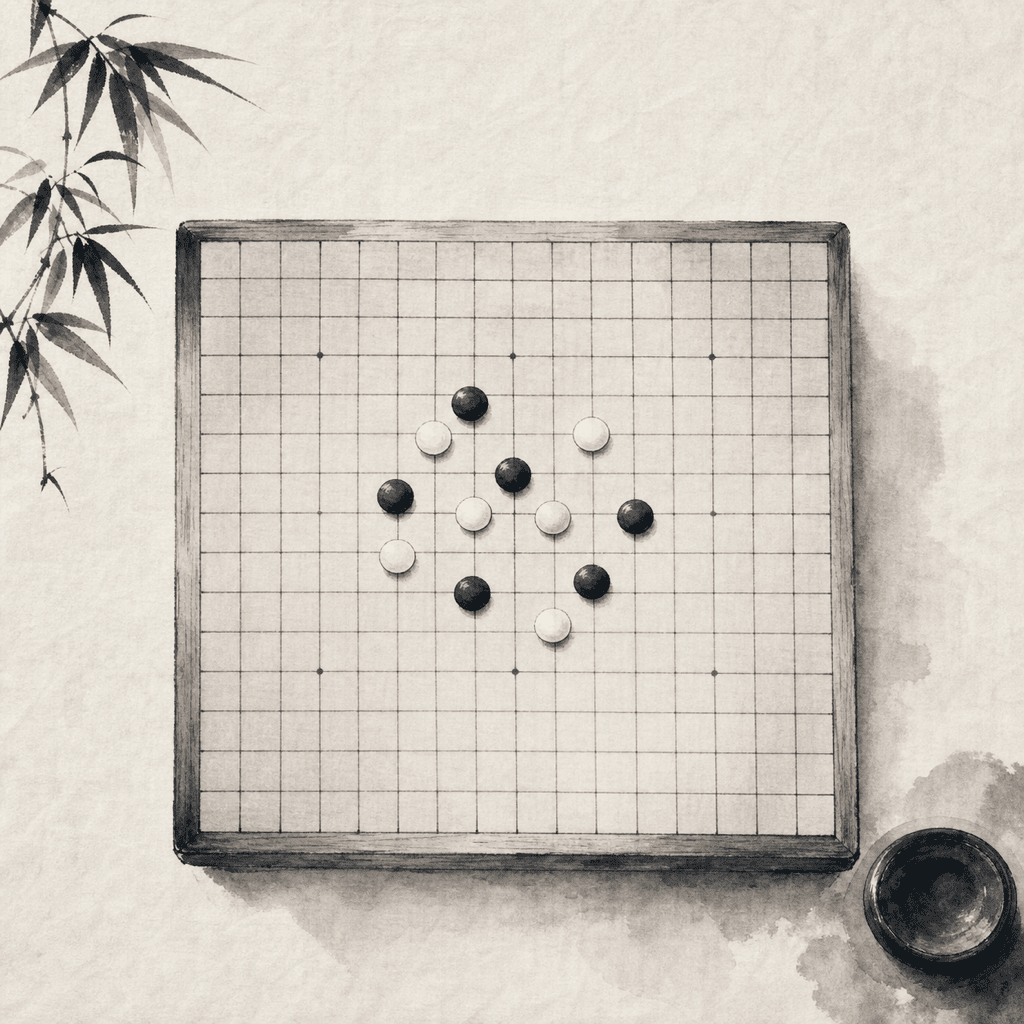
You may have met this kind of opening: Black places the first stone, White answers with one of their own, and the position already seems to have been pushed onto rails. You know you have to defend, yet somehow you always feel half a beat late. This is where Swap2 matters: it is not in a hurry to give anyone an advantage. First, it lowers the volume of the first move.
The World Team Gomoku Championship, to be held in Yerevan, Armenia, in August, will use Gomoku - Swap 2. The RenjuNet tournament page lists the dates as 2026-08-15 to 2026-08-19, with a rated, single round-robin format and a time control of 120 minutes plus 30 seconds per move. Rules are not decoration. They change how you understand the opening.
Swap2 First Takes Away the First Move’s Right to Monologue
In ordinary Gomoku, Black’s first move is naturally more active. Especially when that first move is near the tengen, the second and third moves can easily lead White into a familiar defensive script. You are not losing because you cannot calculate. You are being forced to answer from the very beginning.
Swap2 is more restrained. According to RenjuNet’s rule explanation, the first player places 2 black stones and 1 white stone anywhere on the board; the second player may choose to continue as White, swap colors, or place 2 more stones and let the opponent choose colors. The opening is no longer “I move first, so I design your position.” It becomes: “I present a position, and I must also accept the possibility that it will be swapped.” The board grows quieter because of it.
2 Black Stones and 1 White Stone Are Not Opening Showmanship, but a Proposal
When placing the first 2 black stones and 1 white stone, many players want to create something fierce. Perhaps the black stones sit near the tengen, while the white stone is placed farther away, leaving the shadow of a continuous attack. The problem is that the opponent can swap.
So a good proposal cannot be too greedy. It needs to give Black some thickness, but not make White wholly uncomfortable; it should leave room for variation, but not lean obviously to one side. The aesthetic here is closer to hand-finishing: the lines need to be fine, the force held in check. The first player is not announcing an answer, but offering a question. If the question is too biased, the opponent will simply take the more comfortable color.
A good opening does not coerce. It invites.
The Second Player Gains a Real Choice, Not Merely a Repair Job
In ordinary openings, White often feels as if they are patching holes. Black plays near the center, and White must first judge whether there is potential for an open three; Black lays out a diagonal, and White must watch for the next move’s two-way development. White’s first feeling is that they cannot afford a mistake.
Swap2 turns the second player from a “repairer” into a “reader of the question.” They may say: this position is too comfortable for Black, so I swap. Or: White has enough elasticity, so I continue. Or they may add 2 new stones and send the problem back. This is not complication for its own sake. It simply brings into the open the imbalance that was once hidden inside first-move advantage, so both sides can see it.
Adding 2 Stones Is the Third Option Most Easily Underestimated
Many beginners think Swap2 is only about whether to swap. In fact, the third option has the most texture: the second player may place 2 more stones, then let the opponent choose colors. The position grows from 3 stones to 5, and judgment shifts from instinct to structure.
For example, the original 2 black stones and 1 white stone may seem somewhat favorable for Black, but not so strong that swapping is mandatory. You can add 2 stones, creating tension in two directions on the board: on one side, Black appears to have a potential four-in-a-row; on the other, White is brought close enough to form a counterattack. At that point, the opponent cannot look only at who has the first move. They have to ask which color is harder to live with.
This step trains you to play fewer stones that are “pretty but thin.” Every stone may become the opponent’s asset. Swap2 makes the beauty of the opening not ornamental, but strong enough to endure being swapped.
Swap2 Cools the First-Move Advantage, Not the Attack Itself
Do not misunderstand. Swap2 does not make the game slow, nor does it abolish attack. It only makes it harder for early attacks to succeed by inertia. An overly obvious Black advantage may be swapped away; an overly cautious proposal may hand the initiative to the opponent.
This forces you to reconsider the open three. In ordinary games, the open three is often the button Black presses to advance the tempo; in Swap2, open-three potential must be evaluated together with color choice. The question is not “Can I make an open three?” but “Will this open three end up belonging to someone else?” What Swap2 reduces, then, is crude first-move pressure. Truly good attacks remain. They simply need cleaner reasons.
When Watching the 2026 Team Championship, Watch the Measure of the First Three Moves
Yerevan in 2026 will be worth watching. Beyond the Gomoku team championship, RenjuNet also lists the context of a Renju team event in the same city and period; see the related Yerevan 2026 page. In one city, different rules will illuminate the question of “opening fairness” more clearly.
When watching a Swap2 game, there is no need to rush into counting the later killing lines. First, pause at the first three moves: which lines the 2 black stones and 1 white stone control, whether they are all close to the center, whether the white stone is blocking or inviting. Then look at what the second player chooses.
If they swap directly, the original proposal may have favored Black; if they continue as White, White likely has enough space; if they add 2 stones, it usually means the position has not yet taken shape and deserves to be repriced. The first three moves are brief, but they contain the temperament of the whole game.
The first three moves decide how the board breathes.
Treat Swap2 as Everyday Training, Not Just a Tournament Rule
You do not need to wait for formal competition to practice Swap2. In casual games with friends, you can agree that every game begins with 2 black stones and 1 white stone, and require each player to explain the reason for their choice. If you cannot explain it, you are merely choosing a color by feel.
A better exercise is to try the same 3-stone position in three consecutive games: one in which you continue as White, one in which you swap, and one in which you add 2 stones. You will discover that many openings that seem “obvious” are really just directions you have grown used to. Change colors, and the problem immediately surfaces. Swap2 gives the opening a little less impulse to take advantage, and a little more respect for shape. The next time you place the first three stones, do not hurry to prove how well you can attack. First let the position stand. Then, quietly, play a game.