
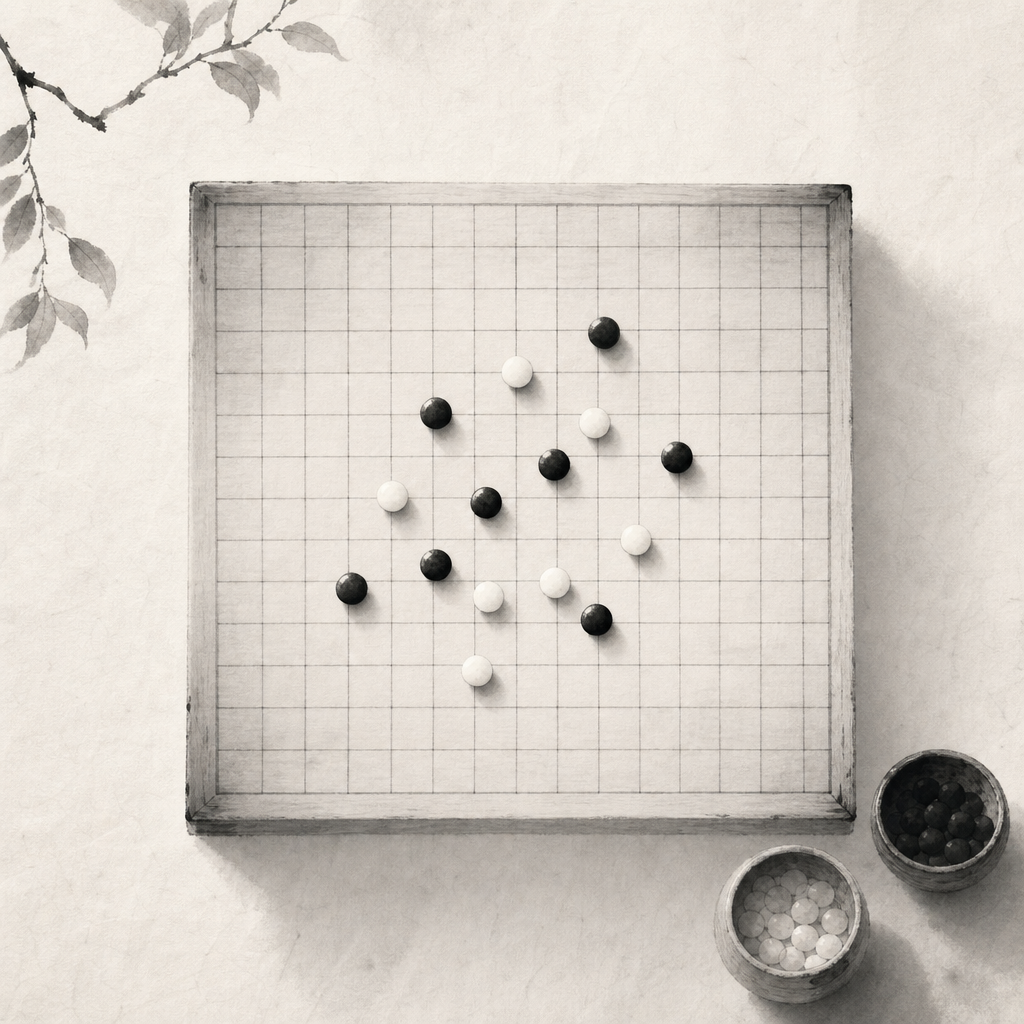
Have you ever seen a position like this: Black opens near tengen, and a few moves later White has not blundered, but is still plugging holes, blocking fours, and breaking up open threes. It does not look bad to lose, but the whole game feels as if you are being pulled along. Swap2 is trying to fix that feeling that the game was tilted before the first move.
First-move advantage is not an illusion
Gomoku is almost stark in its simplicity: a 15×15 board, stones placed on intersections, Black moves first, and five in a row wins. The shorter the rule set, the heavier the first move. Especially in systems with no forbidden moves, or only a few restrictions, Black can start building open threes, four-in-a-row threats, and fork points earlier.
RenjuNet's rules page puts three and four at the center too: an open four is close to decisive, an open three can grow into an open four, and a fork point can create two attacking lines at once. What you are seeing is not Black being lucky. It is the player who moves first getting the structure on the board first.
That is also why Renju limits Black's double-three, double-four, and overline forbidden moves. It is not a compensation for White. It is a way of admitting the first-move edge, then using restraint to bring the game back into a range where it can be argued over. Swap2 takes a different path: it does not restrict moves first; it rewrites who gets Black.
Swap2 puts the choice after the opening
Swap2 works like a quiet test. One side places three stones, usually Black, White, Black. The other side may take Black, take White, or add two more stones and hand the choice back. The exact sequence depends on the event rules, but the idea is clear: the opening is not one player's private advantage; it is something both sides inspect.
This is a delicate move. If the first player makes the trio too strong, the opponent takes the better color. If it is too weak, the opponent simply chooses the side that feels more comfortable. So the opening becomes less "I move first" and more "can I present a position both of us would accept?"
Fairness comes before the first move.
Why BrnoCup is a good place to watch Swap2
BrnoCup 2026 is set for May 16, 2026, at Antonínská Elementary School in Brno, Czech Republic. The RenjuNet event page lists it as Gomoku - Swap 2, Rated, Swiss system, with 20 minutes plus 3 seconds per move; the event note says seven rounds, 2×20 minutes plus 3 seconds.
What makes it interesting is its tone: open to all enthusiasts, experienced players, beginners, and children, with a rules introduction at the start. This is not a closed arena for experts. It is a public event with an educational streak. The fact that Swap2 appears here shows it is not just a complicated professional device.
For beginners, Swap2 may even be clearer. You do not have to memorize a pile of standard openings on day one. Instead, you ask a concrete question: if these three stones were handed to me for color choice, which side would I want? That question is more tangible than "how do I get stronger?"
The Ukraine Cup shows this is not a one-off experiment
Gomoku Ukraine Cup 2026 is scheduled for May 25, 2026, in Ivano-Frankivsk, Ukraine. The RenjuNet page also lists Gomoku - Swap 2, Rated, Swiss system, with 20 minutes plus 30 seconds per move; the organizer is UGRF.
The two events differ in scale and setting: one is an international open in Brno, the other a regional event in Ukraine; one uses a very short increment, the other a longer one. What they share is this: both choose Swap2 for their Gomoku format. That repetition says more than a slogan ever could.
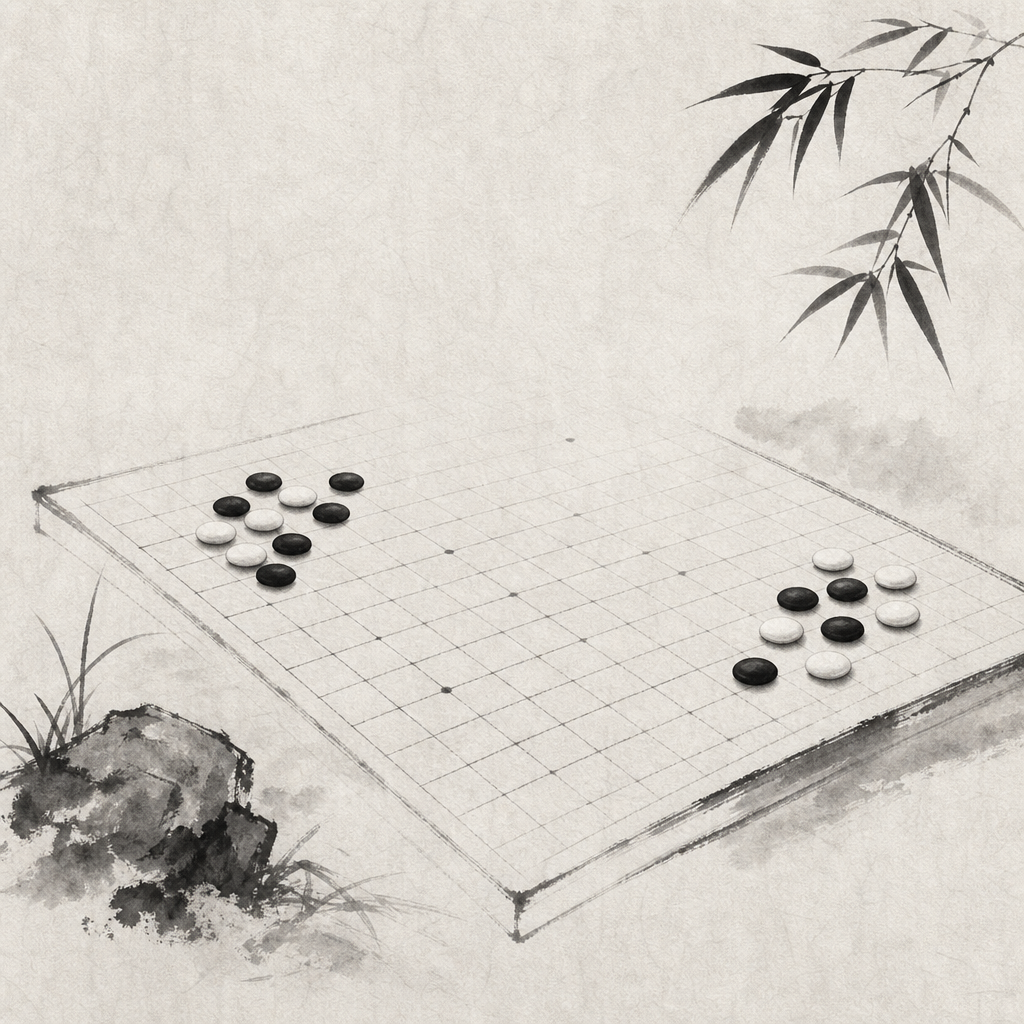
Swap2 changes the psychology, not the board
In a traditional Black-first game, the first move is often read as a declaration of initiative. Swap2 sharpens that. What you place is not "my advantage" but a proposal that your opponent will judge, take over, or turn down by choosing the other side. The board stays calm. The pressure just moves.
Say you lay out a pretty center structure, with two ways for Black to build an open three later. If your opponent decides it is too strong and simply takes Black, you have to live with the firepower you designed. Pretty still matters. But pretty by itself will not win for you.
That makes choice itself part of the constraint: not more rules, but a rule that makes choice do the work. The stronger side is no longer the player who placed the first stones. It is the player who can read the shape more deeply.
When you read a Swap2 opening, look for three things
First, whether the three stones cluster too quickly around tengen. The center is good, but a center that feels too comfortable makes choice dangerous. Second, whether the white stone is only decorative. If White cannot cut off any future line, Black's shape may be too strong.
Third, look for hidden dual-threat points. A three on one line is not always scary. What is scary is a move that threatens both sides at once, forcing every reply to be defensive. In Swap2, that judgment often lives inside the open threes that have not happened yet.
A good opening can survive being chosen.
It turns fairness into a skill you can practice
If you want to understand Swap2, you do not need to memorize every opening name first. Set three stones on an empty board, then stop for ten seconds: if I were the opponent, would I take Black, take White, or add two more? That question forces you to see attack, defense, and rhythm at once.
BrnoCup and the Gomoku Ukraine Cup are just two recent examples; you can check the schedule and rules on RenjuNet, and the basics of Gomoku and Renju on RenjuNet rules. Before the next game begins, try placing a position you would be willing to hand to your opponent.