
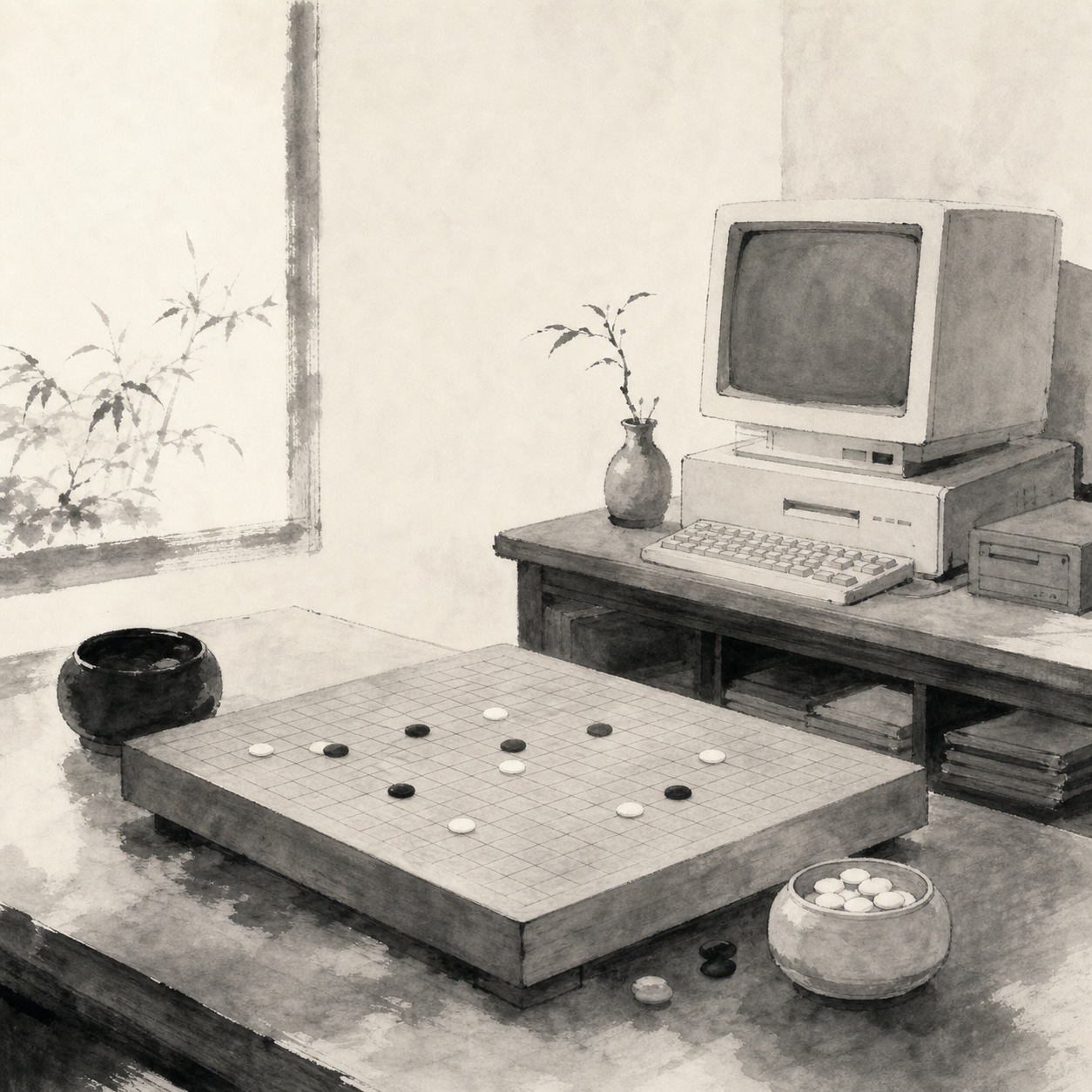
There is a sentence in Gomoku that sounds almost too final: from an empty board, Black can win. The first time you hear it, you may take it as lore, the sort of judgment an old player leaves behind at a tea table. The program rewrote it. It broke experience into a checkable winning line, then placed that line inside a route a machine could execute.
First-move advantage was once just consensus
Gomoku has simple rules: connect five in a row and you win. Because the rules are simple, Black’s first stone matters enormously. Black takes the center first, creates threats first, and forces answers first. Japanese professional players had long believed that Go-Moku was a first-player win, but before computer proof, that belief was mostly expert judgment.
Judgment has weight. But judgment cannot exhaust every possible reply for you. If White has one defensive line nobody has seen, then “Black wins” remains a claim that has not quite landed. The program’s value appeared in exactly that gap.
What the program proved
In 1993, L. Victor Allis, H. J. van den Herik, and M. P. H. Huntjens described the program in “Go-Moku Solved by New Search Techniques.” The paper’s abstract was direct: on a horizontal 15×15 board, Go-Moku is a won game for the player to move first.
“Proof,” here, did not mean praising the program for playing well. Nor was it merely a record of match results. It was closer to a conclusion you could inspect: with Black to move first, the program could find a forced win even against best defense. In other words, Black’s advantage moved from feeling into nodes and branches on a tree.
It did not brute-force the board
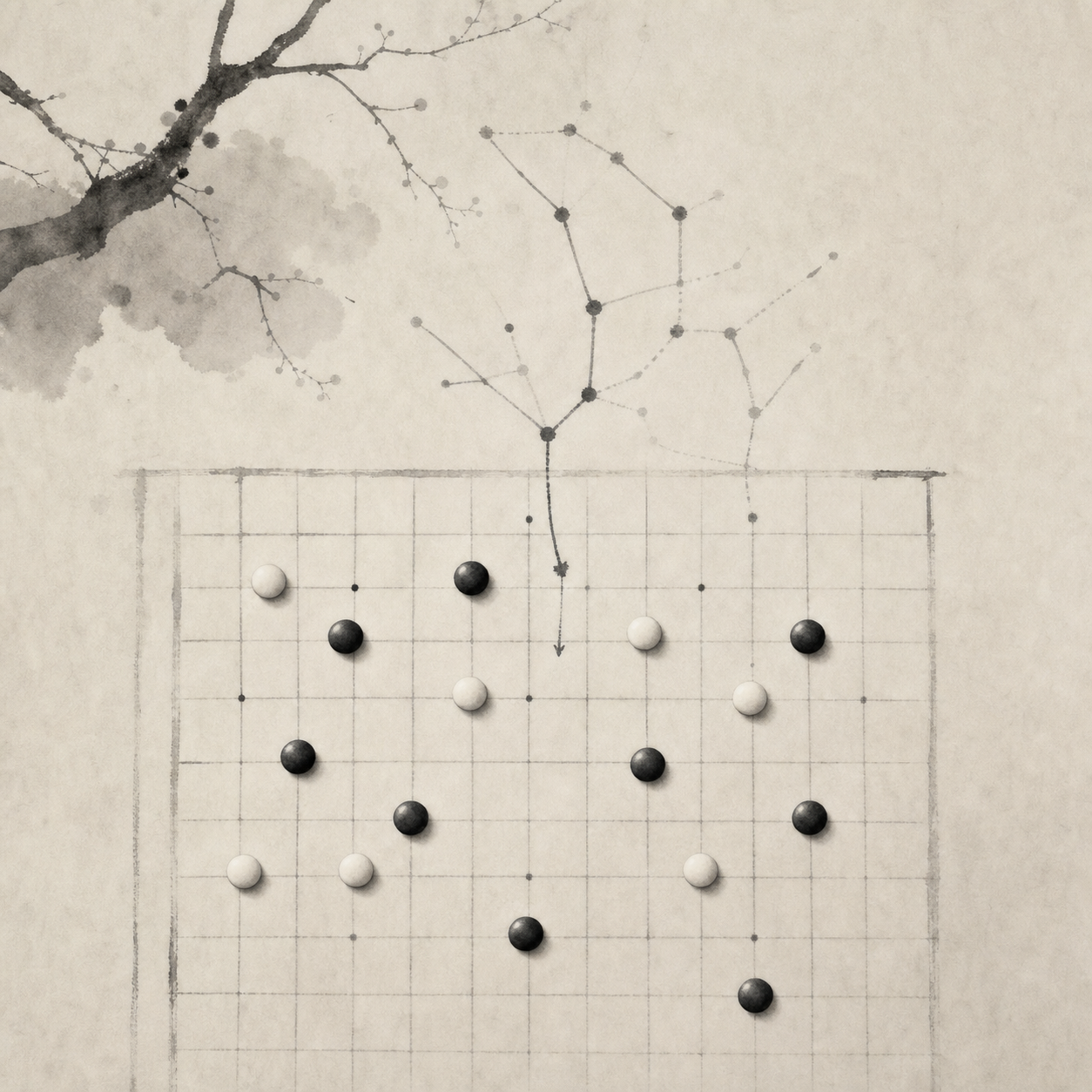
If you simply expand every intersection on a 15×15 board, the search explodes almost at once. The key was not that the program “calculated more.” It knew where to calculate first. It used two techniques: threat-space search and proof-number search. The first isolated the attacker’s meaningful sequences of threats; the second filled in the parts that required formal confirmation.
In a 1993 abstract, Darse Billings noted that the Go-Moku solution tree contained 138,790 positions; another common variant, in which an overline does not win, required 153,284 nodes. Those numbers do not look large today. But they remind you of something important: good search does not win by force alone. It puts complexity where checking matters most.
Good reading first makes the board smaller.
Why threat space fits Gomoku
In Gomoku, an attack is often not “I win on the next move.” More often it is “this move gives you only one kind of answer.” An open three, a four-in-a-row, and a chain of forcing moves all narrow the defender’s choices. Threat-space search works in that rhythm: look first at the attacking line, then consider the points the defender is compelled to answer.
That is close to the way you review a game. You do not treat every empty point on the board as an equal candidate. You look first for moves that make the other side respond. The difference is that people miss things, while the program has to cover that risk with another layer of search. Its elegance lies between those two facts.
Proof changed the rules conversation
Once free-style Gomoku was proved to be a first-player win, many rule designs were no longer just “for fun.” Forbidden moves, opening restrictions, and systems like Swap2 can all be read as different corrections to the first-move advantage: some constrain Black, some let the players choose colors again, and some place the burden of the opening on the player who sets it up.
This is also the deeper background of Renju and modern tournament rules. Rules are not ornamental complexity added to a simple game. They are an attempt to preserve the feel of play while pressing the opening imbalance into a range where the game can be competed, studied, and played for a long time.
What it gives an ordinary player
You do not need to memorize the solution tree. Its most useful lesson is to see a “threat” not as one beautiful move, but as a string of questions. After every move, ask: if the opponent has to answer, how many answers remain? If the answer is many, the move may only look good. If the answers keep shrinking, a plan is beginning to form.
A program proof has limits
The proof applies to Go-Moku under a particular ruleset. It does not mean that every form of Renju, every opening rule, and every variant has been solved at the same time. ICGA’s own summaries discuss Connect Five, Go-Moku, Renju, Pente, and related games separately, because small rules can change the mathematical shape of the whole game.
That matters. “Gomoku has been solved” is too blunt. “Under certain common Go-Moku rules, a first-player win has been proved” is more accurate, and more respectful of the game itself. A quiet conclusion usually lasts longer than a grand claim.
Leave the proof behind the board
Open a Gomoku board today, and it will not stand beside you whispering, “Black wins.” The proof is more like background knowledge. This game needs rules, opening design, and comfortable ways to begin again because its simplest version has already been seen deeply enough.
A good board does not need to display the proof. It only has to make the next stone feel clear: where the pressure comes from, where the choices are narrowing, and whether the move you are about to play really makes the position quieter.
The proof sits behind the game; the feel of play stays in your hand.