
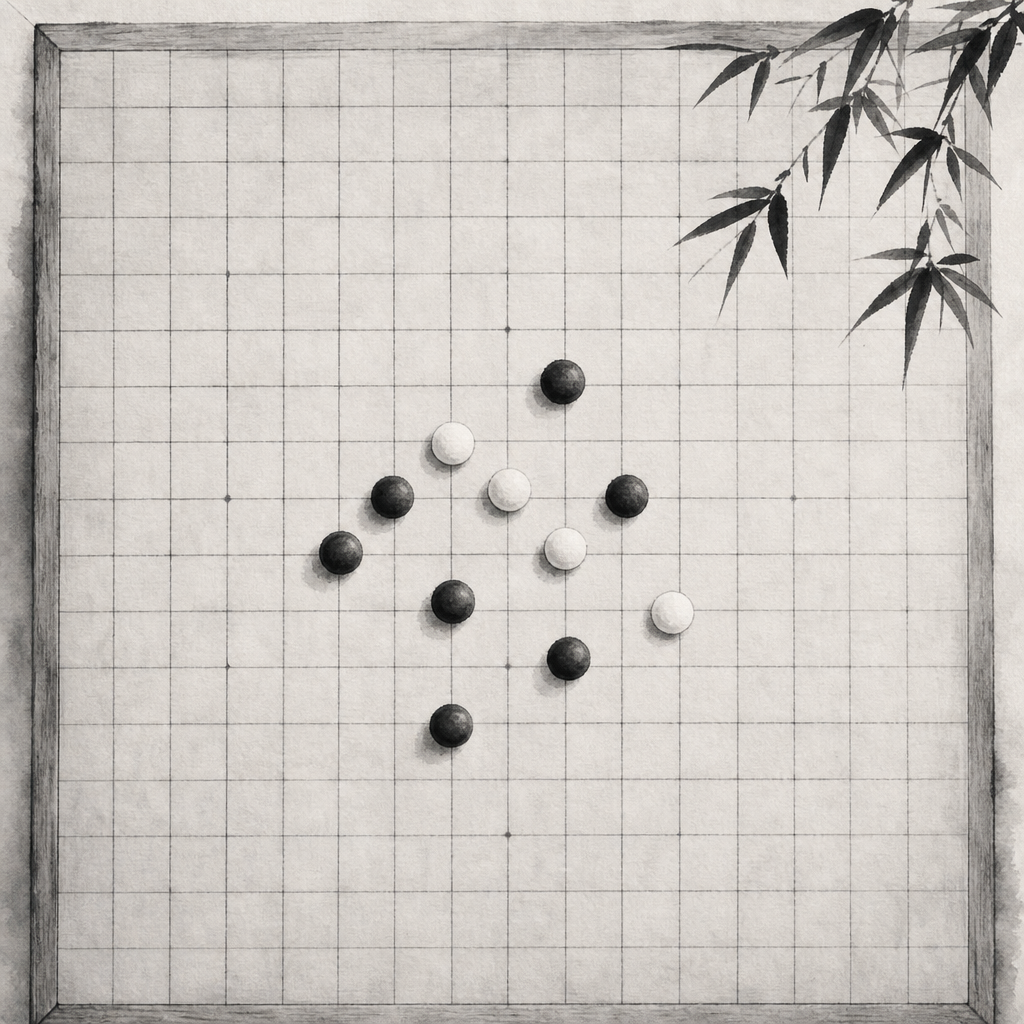
When you are just learning Gomoku, the first place you tend to lose is in the first three moves. You place a stone in the center, as you have been told to do, and still, almost immediately, the game begins to belong to your opponent. You miss the open three; you make a four-in-a-row too soon. The value of the traditional openings is not that they give you a professional answer to recite. It is that, in your first week, they offer five calm, restrained ways of looking: where tengen is, how the second move sets a direction, and why the third move should open the board.
First understand the opening three moves: tengen, direct openings, and diagonal openings
Traditional Renju openings usually begin at tengen, the exact center of the board. The first move goes there not because the point is mystical, but because it leaves room in all four directions: horizontally, vertically, and along both diagonals.
The second move decides the broad family of the opening. If White plays next to tengen orthogonally, it is called a direct opening; if White plays next to tengen diagonally, it is called a diagonal opening. This move is like setting the light for the game. The third move will look for distance, symmetry, and attacking lines within that light.
The third move is where your real judgment begins. It should not be merely “somewhere a little farther away.” It should answer three questions: Have I avoided White’s close pressure? Can I see more than one direction at once? Have I left room for a future open three?
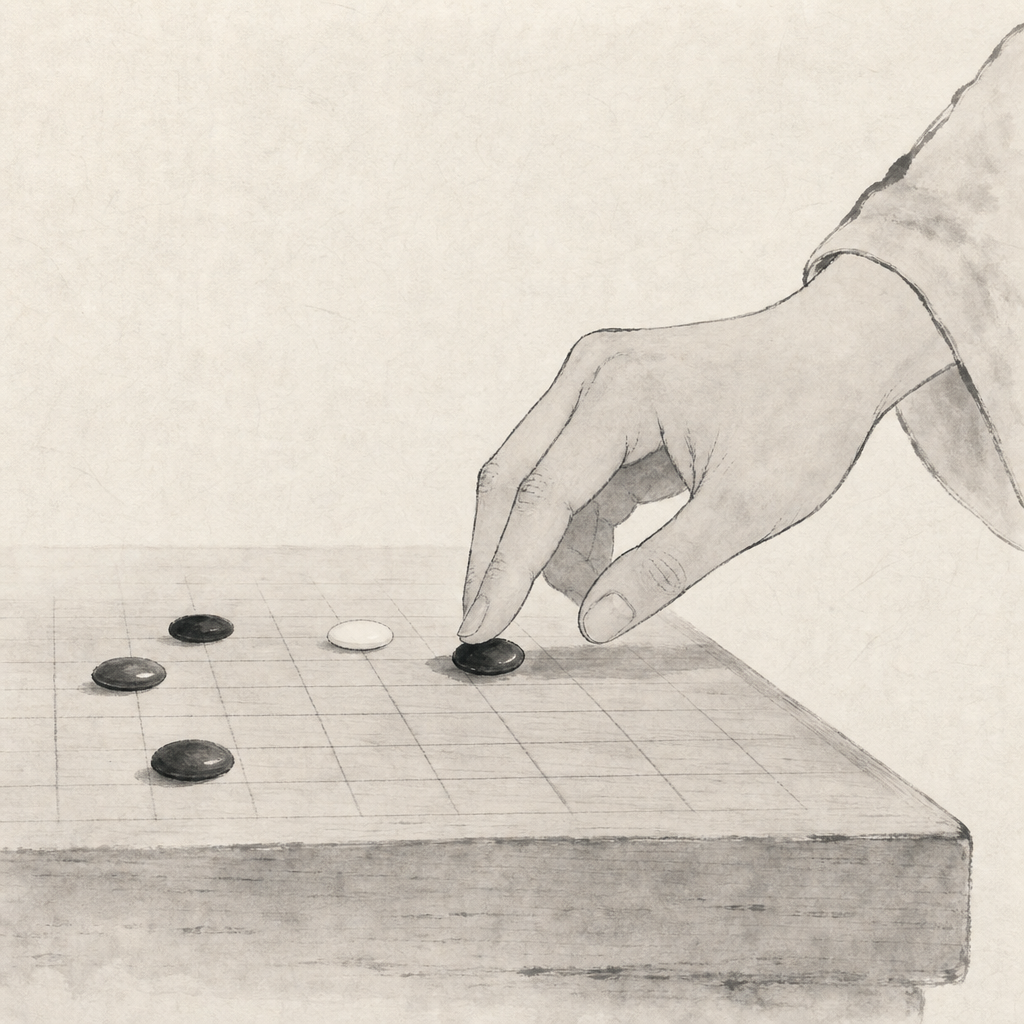
The five openings below are all suitable for a first week of practice. Treat them as training lenses, not as complete joseki. In casual Gomoku, your opponent will rarely follow a book line; what you are learning is to see the reason inside the shape.
Chōsei: learning near and far from a diagonal opening
Chōsei belongs to the diagonal-opening family. After the first move at tengen, White attaches diagonally beside the center; Black’s third move chooses a more relaxed distance from the center, usually letting the first and third stones echo each other along the same diagonal, or nearly the same main direction. The name contains the idea of a “star.” For now, remember that feeling: you are not clinging to the fight, but drawing out a star that can still shine back toward the center.
If White’s fourth move immediately comes close to your third stone, do not rush into a four-in-a-row. First check whether the space between tengen and your third stone has begun to form the seed of a two-way threat. If White blocks near the center, continue expanding from the outside of your third stone; if White presses the third stone, look back toward tengen for the starting point of an open three. Chōsei trains distance, not speed.
Sosei: learning looseness and density from a direct opening
Sosei belongs to the direct-opening family. The first move is still tengen; on the second move, White presses the center from an adjacent orthogonal point; on the third move, Black draws the shape to the other side or to a diagonal side, creating a more “open” space between the stones. This opening is especially useful for beginners because it forces you to leave the close tangle.
White has two common reactions. One is to keep blocking beside the center, trying to make all your stones feel short. The other is to move close to your third stone, preventing you from making an open three. Against the first, answer by extending outward; do not pull the game back into the crowded place. Against the second, use tengen as a pivot and look for another diagonal. The point of practicing Sosei is to let the board breathe.
The opening is not about being fast. It is about keeping directions available.
Zuisei: learning to look back to the center from a direct opening
Zuisei also belongs to the direct-opening family, but its third move places more emphasis on its relationship to tengen than Sosei does. You might think of it this way: White attaches to the center head-on, and Black does not fight for one breath in the close quarters. Instead, Black places the third move where it can look back toward tengen, leaving room for the two black stones to connect or turn.
If White’s fourth move cuts between your two black stones, do not look only at the fact that you have been “separated.” First ask whether White’s move has also become a weakness for White. It may block one line while loosening another. Zuisei is good for practicing the habit of “looking back to the center.” With every move, ask: Is tengen still helping me?
Shagetsu: learning to turn the corner from a diagonal opening
Shagetsu is a traditional name many beginners hear early, and it belongs to the diagonal-opening family. The first move is tengen; White’s second move attaches diagonally; Black’s third move does not simply lengthen along the same diagonal, but introduces a slight sense of turning, so that the shape opens away like a crescent moon.
The virtue of Shagetsu is that it quickly lets you feel that there is more than one direction. If White presses the center, you can turn out from near the third stone onto a diagonal; if White chases the third stone, you can borrow tengen to connect on the other side. It is not as satisfying as a straight sprint, but it is better for sharpening a beginner’s eye.
One caution: in formal Renju materials, Shagetsu contains deep variations, and the description here should not be treated as a professional prescription. In the first week, one judgment is enough: each time White presses one side, can you see the shadow of an open three or a sleeping three on the other side? If you can see the shadow, you have a direction.
Shōgetsu: learning soft defense from a direct opening
Shōgetsu belongs to the direct-opening family. Unlike the “star” openings, whose names can feel firmer and whose shapes often emphasize straight-line correspondence, Shōgetsu is well suited to a softer kind of defense: the first move at tengen steadies the center; White’s second move approaches orthogonally; Black’s third move lands where it can take care of both the center and the outside.
White’s common reaction is to attach at once to your third stone, forcing you into a local exchange. Here, do not be greedy for a short four-in-a-row. Once your opponent blocks it, your shape may immediately become narrow. A better method is to prepare two candidate lines first: one aiming to make an open three, the other ready to restrain White’s counterattack. Shōgetsu trains touch. Your hand should be a little lighter.
How to practice in the first week: memorize fewer names, look at more shapes
Play three games each with Chōsei, Sosei, Zuisei, Shagetsu, and Shōgetsu, and you will find that the names are only the doorway. What remains is your sensitivity to direct and diagonal openings, your judgment of the third move’s distance, and your patience when White defends close to your stones.
In the first week, do not hurry after the “strongest opening.” First make the board look good: a clear center, clear directions, attack and defense not jammed into one knot. Looking good is already a reason. And in Gomoku, a good-looking shape often makes the next move easier to see.
First make the shape clear. Then talk about winning and losing.
Your next game can be very simple: choose one name, play the first three moves according to tengen, the direction of the second move, and the purpose of the third, then quietly watch how White answers. One game is enough to start. The feel will come slowly.