
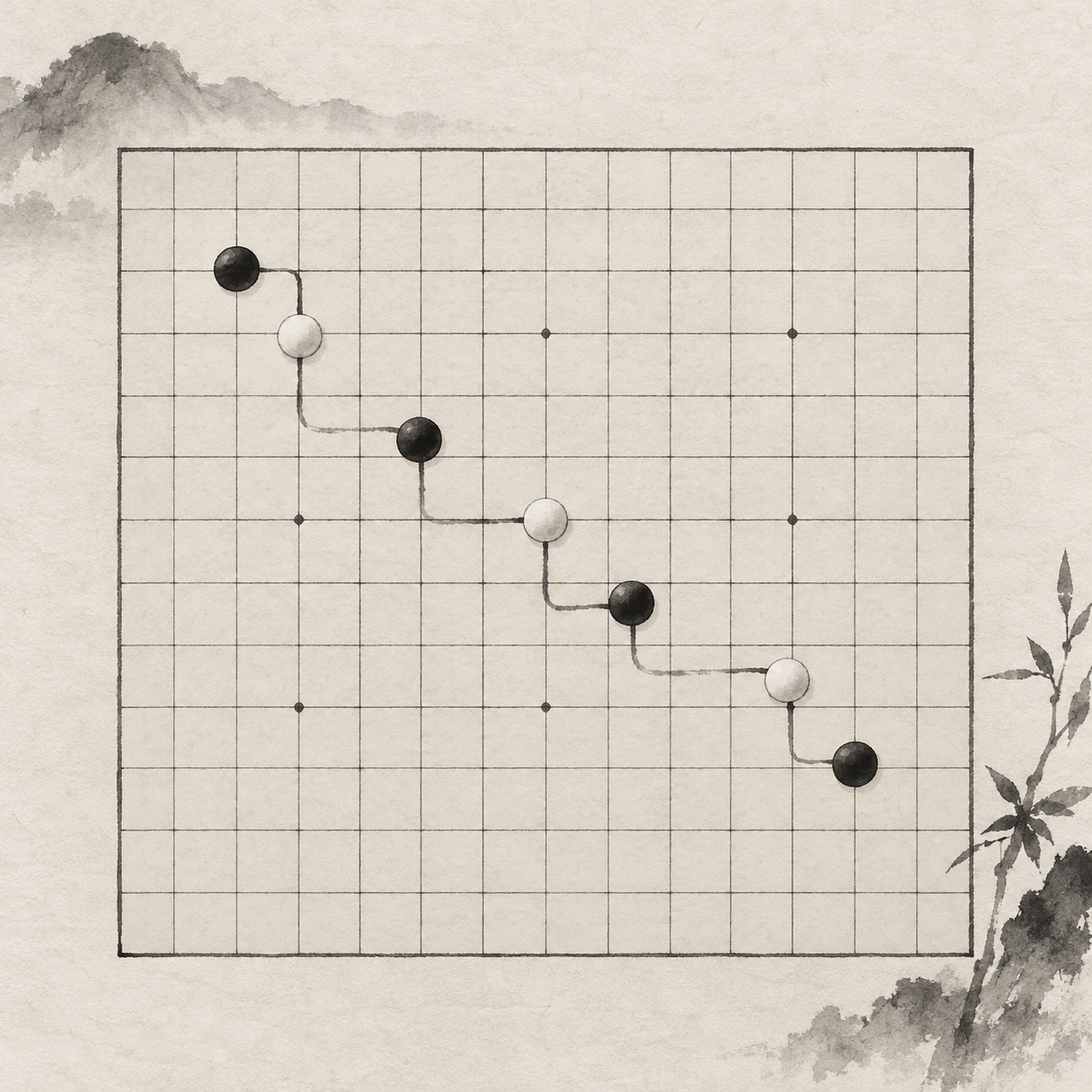
You have just played a four-in-a-row on the right side of the board. Your opponent must fill its one remaining gap. When your turn comes again, the question is whether that defense has set up your next threat. VCF and VCT are ways of calculating such exchanges until you can make five.
A four-in-a-row fixes your opponent’s next move
A four-in-a-row has four of your stones on one line, with one end blocked and only one point where you can make five. If your opponent does not cover that point, you win on your next move. But the four is not itself a win: your opponent will take that point. You need to know what threat remains after the defense.
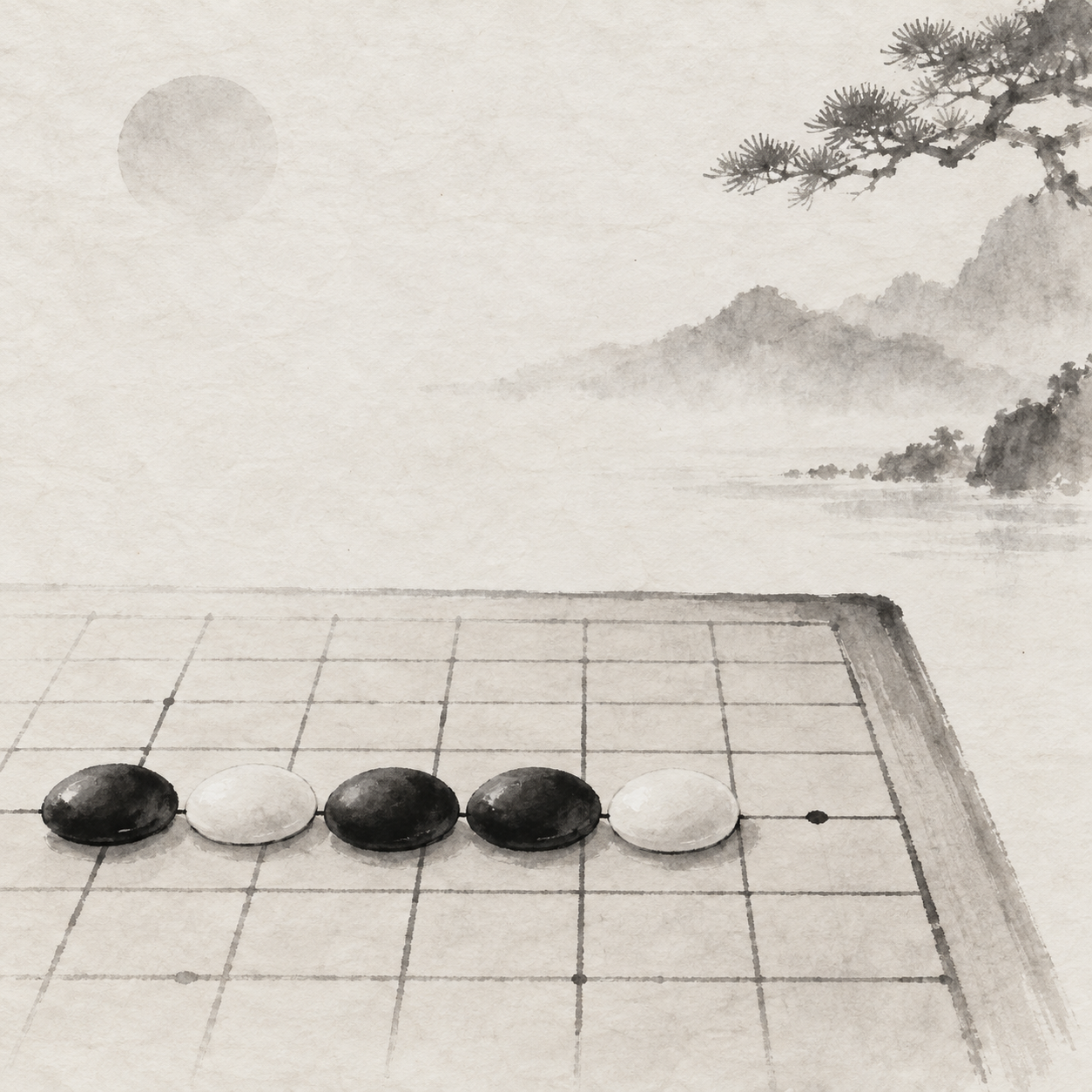
Start by reading just two moves: your four-in-a-row and your opponent’s block. If the resulting position offers no further threat, the four has merely spent your initiative.
Open threes and open fours keep the threat alive
An open four has two points on the same line where it can become five. Your opponent can block only one end in a single move, leaving the other open. An open four is therefore usually close to a forced win.
An open three can become an open four with one more stone, so your opponent must address the threat. Unlike a four-in-a-row, it does not present just one point to defend. You have to examine each possible defense and the position it leaves behind.
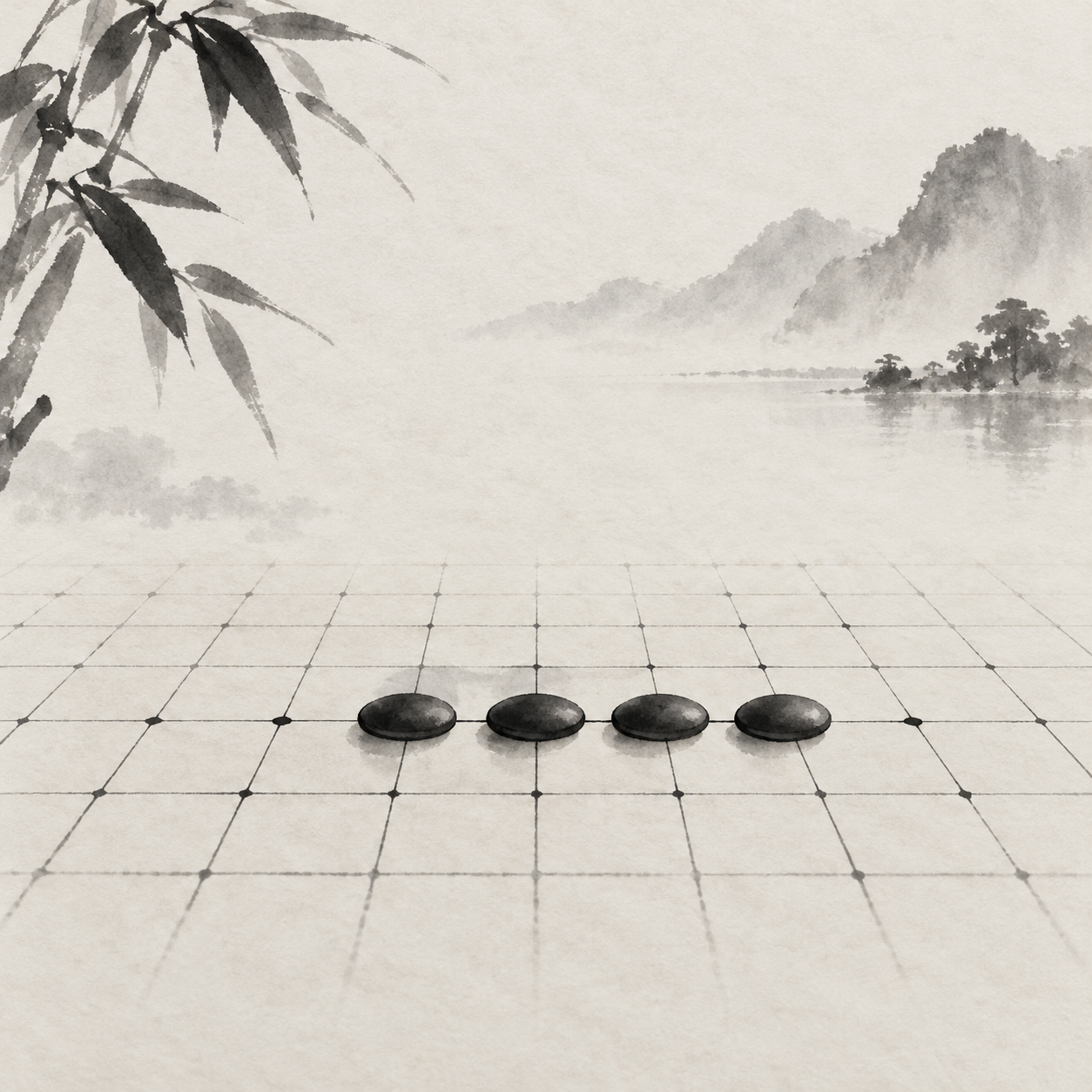
These shapes suggest a reading order: an open three threatens to become an open four; a four-in-a-row forces a defense at a particular point; an open four leaves two ways to make five. In play, what matters is whether those shapes can form one continuous line of attack.
VCF follows successive fours to a win
VCF stands for Victory of Continuous Four. Also written VC4, it is a form of calculation of a forced win: you play successive fours-in-a-row, your opponent blocks each one at its only defensive point, and the sequence ends with your chance to make five.
To calculate a VCF, find the first four-in-a-row. Then place your opponent’s block and look for the second. The moves form a genuine sequence only if the first has helped create the second—perhaps by adding a stone you need, or by letting the defending stone close off another end.
Check two things at every step: does your new stone actually make a four-in-a-row, and does your opponent really have only one point to defend? If any move fails to force a response, the five you imagined at the end is not established by that VCF.
To calculate a VCF, put every defending stone on the board before looking for your next move.
VCT brings open threes into the sequence
VCT stands for Victory of Continuous Threat. Also written VC3, it describes a win built from successive threats. It can link open threes with fours-in-a-row, so there are usually more defensive replies to calculate than in a VCF.
An open three, for instance, may force your opponent to prevent an open four. If the reply leaves you a four-in-a-row on another line, you can keep the initiative. The crucial step is to check every defense against the open three, rather than treating it like a four-in-a-row with a single point to block.
You also have to watch for a counterattack. If one defense gives your opponent a four of their own, you may have to block it first. Your planned next move may no longer be available.
Work backward from the winning point
When a position looks promising, find the final point where you could make five, or the open four that would secure it. Then ask what threat could bring the position there. Working backward focuses your attention on a few connected points instead of every possible four.
Next, play the sequence forward, placing attacking and defending stones in turn. If the block against your first four occupies the point where you planned to play your second, the sequence ends there. Threats that look connected on paper may not coexist on the board.
In Renju, Black must also check for forbidden moves
Under Renju rules, Black must avoid double-threes, double-fours and overlines. A VCF that looks continuous may include a four-making move that also creates a forbidden pattern. Check each move before counting the sequence as a win. VCT offers Black another way to look for a legal winning line, but an open three does not remove the risk of a forbidden move. The position after each stone is placed—and the rules you are playing under—decides what is legal.
Record each threat and reply when you review
In unrestricted Gomoku, with no forbidden moves, Black’s first-move advantage is immense. In 1993, Allis and colleagues used “threat-space search” to prove that the first player can force a win. Continuous threats are both a practical way to read the board and a starting point for computer solvers.
When you review a sequence that failed, start with the first four-in-a-row or open three that did not work. Did you miss a defensive point? Did a blocking stone change another line? Did Black run into a forbidden move? Make a note of that position, and you will be more likely to recognize it next time.
A sequence works only if it survives the board your opponent leaves after each reply.
In your next game, try reading just two threats ahead. Play the first, place your opponent’s defense, and only then decide whether the second still keeps the initiative.