
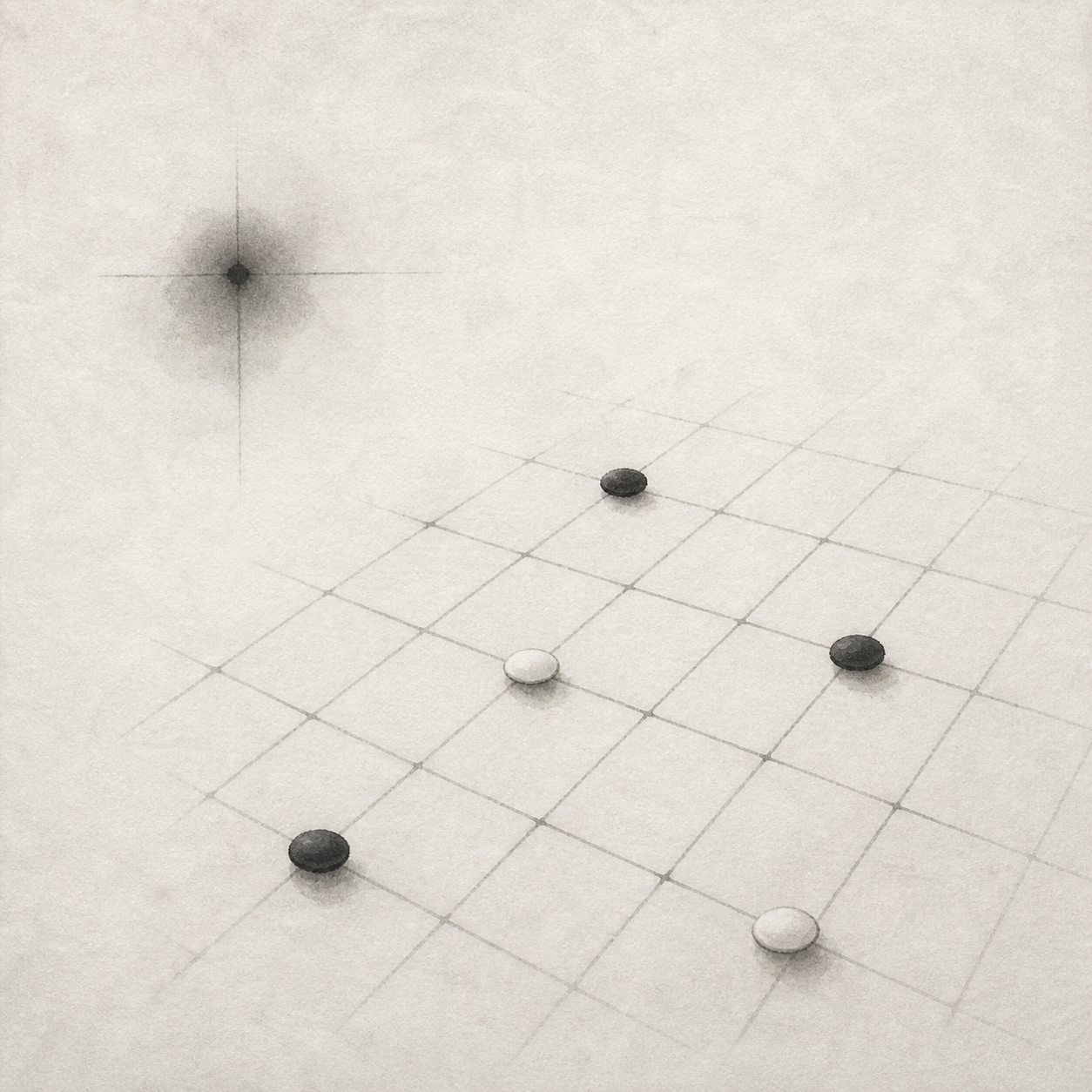
By the time you reach the third move, the most natural place is usually still near the center. The Pro Rule refuses that comfort: Black’s first move is on tengen, White’s second move may be anywhere, and Black’s third move must land outside the central 5×5 zone. It looks fussy at first. In fact, it is an early reminder that an opening has to open the whole board, not simply fill the most comfortable points.
It starts with a small correction
RenjuNet’s definition of the Gomoku Pro Rule is brief: Black’s first move is placed at the center of the board, White’s second move may be placed anywhere, and Black’s third move must be outside the central 5×5 square. The rule also notes that this system has no forbidden moves, and that making a longer line does not count as a win.
What matters is not the length of the rule, but where it chooses to intervene. It does not wait until the position becomes complicated and then try to repair it. It does not restrain Black with a long list of prohibitions. On the third move, it simply nudges Black out of the most comfortable gravity well.
When the center is too comfortable, Black works too easily
In Gomoku, the first-move advantage often comes from the number of directions available near the center. You do not need a mysterious opening formula to explain it. Around the center, horizontal, vertical, and diagonal lines are all intact; Black moves first, and it is naturally easier to turn the next move into pressure in several directions.
If the third move can still reinforce close to the center, Black can quickly turn the advantage of “moving first” into the advantage of “organizing first.” White is no longer answering a single intersection. White is dealing with a rhythm already taking shape.
Going wide slows the advantage down.
When the third move goes wide, the board has to open
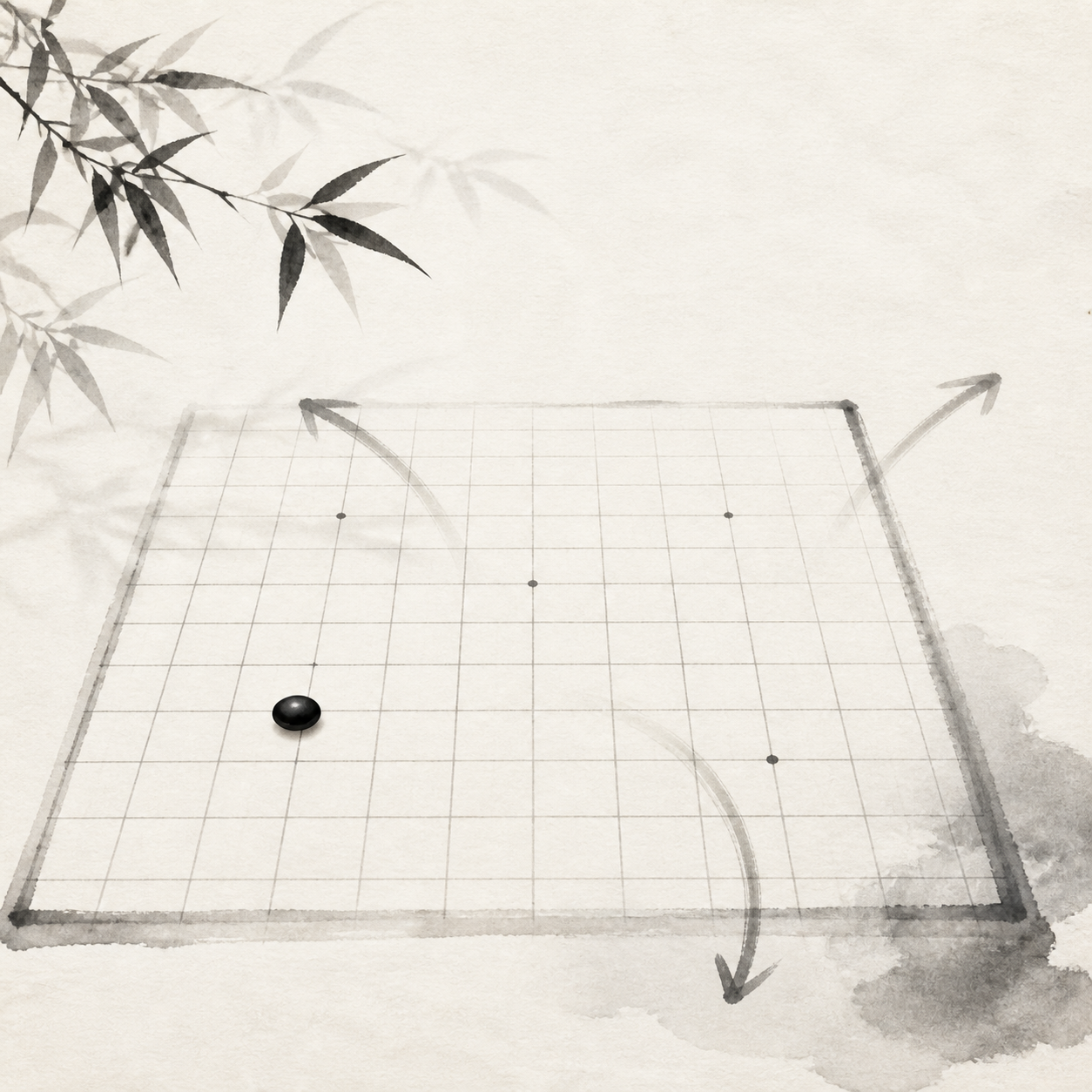
Once the third move leaves the central zone, Black cannot rely only on close reinforcement. It has to explain its plan in a wider space: stretch a diagonal line, create two loose points of support, or simply lure White toward one side.
The beauty of the move is that it does not make the game slower. It makes variation arrive sooner. You begin to see that distance itself is information: too close becomes piling up, too far loses contact, and the right kind of far leaves air for later threats.
It solves the same problem as Swap2
Swap2 takes a stronger approach: the opening first presents an initial position, then lets the other side choose colors, or add more stones before returning the choice. It puts fairness in the act of choosing.
This rule feels like a different design language. It does not ask the two sides to exchange identities. It directly restricts the first player’s earliest comfortable path. One balances through choice; the other balances through space. The aim is the same: do not let the first move determine the whole board’s breathing too soon.
For practice, it is a useful exercise in seeing
You may not play every game under the Pro Rule, but you can use it to train opening judgment. After placing tengen and White’s second move, do not rush to find the strongest point. Ask yourself: if the third move must go wide, which directions can still support each other? Which attractive-looking points are merely close to the center?
This exercise forces your eyes up from a single intersection. You start noticing edges, distances, future lines. You stop staring only at the point that feels most natural right now.
Rules are not decoration. They are feel.
After the Gomoku World Championship recorded by RIF resumed in 2009, it used new balanced opening rules. That context says something important: changes to Gomoku rules often serve fuller games, not complexity for its own sake.
A good opening rule is like an invisible hand. It does not play for you. It simply shifts the too-easy road a little aside, so that you have to look one layer deeper. Moving the third move outward is exactly that kind of small, clear adjustment.
A sense of fairness often begins with a little discomfort.