
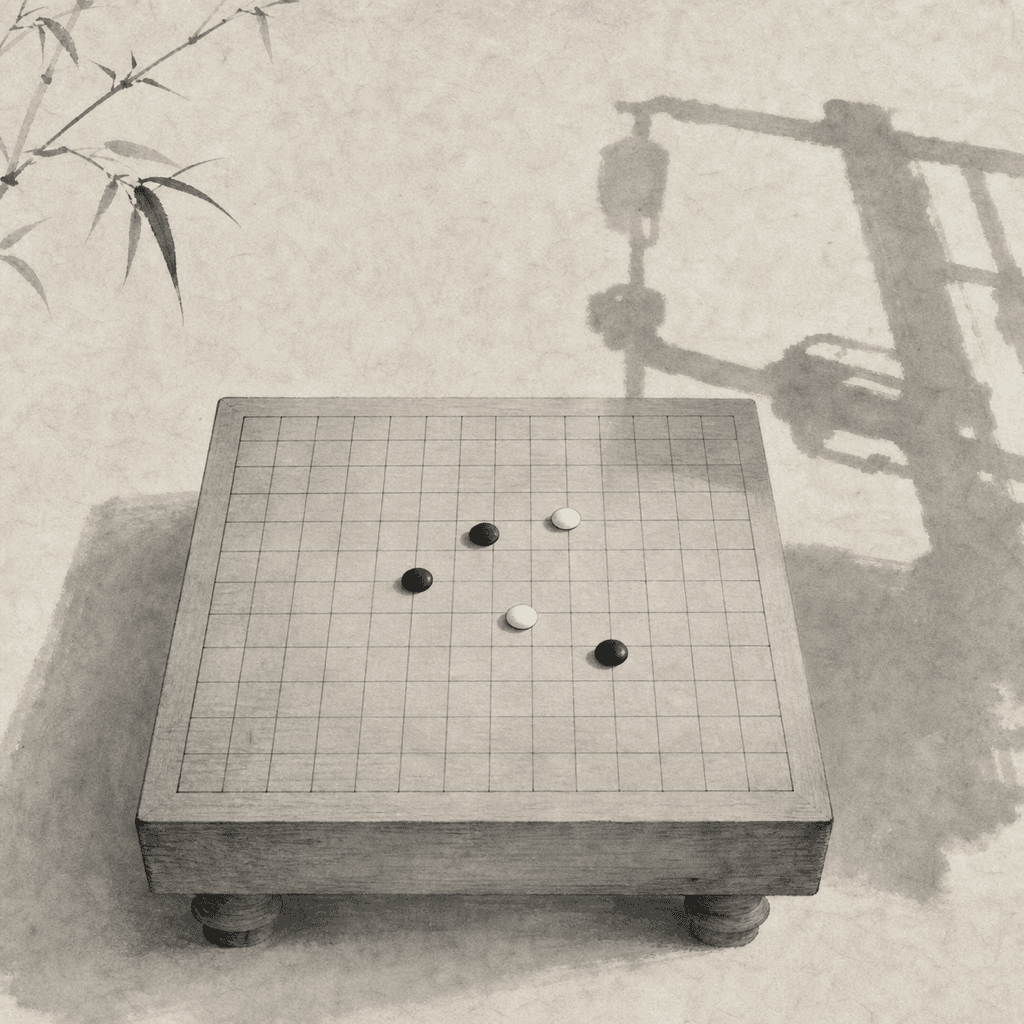
You may know the feeling: you finish watching a high-level game, remember who won, and cannot quite say what you learned. The results of Gomocup 2026 are already on the table. But what makes the event worth watching is not only where RAPFI25, KATAGOMO26, and ALPHAGOMOKU.MK26 finished. It is in the quieter details: how openings were selected, how rules changed the shapes on the board, how computational style reflected human judgment back at you. Being compelling is reason enough.
Look Past the Champion
According to the official results page, Gomocup 2026 was held from June 5 to 7. In the freestyle 20×20 division, RAPFI25 ranked first with an Elo of 2495, followed by KATAGOMO26 at 2290 and ALPHAGOMOKU.MK26 at 2190. The numbers are clear.
But the ranking is only the surface. What is more interesting is how the event put hardware, servers, rules, and openings on the same table: four Tencent Cloud SA9.8XLARGE64 servers, Windows Server 2025 Datacenter, x64 32 vCPU AMD EPYC 9K65, and 64GB of RAM. In other words, this was not a casual set of games. It was an attempt to compare styles on level ground.
That matters for human play, too. When you review your own games, you often blame a loss on a single move you “missed.” You ignore the conditions around it: whether the opening favored one side, whether the rules rewarded early aggression by Black, whether time pressure pushed you toward familiar shapes. A tournament lays those variables out. The game becomes easier to feel.
Twelve Openings, Twelve Futures
The official page notes that each ruleset used 12 prepared openings, selected by Alexander Bogatirev, Zijun Shu, and Qichao Wang. It is a small detail, and a crucial one. An opening is not ornament. It determines how every later move breathes.
If you usually begin near tengen, the center of the board may feel naturally comfortable. If the opening is nudged toward the edge, you discover that the same open three no longer has the same weight. A quiet preset can make one kind of attack arrive earlier. It can also give a defender one extra beat.
That is Gomocup’s first lesson for a human player: do not treat the opening as ceremony. The distance between the first, second, and third moves is already distributing future possibilities. The game has not warmed up yet, but the structure has started to speak.
The opening is not a prelude. The opening is the game.
Freestyle Is Beautiful Because It Stays Dangerous
The freestyle 20×20 division is attractive because it preserves many direct, sharp possibilities. Without the trimming effect of forbidden moves, Black’s initiative has more room to unfold. Open threes, four-in-a-row threats, and two-line attacks can connect early. The position looks beautiful. It is also more dangerous.
For a human player, this kind of game is especially good at producing misreadings. You see an opponent’s four-in-a-row and assume you must answer at once. You see your own open three and think the attack is already enough. But in freestyle Gomoku, the real question is not the single shape. It is whether the next turn can create two points that both demand a reply.
RAPFI25’s first-place finish does not need to become a myth. A more restrained reading is this: under these conditions, it handled the rhythm of freestyle rules more steadily, preserving initiative for longer. Strength is not only seeing farther. It may also be refusing to turn a good shape into a hurried one.
The Gap Is Style, Not Just Computing Power
Elo 2495, 2290, and 2190 look like a cool column of numbers. But if you read them only as a measure of computing power, you miss the best part of the tournament. Under the same hardware conditions, programs still reveal different preferences: some like to lock down a winning line early, some are willing to keep the position complex, some show more patience when shifting from defense to attack.
Human games are similar. Two players of similar strength face the same position. One immediately plays a four-in-a-row. The other first reinforces a point so that a double-three becomes unavoidable. The first looks sharp; the second looks calm. The real difference is who understands more clearly what the next move will force the opponent to answer.
So when you watch Gomocup 2026, do not only ask, “Who is strongest?” Ask better questions. In what positions does the winner’s strength appear? Did the runner-up lose points because the openings were uncomfortable, or because its middlegame transitions were one tempo slow? Those questions last longer than the standings.
Machine Games Clarify Human Weakness
Watching machines play can feel remote. They do not get nervous. They do not regret. They do not rush to prove themselves after losing the previous game. But that is exactly why they illuminate some of your bad habits so clearly.
For example, you may notice danger only one move before your opponent forms a double-three. In machine games, that danger usually does not appear out of nowhere. It has been prepared two or three moves earlier: liberty kept in one direction, a jump point preserved in another, with an apparently dull connection in between. It does not rush.
That is where a refined feel for the game comes from. Not every move has to be fierce. Every move has to make the next one harder to refuse. If you can see that process, the position slowly getting heavier, in Gomocup records, you will gain more than by remembering the champion’s name.
Strong players are not more hurried. They are more exact.
Bring the 20×20 Lesson Back to 15×15
Gomocup’s freestyle 20×20 division is not exactly the same as the 15×15 board you may play on every day. There is more space. The edges are farther away. Many shapes extend differently. But the method of judgment can travel.
First, do not only count consecutive stones. Ask whether both ends are still alive. Second, do not only ask whether you have a four-in-a-row now. Ask whether your opponent can seize initiative after you play it. Third, do not chase a move that merely looks good. Ask whether it makes the next move more natural.
You may find that many losses do not come from failing to kill. They come from revealing your intention too early. An open three with no follow-up is just a shape. A quiet reinforcement that thickens two lines at once may be much closer to a real attack.
Gomocup 2026 Makes the Game Slow Down
Gomocup is a long-running tournament for Gomoku programs, and its background is available in public sources. But the 2026 edition does not have to be read merely as technical news. It is more like a polished mirror, holding openings, rules, hardware, style, and judgment in the same frame.
If you only want the standings, three minutes is enough. If you linger, and watch how openings become middlegame pressure, why one four-in-a-row comes too soon, how one unremarkable reinforcement quiets the whole board, the event becomes much more interesting.
The next time you open a board, try playing one game a little more slowly. Do not rush to win. First ask whether each move makes the shape clearer. Once you can see that clarity, the value of Gomocup 2026 will no longer live only on the leaderboard.