
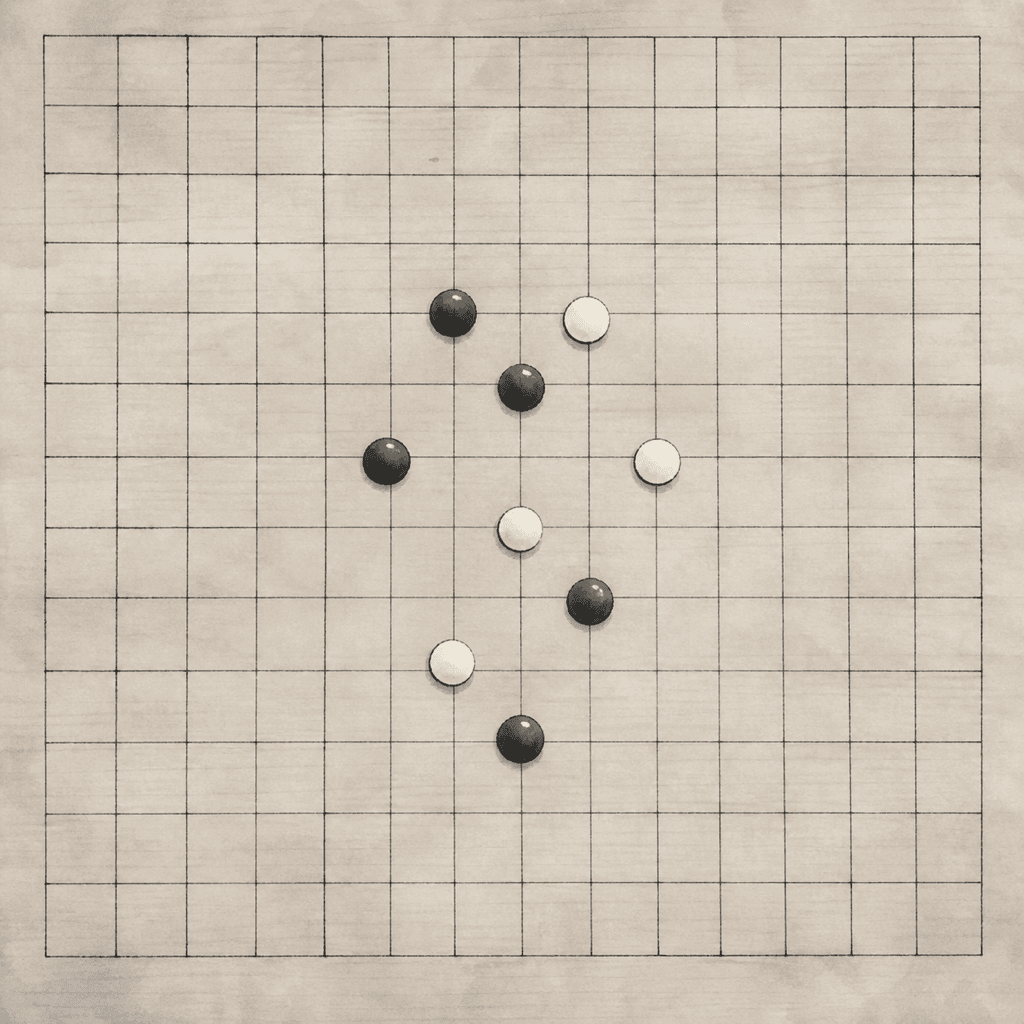
You have just finished reviewing a game. What hurts most is often not the miscalculation in the middle game, but the feeling that by move ten something was already off. The shape is not bad, yet everything is half a beat slow. There is no obvious mistake, yet your opponent is leading you around. Gomocup 2026 has just ended. An ordinary player does not need to remember every program’s name. But it is worth noticing the opening mood it leaves behind: less showmanship, more restraint; less memorization, more craft.
Gomocup 2026 Was Not Just About the Winner
According to the official Gomocup results, the 2026 tournament was held from June 5 to 7. The top three in the Renju division were RAPFI, KATAGOMO, and ALPHAGOMOKU. The ranking matters, of course. But if you read it only as a leaderboard, you miss the more interesting part.
A program tournament is a kind of magnifying glass. It puts under a hard, fine light many things in Gomoku that are usually passed over as instinct: the distance from the first move, the direction of the third, whether the fifth commits too soon. The stronger the game, the less hurry there is to look clever.
I am more interested in the opening. It is the part of the game that most resembles handwork. One stone near tengen, shifted by a single intersection, can change the temperament of every line that follows. Beauty is reason enough. But in Gomoku, the shapes that are truly beautiful are usually the ones that last.
Twelve Set Openings Turned Memorization Into a Test
One easily overlooked detail appears in the tournament information: each rule set had 12 prepared openings, and the games were run on four identical cloud servers. The openings were selected by Alexander Bogatirev, Zijun Shu, and Qichao Wang.
That means the tournament was not simply asking programs to start from an empty board and prove their computing power. It was more like placing the players in twelve different workshops. Some wood is easy to handle. Some has a twisted grain. Some is smooth on the surface but cracked inside. The closer a player can sand the position into calmness, the closer it gets to the answer.
The same is true for you. Memorizing a common opening is not hard. The hard part comes when your opponent deviates by one move and you still understand where the shape’s center of gravity has gone. An opening is not a password. It is training in judgment.
Swap2 Takes Away the First Move’s Privilege
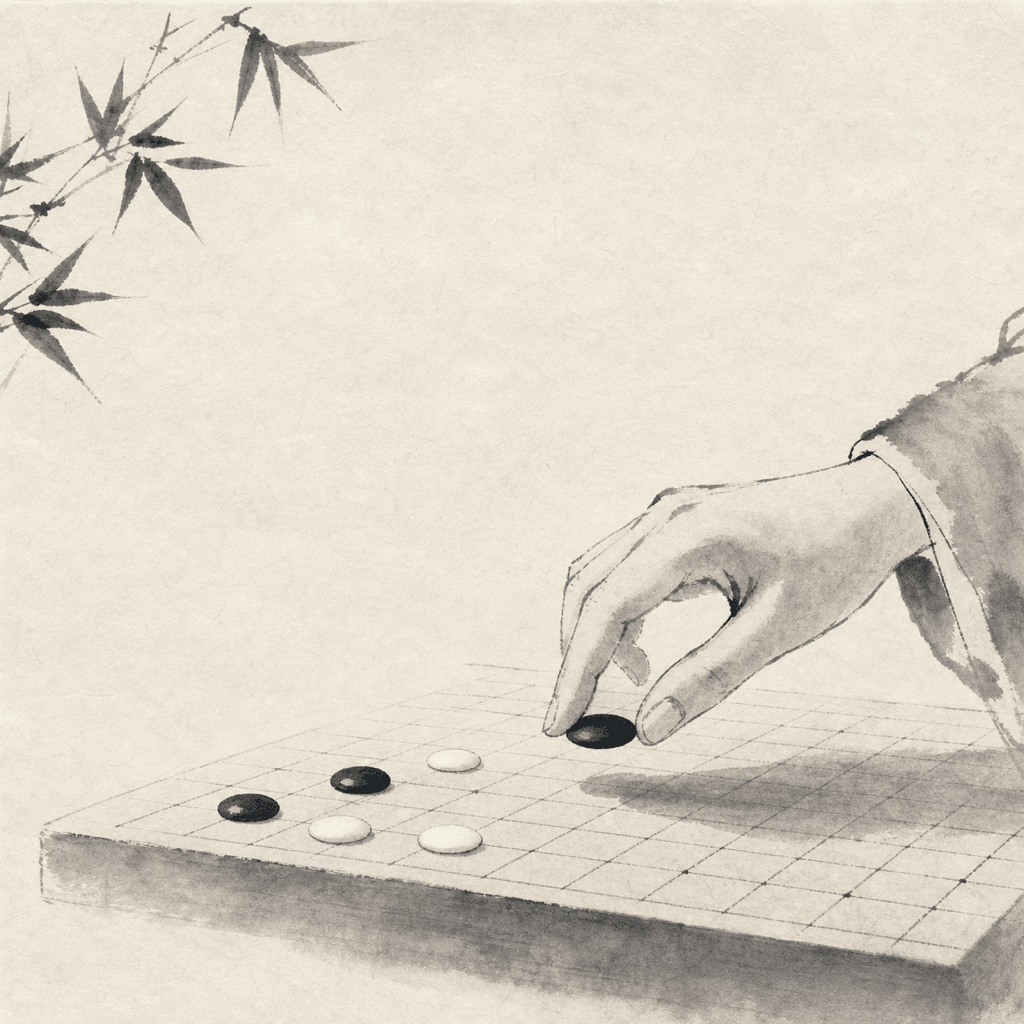
Many people hear Swap2 for the first time and assume it is a complicated rule. Its core is plain. The second player may continue as White, swap colors, or add more stones and pass the choice back. It does not exist to add ceremony. It exists to weaken Black’s natural advantage in the opening.
That changes the psychology of the first move. You cannot think only, “How do I make the strongest shape as quickly as possible?” You also have to think, “If my opponent takes over this position, would I be willing to sit on the other side?” A genuinely refined opening is often not the fiercest one. It is the one neither side can easily refuse.
That is Swap2’s real lesson. Before you place a stone, it forces you to think once on behalf of your opponent. Gomoku becomes a little less brute force, a little more workmanship.
A good opening is hard for either side to refuse.
Craft Begins With Shapes That Can Breathe
A common mistake is to treat the opening as a contest in tightness. Stones that sit close together can indeed create threats. They can also flatten your own choices. Before the seventh move, if every stone serves only one fantasy of a four-in-a-row, the game will lose its elasticity very quickly.
The comfortable openings I notice tend to preserve at least two directions of growth. If a central cluster can become an open three to the left, or turn right into a diagonal restraint, your opponent cannot defend only one point. Here, open is not an adjective. It means the shape can still breathe.
You can run a small check in your own games. After the fifth move, ask: “If this is blocked, do I still have a second line?” If the answer is no, the opening is probably too thin, and too impatient.
What Ordinary Players Can Learn From Champion Programs
RAPFI’s win does not need to be mythologized into some remote technical story. For an ordinary player, its greater value is the reminder that high-level games now demand more from the opening than “Does this line exist?” The question is whether that line can hold up under different rules and different assigned openings.
KATAGOMO and ALPHAGOMOKU finishing just behind it also suggests how fine the margins are among the strongest. At that level, the value of a move often lies not in whether it kills immediately, but in whether it makes the next three moves feel more natural. The beauty of modern Gomoku is moving from the explosion to the sequence.
The same holds in human games. Do not ask only, “Do I have a threat?” Ask also, “Is my next move smooth?” Smooth does not mean soft. Smooth means the structure has not tied itself in knots.
Review the Opening, Memorize Less
During review, many players rush to ask, “What should I have played here?” It is a useful question, but not enough. A better one is: Which directions did this move strengthen, and which did it erase?
If you change only one habit, start by marking moves 1 through 9. Beside each move, write one sentence: what it prepared, and what it sacrificed. The move you cannot explain was probably played by feel.
It is a small exercise, but an effective one. It does not ask you to memorize new variations. It does not ask you to get stronger overnight. It simply asks you to feel the board’s space again: where it is too crowded, and where it can still open up.
Forbidden Moves Make the Opening Finer Work
Forbidden moves in Renju rules often make beginners feel constrained. According to RenjuNet’s explanation of the rules, Black must avoid restrictions such as the overline, double-three, and double-four. On the surface, this locks up Black. At a deeper level, it keeps the opening from being only a race for speed.
Because forbidden moves exist, Black cannot simply pile up strong shapes. A double-three that looks fierce, if it is illegal under the rules, is only beautiful scrap. So opening choices become more exacting. You want the threat to exist, but not to trap you too early.
That is the feeling of craft. A good carpenter does not spend all his force on the first cut. A good opening does not place all its ambition on the first cluster of stones. It leaves blank space, leaves direction, and leaves a way back.
After Gomocup, Play the Next Opening More Slowly
The lesson of Gomocup 2026 for ordinary players is not “play like the champion.” Program tournaments are played at such a height that direct imitation can teach you only the shell. What you can take away is a more modern, more restrained view of the opening: let the shape stand first, then talk about attack.
The next time you sit down at the board, do not hurry to prove how many patterns you know. Look at the distance from tengen. Look at the room left on the two diagonals. Then play. The board will quiet down, and you will hear it more easily.
Slow down, and the opening becomes clearer.
If you like, try one game this way: for the first 9 moves, ask only about structure, not victory or defeat. You may find that the most absorbing part of Gomoku is not merely making five in a row. It is the small, carefully worked choice that comes before each stone lands.