
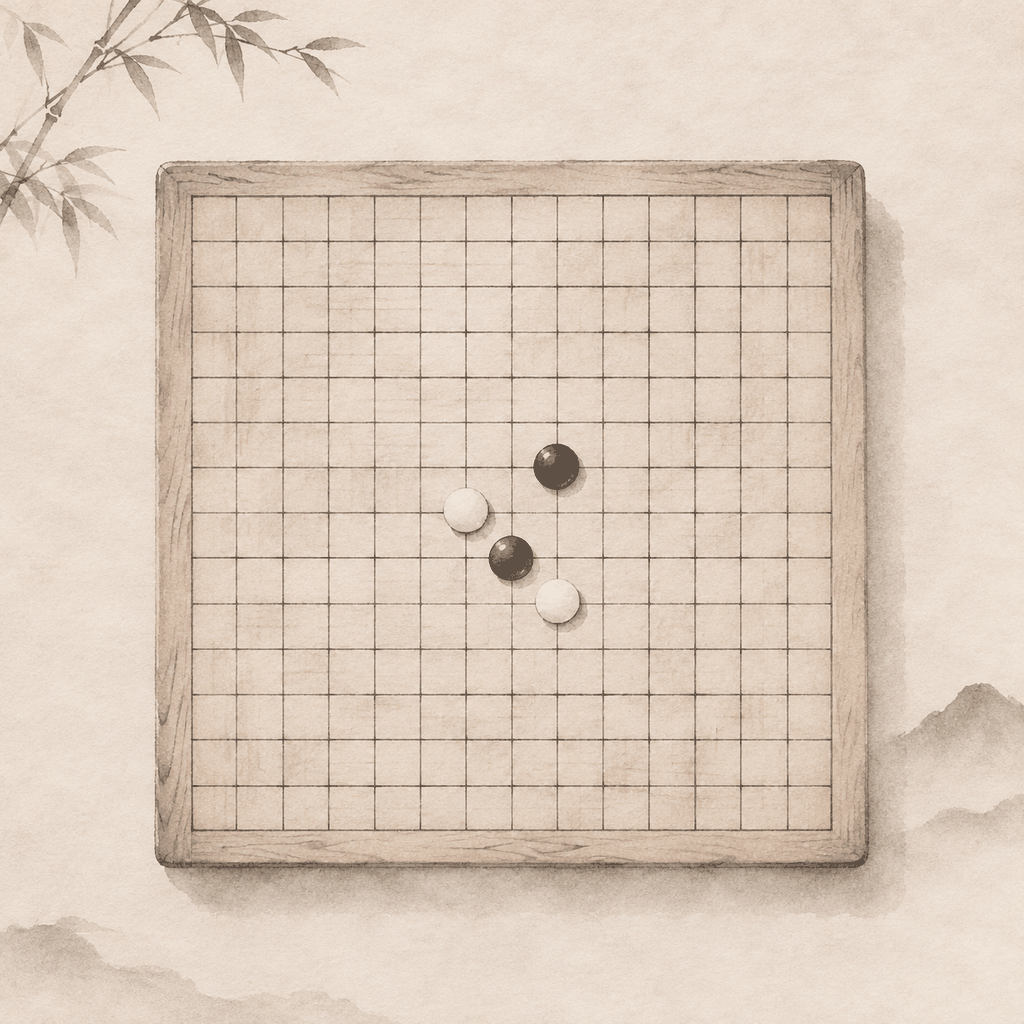
To win at Gomoku, first ask whether you can make five immediately. Then deal with any point where your opponent can make five next. Once the position is stable, look for a move that creates two threats no single reply can stop. The classic finish is a four-three: one move creates a four that demands an immediate block and a three that can become an open four on the next turn. Under Renju rules, you must also check for a forbidden move—a move by Black that creates an overline, double-four or double-three.
What Actually Wins a Game of Gomoku?
Gomoku is won by being first to connect five stones horizontally, vertically or diagonally. In practice, the point is to create more threats than your opponent can answer with one move. According to the RIF beginner’s tutorial, standard Renju uses a 15-by-15 board, with Black moving first at the central point called tengen. Whatever the opening, every calculation returns to the same question: can either side make five on the next move?
If you have only one winning point, your opponent can usually occupy it. That is why a single advancing line so often gives away the initiative. You may force a block on a horizontal line, but if you have no follow-up, your opponent is free to organize a vertical attack. Winning sequences tend to begin with one move that opens two routes, leaving the defense able to close only one.
Why Is an Open Four Unstoppable but a Four-in-a-Row Defensible?
An open four has four stones aligned with a winning point at either end. Your opponent can block only one of those points in a single turn. A four-in-a-row is one move from five but has only one effective winning point, which the opponent can occupy immediately. To judge the strength of a four, count its winning endpoints rather than merely noting that the stones connect.
An open three has room on both sides to develop into an open four. The RIF tutorial notes that an open four can arise only from an open three, so the moment an opponent creates one is the main defensive window. Wait until it becomes an open four and you are already too late. You can block one end, or play a four-in-a-row of your own and force the opponent to answer first.
What Should You Check Before Every Move?
Use the same order every turn: first look for an immediate five of your own, then block your opponent’s four. Next, find moves that create an open four, and then deal with the opponent’s open three. Only when none of those exists should you expand an ordinary shape. The Play Abstract Games Gomoku strategy page follows the same priority and adds another defense: against an open three, you can seize the initiative with a four of your own.
Suppose your opponent has just played in the upper-right corner while you were preparing to extend two lines on the left. If your scan shows that the opponent can make five next, the left-side plan must wait. If there is no immediate winning point, ask whether the move created an open three. A fixed order keeps you from missing a necessary block because you were watching only your own design.
What Separates an Open Three From a Closed Three?
An open three has routes to an open four on both sides. A closed three is blocked at one end and can develop only in the other direction. A solid three consists of three adjacent stones on one line; a broken three leaves an empty point inside the shape. Either can be open, or can lose its force because of the board edge, the spacing of friendly stones or an opponent’s block.
Against a solid three, the usual defense is to occupy one end and reduce its two routes to one. Against a broken three, inspect the internal gap as well. If taking that point splits the shape in two, it is often more precise than blocking an outer end. Near the edge of the board, count the available space again: an apparently open end may not have enough room to hold five stones.
Why Is the Four-Three the Most Common Finish?
The four-three is common because one move combines a four that must be blocked immediately with a three that can become an open four on the next move. After your opponent blocks the four, you develop the three and leave two winning points. In your calculation, confirm that both threats truly come from the same move—and that the forced block does not also break the three.
In the example from Play Abstract Games, Black plays k8, forcing White to answer at j8 while preserving a three along another line. Black can then play h5 or l9 to create an open four. It is a useful exercise in reading crossing lines: find the single forced reply, then ask which line still has two development points afterward.
When calculating a four-three, find the four’s only forced reply, then verify that the other three can still become an open four.
How Do You Calculate a VCF?
VCF is a way of winning through a continuous sequence of four-in-a-row threats. Each attacking move creates another four, denying the defender a free turn, until the final move produces two threats that cannot both be answered. The difference from a four-three is timing: a four-three places two threats in one move, while a VCF uses a chain of forced replies to draw the defender into a prepared position.
When searching for a VCF, begin with nearby closed threes, broken threes and twos that can be extended, then work backward from a possible finishing point. At every step, record each legal blocking point and check whether the defending stone also cuts off your next four-in-a-row. If even one move in the sequence fails to demand a reply, your opponent may turn and make five—or simply occupy your connecting point.
Why Does Black Favor a Four-Three Under Forbidden-Move Rules?
Under forbidden-move rules, Black’s legal double threats are constrained by the double-three, double-four and overline restrictions. That is why the four-three is taught as Black’s basic finishing route. A double-three creates two open threes at once; a double-four creates two fours; and an overline gives Black six or more stones on one line. White faces none of these restrictions and may win directly with a double-four. The RIF beginner’s tutorial identifies all three kinds of moves as forbidden for Black. A continuous four sequence, or VCF, is bound by the same rule: its final move must produce a legal four-three to complete the attack. Chinese Gomoku instructional material therefore emphasizes steering Black’s attack toward a legal four-three.
Forbidden moves also change the purpose of defense. White can gradually narrow Black’s usable points until a critical intersection would create a double-three, double-four or overline. On Black’s turn, even a point that appears to launch a strong attack must be checked in three directions. If the move is forbidden, White can claim the win under the rules. White, meanwhile, can deliberately preserve such points as traps: playing there would itself be illegal.
How Should You Practice Tonight?
Tonight, practice just one habit. After every opposing move, use that stone as the center of a scan: horizontal, vertical, diagonal left and diagonal right. Mark any immediate winning points first, then look for fours, open threes and points connected to forbidden moves. Only after the scan should you consider your own attack. A single game will rehearse the order of threats many times without letting elaborate opening patterns distract you.
In your next game, set a modest goal: miss one fewer immediate threat, and fully calculate one four-three or VCF. Afterward, ask three questions. Did you check for five first? Did you mistake a four-in-a-row for an open four? Did you overlook a forbidden move on Black’s turn? Keep those questions in mind, then play again.
Key terms
- Open four
- Open four is a line of four consecutive stones with both ends empty, allowing five in a row at either end.
- Four
- Four is a pattern with only one effective point for completing five in a row, which the opponent can block immediately.
- Four-three
- Four-three is a move that simultaneously creates a four and an open three, producing two follow-up lines that are difficult to stop together.
- Forbidden move
- Forbidden move is an illegal Black move under Renju rules that creates an overline, double-four, or double-three.
Frequently asked questions
What is the difference between an open four and a four?
An open four has two endpoints that complete five in a row, so one defensive move cannot block both and victory is normally assured. A four has only one effective winning point, which the opponent can occupy immediately.
How should I defend against an opponent's open three?
Block one side of the open three first so it cannot become an open four with two winning endpoints. Against a broken three, also check its internal empty points. Alternatively, create your own four to force the opponent to respond.
Why does a four-three usually win?
A four-three creates both a four and an open three with one move. The opponent must block the four first, after which the attacker develops the open three into an open four, leaving two winning points that cannot both be blocked.
How can I tell whether a sequence of consecutive fours works?
Verify move by move that every attacking move creates a four requiring an immediate response, and record every legal blocking point. The sequence fails if any defense also cuts off the next attacking line, or if an intermediate move does not create a four.
Why must Black check for forbidden moves before attacking?
Under Renju rules, a Black move that creates a double-three, double-four, or overline of six or more stones is forbidden. Even if the point appears to create a double threat, it cannot serve as a legal winning move if it is forbidden.