
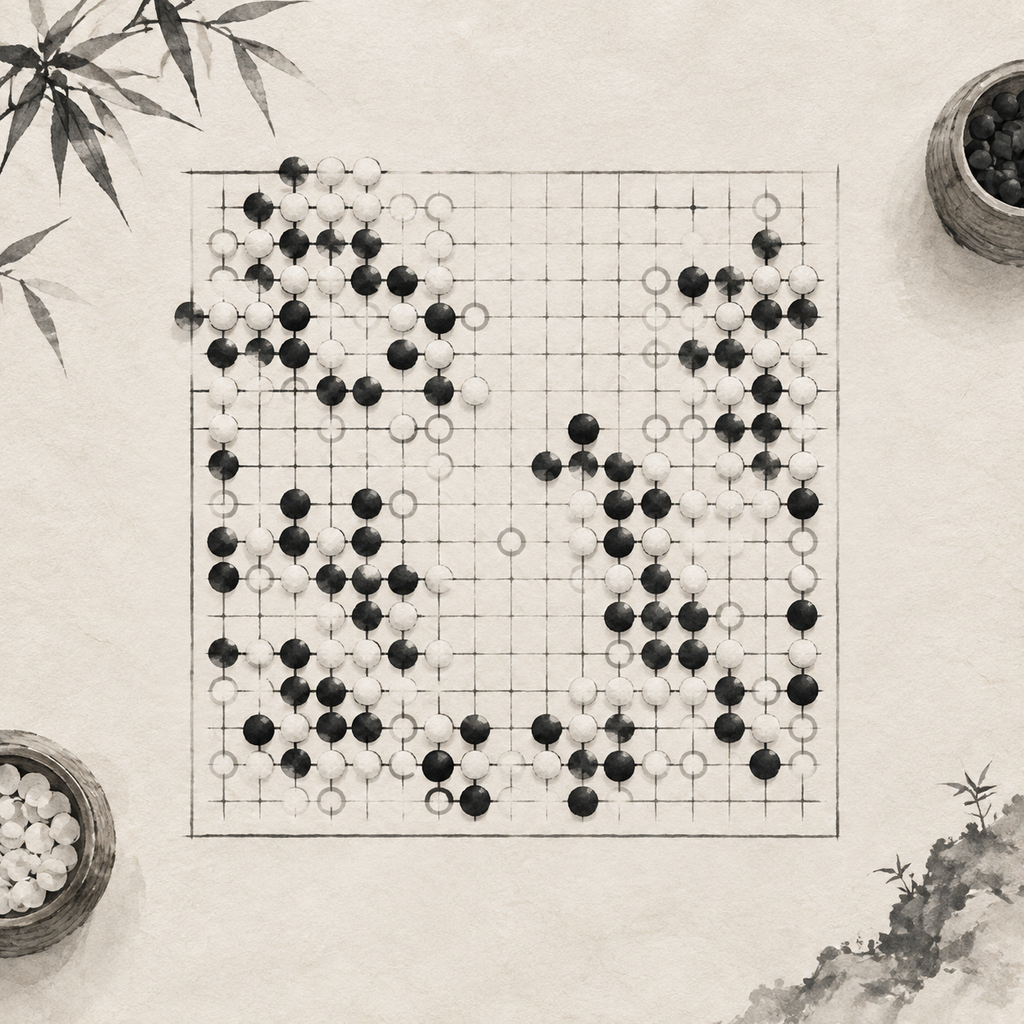
Imagine this game: move 225 is played, occupying the last intersection on a 15-by-15 board. You inspect every horizontal, vertical, and diagonal line, finding neither five black stones in a row nor five white stones in a row. The tension does not vanish simply because there is nowhere left to play. What must be confirmed is how the rules in force define the end of the game and a draw.
A Full Board Is the Most Obvious Endgame Boundary
Ordinary Gomoku is commonly played on a 15×15 board, with the first player to make five in a row horizontally, vertically, or diagonally winning the game. If the board is completely filled and neither player has made five in a row, many rules declare a draw. The logic is straightforward: there are no legal points left, the position cannot continue, and no winning condition has been triggered.
Still, “a full board means a draw” should be understood as a common end-of-game rule, not the one answer shared by every platform, event, and informal agreement. The method of play, forbidden-move rules, timing system, and whether an agreed draw is permitted can all change when a game officially ends. If those terms are not settled before play begins, the final point can become the start of a dispute.
First, Distinguish Ordinary Gomoku from Renju
The rule name is the easiest thing to overlook when discussing draws. Ordinary Gomoku, as it is commonly played, centers on making five in a row first; Renju introduces more detailed restrictions for Black to balance the first-move advantage. Both can reach a position in which the board is exhausted, but their judgments about certain apparently completed lines are not identical.
Section 9 of the International Renju Rules defines wins and forbidden moves: a Black overline, double-four, or double-three is a forbidden move, while the treatment of White is different. In the endgame, you cannot simply count whether “five stones are next to one another”; you must also ask whether the line was created by a legal move. The rule text is available in Section 9 of the International Renju Rules and the Renju rules materials.
The disappearance of open points is a fact about the position; whether a draw stands must still be confirmed by the rules adopted before the game.
A Draw Does Not Only Happen After the Final Move
A full-board draw is striking because it leaves clear visual evidence: there are no open points. Under formal rules, however, a draw can occur earlier. Section 10 of the International Renju Rules lists draw conditions including mutual agreement and both players running out of time. The precise judgment may still differ by platform and event, so the published rules for that setting control.
This is why practical play requires a distinction between “the position looks unwinnable for either side” and “the game has been officially declared a draw.” The first is a player's assessment of the position; the second is an outcome under the rules or a ruling by an official. If both players still have time and legal points remain, and the rules do not allow an agreed termination, even an extremely blocked position will usually have to proceed through the required process.
The Final Open Points Determine Which Lines Still Have Rights
The difficulty of reading an endgame lies not in the small number of open points, but in the fact that each one belongs to several lines at once. An open point just right of center might block the extension of White's diagonal, or give Black an entry point for a horizontal four-in-a-row on the next move. Before playing, check the horizontal, vertical, and two diagonal lines that pass through the point instead of watching only the most conspicuous group of stones.
When only three open points, A, B, and C, remain, use the same checklist for each one: after the move, who can make five on the next turn; which open three or four-in-a-row is cut off; and whether playing there as Black creates a forbidden move. If A blocks only one four-in-a-row direction, B cuts off two lines that can still extend from open points, and C affects only the edge without creating an immediate win, B is usually the first point to compare. Endgame reading should proceed line by line before comparing how many winning points the opponent retains.
Defense Is Not About Filling Every Gap
Near a full board, the defensive goal is to stop the opponent from completing a playable five-in-a-row, not to make the shape look elegant. A line already severed by stones from either side is no longer a threat, no matter how long it once was. What matters are lines still connected by open points and capable of closing within one or two moves. Spending limited turns beside dead lines often means handing over the initiative.
Under Renju rules, Black must also perform an additional legality check. The overline, double-four, and double-three forbidden moves listed in Section 9 of the International Renju Rules mean that a point which appears to block an attack cannot automatically serve as Black's defensive answer. White, too, cannot relax simply because Black seems to have a move that stops the threat: whether that move is forbidden may be the dividing line in the endgame evaluation.
The value of an endgame move is not that it occupies one more point, but that it first clarifies which point can still change the result.
Tempo Becomes More Absolute as Open Points Shrink
In the middlegame, an ordinary reinforcing move can sometimes wait. Near the end, the number of open points itself becomes a countdown. With every move, one fewer intersection is available to both players, and many lines shift directly from “still connectable” to “permanently broken.” So your calculation should not ask only whether you can build an attack; it should also ask how many key points that still serve two lines at once remain for your opponent after the move.
These positions are especially suited to a simple order of checks: first look for an immediate five-in-a-row, then for a winning point that must be blocked, next for a point that creates a double threat, and only afterward compare positional shape. The order helps eliminate illusions. The fuller the board, the more likely a beautiful shape is merely an unfinished fragment; a real threat must have an open point where it can be completed.
Write the Rules Before the Game Begins
Before a friendly game or online room begins, settle three points: whether you are using ordinary Gomoku or Renju rules, whether forbidden moves apply to Black, and how a full board, timeout, and agreed draw will each be handled. If the platform has an automatic ruling system, follow the room rules and event regulations. Do not carry assumptions from one variant into another.
For the basic game and the common background of the 15-by-15 board, see the Gomoku entry; for competitive rulings, consult Sections 9 and 10 of the International Renju Rules, then return to the regulations published for the specific event. Sources can explain the common framework, but they cannot replace the details governing time controls, forfeits, appeals, and forbidden moves in a particular competition.
After the Last Point, What Remains Is a Review
A full game with no winner does not make the calculations that came before it meaningless. It preserves on the board every attack that failed to continue and every route that was closed in time. In review, work backward from the final ten moves: which open point once served two lines at once, which move turned a live line into a dead one, and which defensive move had already steered the position toward an outcome without a winner.
When the last intersection is occupied, do not rush to label the game disappointing or dull. Check the rules, inspect every direction, and under Section 9 of the International Renju Rules confirm whether a legal five-in-a-row exists; if the answer is no, determine whether the position is a draw under the applicable rules. A full board means the space has been exhausted. How you read that space still carries into the first move of the next game.