
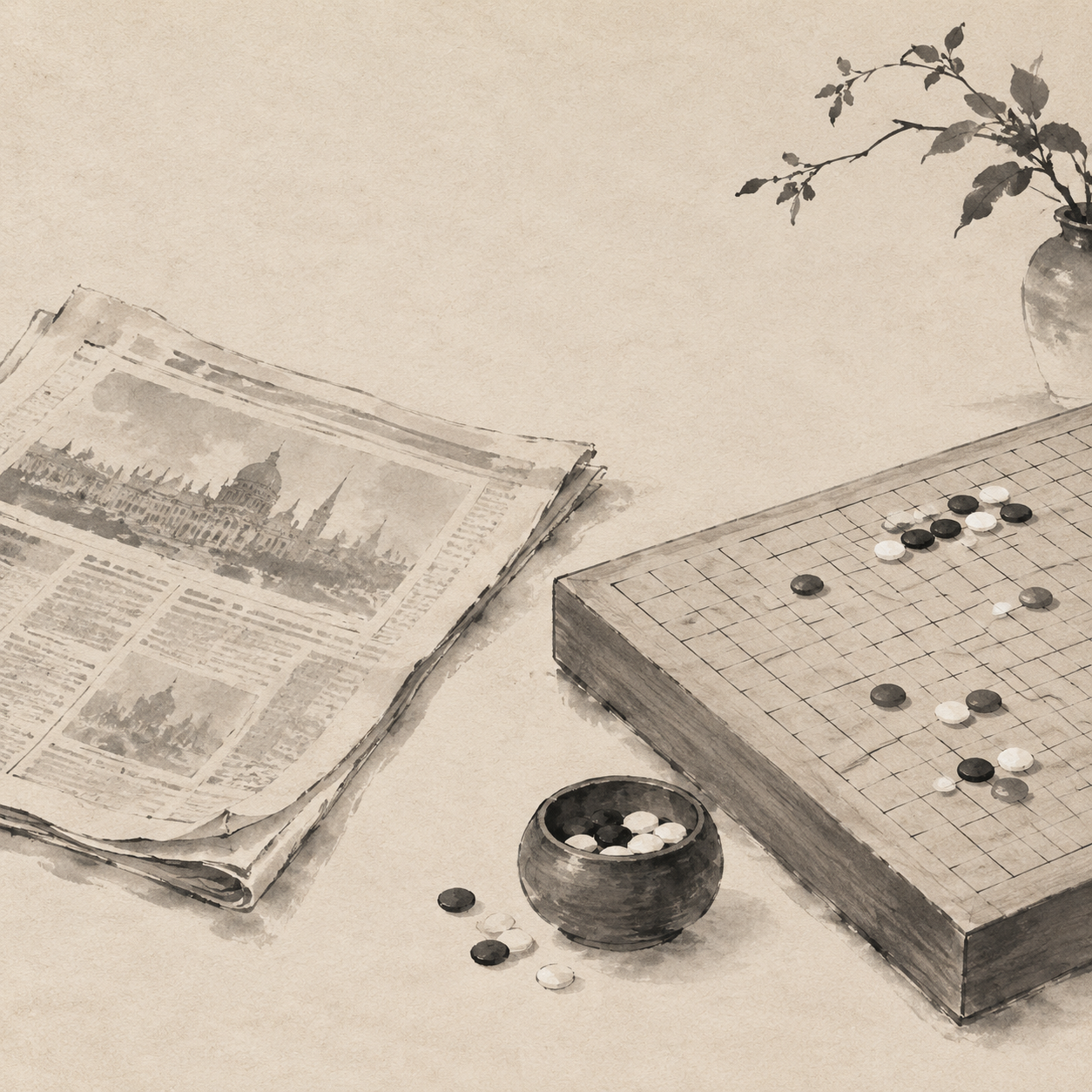
Why did the British call Gomoku Go Bang? The answer has nothing to do with a crashing sound. It lies in a Japanese word for a board — one that English ears heard imperfectly, split apart, and respelled into something printable. Early nineteenth-century sources show the name entering British print as a novelty label for an Eastern board game, only to give way, in time, to the more transparent terms gomoku and five in a row.
Why the name seems strange
A modern English reader encountering Go Bang will naturally parse it as two ordinary words: go and bang. One suggests a move; the other suggests a sound. But neither reading follows the game's actual etymology. The more defensible explanation is that the phrase derives from the Japanese goban — the board used for Go.
Goban, written in Japanese as 碁盤, means the board on which Go is played. Gomoku-style games have long been played on that same board; when the pastime was introduced to English readers through Japanese-adjacent materials, the line between the board's name and the game's name blurred. Goban was heard, broken apart, and respelled as Go Bang — a textbook case of what happens when a foreign word is domesticated by a new language's ear.
1886 and 1888: what the English record shows
The most frequently cited evidence for the British name is the Oxford English Dictionary's entry for go-bang, which lists nineteenth-century citations: one from 1886 and one from 1888. Secondary sources sometimes preserve only the years, so anyone checking the record should consult the OED entry itself for the original sources, volume numbers, and page references. What those two dates establish reliably is that Go Bang had entered British print by the late 1880s.
That is not the same as saying the game was invented in 1886, or that the name was universal among British players. It marks, more precisely, a publishing threshold: the moment when newspapers, game pamphlets, and family-entertainment columns began introducing a five-in-a-row contest to readers under a name that sounded exotic enough to intrigue and plain enough to set in type.
The spelling path from goban to Go Bang
Rendering goban as Go Bang is not a precise transliteration. In Japanese, go is the character 碁 and ban means board. An English publisher who encountered the spoken or written form likely stretched the final nasal into bang and read the opening go as a freestanding word. The compact goban thus became two words that felt, to English eyes, perfectly natural.
There was also a commercial logic to the transformation. Go Bang is short, punchy, and readable — well suited to a Victorian parlor-games column or the lid of a boxed set, where an unfamiliar Japanese compound would have given pause. Once a name circulates alongside a set of rules, a misreading stops being merely a mistake and becomes part of the historical record.
What makes <em>Go Bang</em> interesting is that it captures a halfway state: people had not yet fully grasped the original word, yet they had already begun using it to make sense of a game.
Did it mean Gomoku or Renju?
The Go Bang of nineteenth-century English sources corresponds roughly to what we now call gomoku — the family of games in which two players alternate placing black and white stones on a grid, with the goal of forming an unbroken line of five. Early descriptions typically seized on that clean objective and stopped there, well before the competitive ruleset introduced forbidden moves, opening protocols, and balancing constraints.
Renju represents a later fork in the rules. Verifiable Renju history generally places the naming of 連珠 by Kuriyama Ruikō in 1899 as a key moment; accounts in the Yorozu Chōhō and subsequent organizational histories of the game all center on that date. From there, Renju gradually pulled away from ordinary Gomoku by restricting the black player and codifying concepts such as the double-three, double-four, and overline as forbidden moves.
The "Japanese game" that British readers encountered
Victorian writing on domestic entertainment had a habit of packaging Asian board games as "Japanese games" or "Eastern games." The framing suited the moment but not the history: it emphasized novelty and routinely glossed over the multiple origins and names a game had accumulated within East Asia. Go Bang was fixed in place by that same framing — pointing toward a Japanese board while obscuring the longer tradition of five-in-a-row play behind it.
Asking why the British used this name, then, is not a search for a single inventor. The more accurate answer is that Go Bang was the joint product of print culture, packaged games, Japanese vocabulary, and English phonology. The name looks casual, but it records how rules were paraphrased, objects were labeled, and readers used a borrowed word to get their bearings with a new game.
What the misreading left behind
Today the common terms are gomoku and five in a row. By comparison, Go Bang sounds like an antique, carrying the accent of the nineteenth-century English-speaking world. It is a reminder that game names do not always grow organically from rules. More often they pass through boards, rulebooks, translators, and readers before settling into print.
The short answer to the Go Bang question is this: the name most likely derives from the Japanese goban, which British publishers split and respelled according to English habit, and which enjoyed a period of currency before plainer terms displaced it. The longer answer is a journey — from board name to game name, from mishearing to convention, from parlor pastime to a competitive ruleset with forbidden moves. The old English name for Gomoku happens to have preserved that journey on the page.