
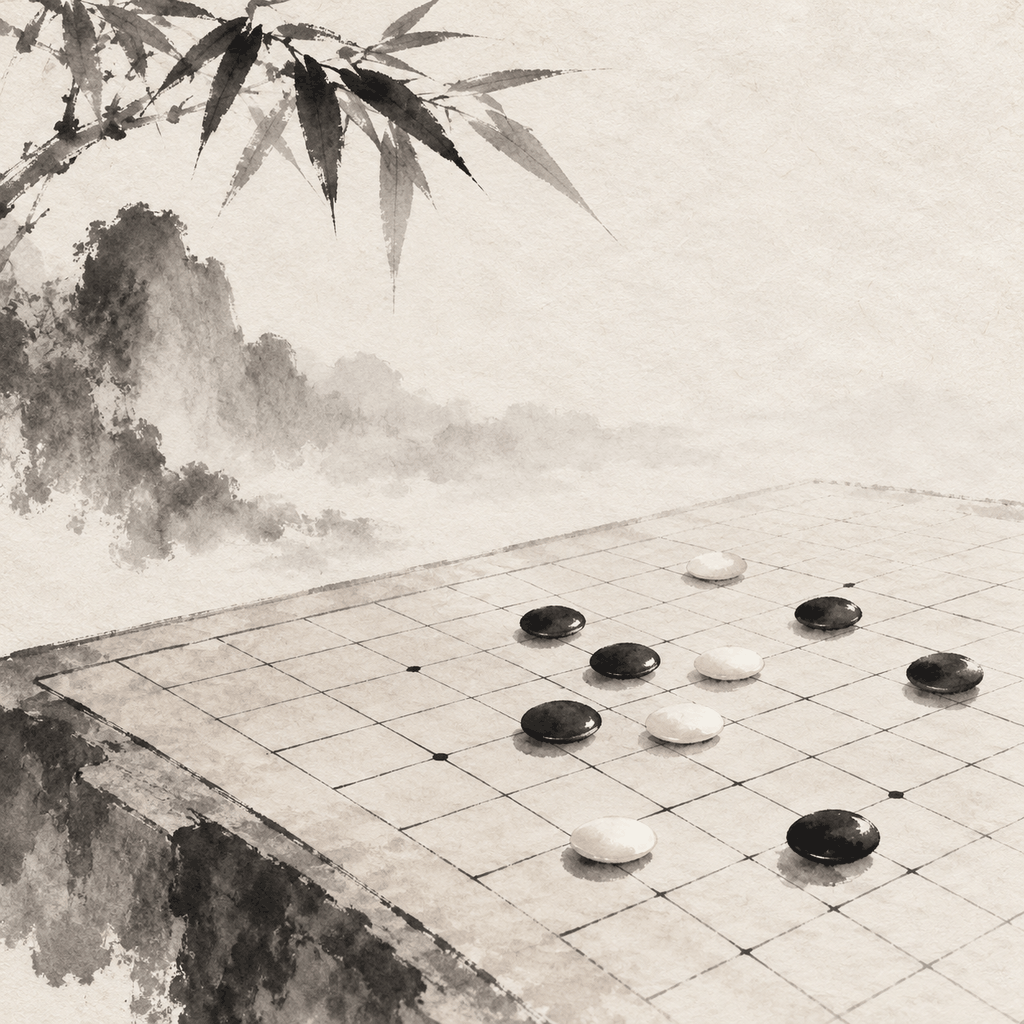
At a dinner table in Korea, two people lay out a Go board and begin a game of Gomoku with black and white stones. Its grid has 19 lines in each direction—the same board an older relative might use for Go. The first stone goes on tengen, the center point. After that, the questions are how to make five in a row and which moves are forbidden.
A Different Game on the Go Board
Korean omok, a five-in-a-row game, usually uses Go equipment: a 19-line board and black and white stones placed at the intersections. In Go, you count the territory you surround. In omok, the contest turns on five consecutive stones. The equipment is the same, but the shape that wins is different. That makes board size matter in a different way.
The Encyclopedia of Korean Culture describes omok as a folk game played by two people placing Go stones on a Go board’s intersections. The first to make five in a row wins; gaps do not count. Common Korean omok rules add further conditions: the first stone goes on tengen, a double-three is forbidden, and an overline of six or more stones does not win. Before you play, it helps to settle those three points. On the same 19-line board, different rulings on double-threes and overlines can change which moves each player wants to make.
Set that board beside the international rules for Renju, and the difference appears at once: Renju now uses a grid of 15 lines in each direction. The Renju International Federation’s history of the rules puts it plainly. Today the Renju board is limited to 15 lines, but long ago it had 19, like a Go board. The 15-line board was not there from the beginning.
Where the 15-Line Board Came From
Renju developed its own organizations and tournaments in Japan. The Japanese Renju Association was founded in 1918; its Meijin title competition began in 1962 and remains Japan’s largest Renju title event. As for when the board went from 19 lines to 15, the rules history says only that it happened “long ago.” It gives no year. What is clear is that the board changed—and got smaller.
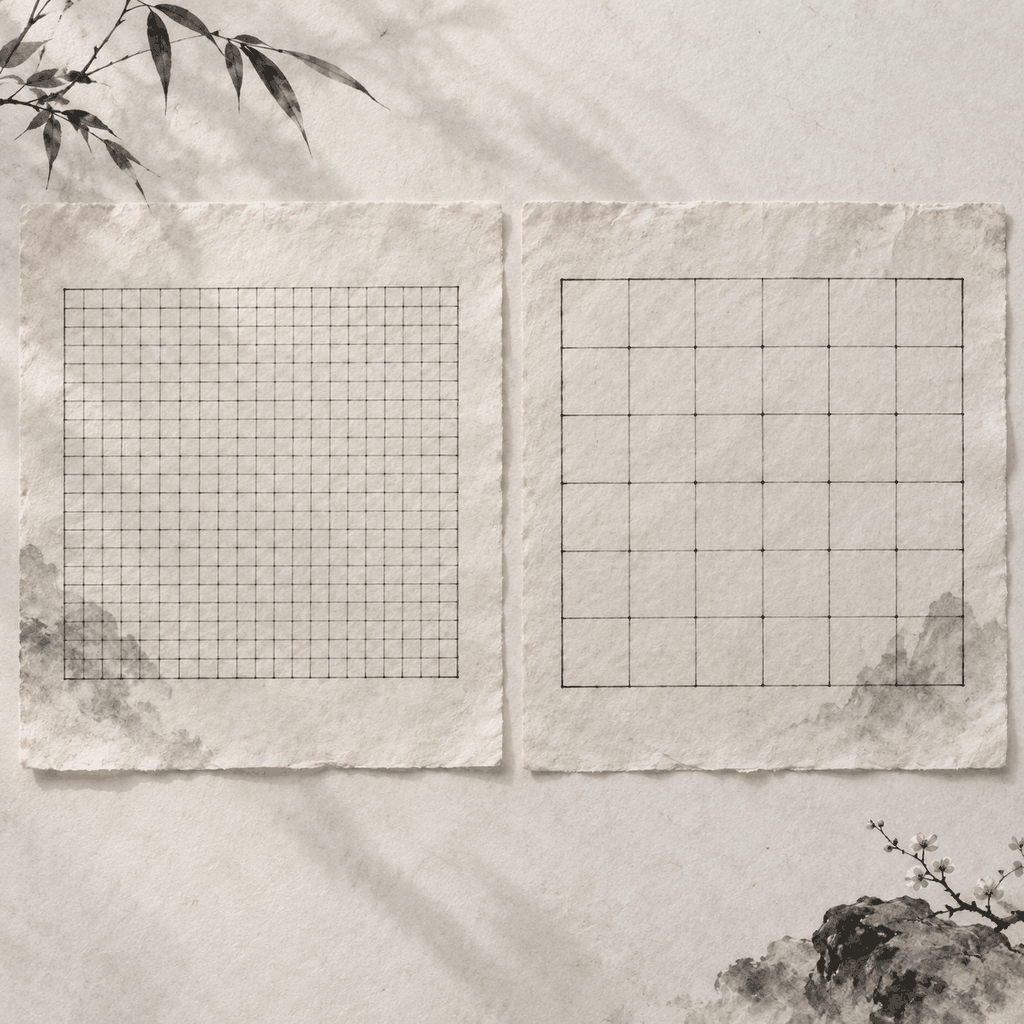
A 15-line board has 15 intersections in each direction, or 225 in all. A 19-line board has 361, an extra 136 places to play. From tengen to any edge, you count seven spaces on the smaller board and nine on the larger one. Both games still require five consecutive stones to win. A smaller board changes the available space and the distance between a developing pattern and the edge.
Suppose Black places three stones near tengen. White must decide which end Black might extend. On a 15-line board, a few moves can carry the contest to the edge; a 19-line board leaves more room to change direction. Shrinking the board lets a local threat reach across more of the game. It also makes the pressure of moving first more important to address in the rules.
What Four More Lines Change
A 19-line board has four more lines than a 15-line board in each direction. Build along a row, and there is farther to extend your stones—and more ground to watch. But a win still takes five adjacent intersections. It is worth keeping those facts separate: a larger board does not change the number of stones needed to win.
Say Black forms an open three to one side of the center, with room to make four at either end. White has to answer, but on a 19-line board may still have space to maintain a pattern on the far side. The same sequence of forcing moves occupies a larger share of a 15-line board. Space affects how much territory a run of threats can hold in check.
A bigger board does not, by itself, solve White’s problem with Black moving first. Black also gains more places to extend, particularly if the rules allow several threats at once. White may struggle to answer them all. Board size determines where an attack can unfold. Whether the first player can repeatedly force a reply depends on the forbidden-move rules.
A win still takes five stones. Board size changes how far a threat can reach.
How Renju Restricts Black
Under the rules published by the Renju International Federation, Black moves first and faces stricter limits: Black cannot make an overline, a double-three or a double-four. An overline by White, by contrast, counts as a win. The players use identical stones, but the legality of a move depends on their color. That is an easy distinction to miss if you are used to less restrictive forms of five-in-a-row.
A double-four is a move that creates two separate threats of four stones at once. Forbidding Black from making one curbs the first player’s ability to present threats that White cannot answer together. An ordinary run of three or four stones is not forbidden.
The finer the restrictions, the more carefully you have to read each new pattern. A beginner seeing Black connect more than five stones might assume the game is over. In Renju, Black’s overline is illegal. Formal games therefore need a referee or an engine that can identify forbidden moves. In a casual game, it is wise to agree beforehand how you will settle a dispute.
What Korean Omok Keeps
Put the two common rule sets side by side, and the contrast is clear. Renju uses a 15-line board and forbids Black’s overlines, double-threes and double-fours. Korean omok commonly uses a 19-line Go board, keeps the double-three prohibition and does not count an overline as a win. A common Korean opening rule also puts the first stone on tengen.
Each arrangement has a cost. A 19-line board lets you use Go equipment as it is, with fewer restrictions to learn. But loosen those restrictions too far, and the first player can build a succession of threats that are hard to answer. A 15-line board draws the contest inward, while stricter forbidden moves for Black help preserve balance. Learning and judging those moves takes more work.
So when you see Gomoku played on a 19-line Go board, you cannot infer the rules from the placement of the stones alone. Ask how double-threes are judged, whether an overline wins and whether double-fours are forbidden. Those questions are usually more useful than debating whether a move was brilliant. The answers determine whether the next stone can be played at all.
Count the Lines Before You Play
Next time you set up a board, count the intersections along an edge: 19 or 15? Nineteen may mean you are using the Go equipment of Korean omok; 15 is a cue to check Renju’s forbidden moves for Black. If the first stone is headed for tengen, confirm the rulings on double-threes and overlines. On a 15-line board, ask about Black’s double-fours and White’s overlines, too. Size gives you a clue. Agreeing on the rules before the first move lets both players read the game the same way.