
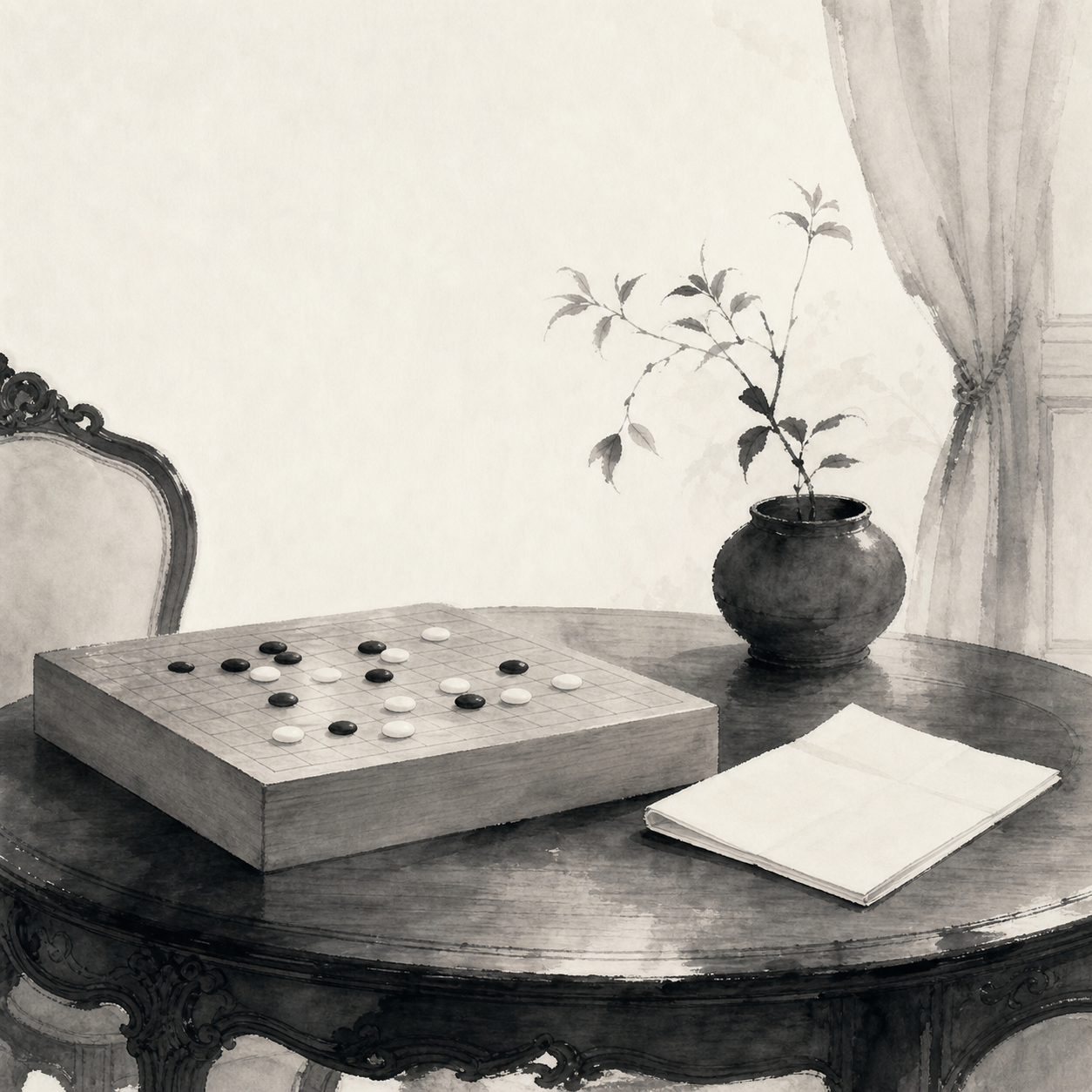
You are leafing through an old English book and find Gomoku written as Go Bang. Your first reaction is probably a pause: is this really the same game? The name, a little loud and a little strange, happens to reveal the trace of a journey. The stones are still black and white; the goal is still five in a row. But by the time the game entered the English parlor, it had acquired a different way of speaking.
The name Go Bang hits the ear first
In English sources, Go Bang had already appeared by the late nineteenth century. Two OED citations are often mentioned: one from the 1886 Cruise of the Marchesa, the other from an 1888 issue of the Pall Mall Gazette. These records cannot tell you how popular the name was, but they do show one thing: it had entered the printed world available to English readers.
Go Bang does not sound like the name of a quiet board game. It has a burst in it, like a door shutting, like a small wooden box dropping onto a table. Perhaps for that reason, it was easier to remember than a stricter transliteration. When a game leaves its original language, its name first becomes pronounceable.
From goban to Go Bang, translation first changed the feel
The usual explanation of Go Bang’s origin is that it emerged through an Anglicized misreading, transcription, and oral reshaping of the Japanese goban, or go-board. There is no need to nail it down as a perfectly straight etymological line. What is more interesting is that the sound English readers heard had already moved one step away from the Japanese original.
The word gomoku, by contrast, comes from the Japanese gomokunarabe. It keeps a more visible Japanese outline and reads like the name of an imported game. Go Bang feels as if it has been placed in an English sitting room: short, loud, with a hint of a title printed on a toy box.
A parlor game needed a name that could start at once
Nineteenth-century English readers encountering an Eastern board game did not necessarily arrive with the patience of rules scholars. If a name was too unfamiliar, the instruction booklet had to do too much work. Go Bang had an obvious advantage: you might not yet know how to win, but you had already remembered it.
This is also the first layer of alteration games often undergo when they travel. The board can remain; the pieces can remain; the objective can remain. The name is adjusted first, into a shape local mouths are willing to say aloud. Translation here is not a dictionary act, but a packaging act.
The name travels first; the rules catch up later.
Spoil Five put five-in-a-row into a British cardboard box
Look a little later, and the V&A’s collection records a boxed game published by Chad Valley Company Limited: Spoil Five, dated 1920 to 1939. It was not simply Go Bang under another name. The record describes it as a positional game combining cards and pegs.
Its objective is familiar: form a straight line with your own pegs while preventing your opponent from completing one. If you have played Gomoku, you can immediately recognize the skeleton inside. Only the stones have become pegs, the board has become a component in a retail box, and the game has been rewritten into a form better suited to the family table.
The name Spoil Five is deft, and very British. It writes victory as five in a row and builds defense into the word spoil. Before you have even read the rules, you know this game will not be only about placing your own five pieces; you will also have to break up the line your opponent is about to finish.
Lasker placed Go and Go-Moku in the same book
Edward Lasker’s Go and Go-moku: The Oriental Board Games offers another point of entry. Google Books records the Courier/Dover edition as a 1960 volume of 215 pages; Sensei’s Library further notes that it was originally published by Alfred A. Knopf in 1934, with the final section devoted to Go-Moku.
The title has a strong period flavor. Go and Go-Moku are placed together in one book, side by side as Oriental board games. For an English reader, the more complex game of Go comes first, five-in-a-row second, like a path leading back from deep water into the shallows.
That does not mean Go-Moku was merely an appendage to Go. Its place in the book is more like an accessible side entrance: the board is similar, the materials are similar, but the verdict arrives more quickly. Gomoku has often been understood this way—near Go, yet retaining its own brisk tempo.
One five-in-a-row line, three English destinies
Set these threads beside one another, and three directions appear. Go Bang was a reinvention in sound, a way for English ears to catch the name first. Spoil Five was a reinvention as merchandise, putting five-in-a-row into a box of cardboard, cards, and pegs. Go-Moku was a preservation on the page, allowing readers to still glimpse its Japanese source.
None of them fully displaced the others. One name entered newspapers, one version entered toy boxes, one term entered books on board games. Gomoku’s silhouette in the English-speaking world is assembled precisely from these traces that do not quite overlap.
Five in a row is short; the journey is long.
Looking at Go Bang today, don’t laugh too quickly
Go Bang sounds a little comic today. But the value of old names often lies in that ill-fitting quality. It tells you that when a game first arrives in another language, it does not immediately receive a stable, elegant, standardized name.
The rules of Gomoku look plain enough: horizontal, vertical, diagonal, five stones in a row. But its names, boxes, and instruction sheets are not plain at all. Every renaming is a rearrangement: who will buy it, who will teach it, who will place the first stone at the table after dinner.
The next time you try a game, you might begin by placing the first stone at the center point, then think about the road the name Go Bang traveled. The board is small, but history has a way of appearing slowly from the corners.