
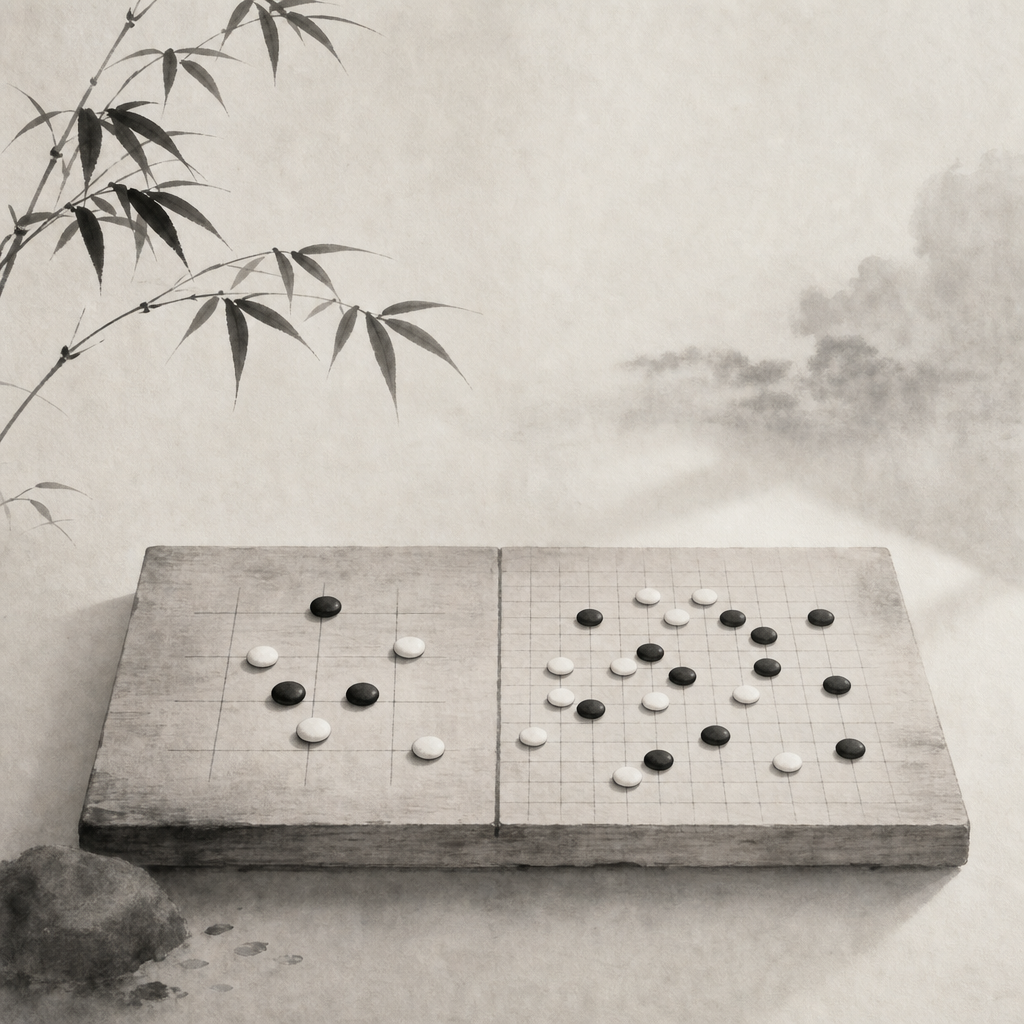
You may only want to learn one black-and-white board game, and still find yourself stuck between Gomoku and Go: one looks intuitive, the other sounds profound; one can end in minutes, the other seems capable of filling an afternoon. Before you ask which is “more advanced,” ask which one fits your patience, your time, and your curiosity right now.
Start with the smaller question: how fast do you want feedback?
If you want to know, in your very first game, why you won or why you lost, Gomoku is usually the friendlier door. The aim is simple: make an unbroken line of five stones horizontally, vertically, or diagonally. The rule is just as clear in this basic introduction to Gomoku, and it asks for almost no prior knowledge.
Go is not especially hard to enter, but its feedback arrives more slowly. You have to understand liberties, captures, territory, endgame counting; you also have to accept positions that make no sense now and only explain themselves a dozen moves later. It is beautiful. It also asks for more patience.
Five differences that matter: rules, curve, fit, time, board
Put the two games on the same table and the choice becomes easier to see. This is not a ranking, only a breakdown of the beginner’s experience. The stones may look the same; the feel under your hand is entirely different.
- Rule complexity: Gomoku’s core rule fits in one sentence: connect five and you win. Go also involves liberties, captures, illegal points, ko fights, and final scoring.
- Learning curve: Gomoku quickly brings you to open threes, four-in-a-row threats, and defensive choices. In your first games of Go, you may spend a long time wondering, “Where exactly did I fall behind?”
- Who it suits: Gomoku suits you if you want quick games and practice reading direction, connection, and threats. Go suits you if you want to spend years sharpening spatial judgment, trade-offs, and whole-board planning.
- Game length: A game of Gomoku often takes a few minutes to fifteen. A 19×19 game of Go can run much longer; 9×9 and 13×13 boards are better for beginners and faster play.
- Board scale: Gomoku is commonly played on a 15×15 board. Go’s standard board is 19×19, though beginners often use 9×9 or 13×13 to reduce the load.
This is why I would not recommend forcing yourself to learn Go first on a full 19×19 board. The rules of Go will tell you that 19×19 is the standard board, but a beginner’s experience does not have to begin with the standard. Letting your eyes keep up matters more than trying to be complete from move one.
The pleasure of starting with Gomoku: every move is close to the result
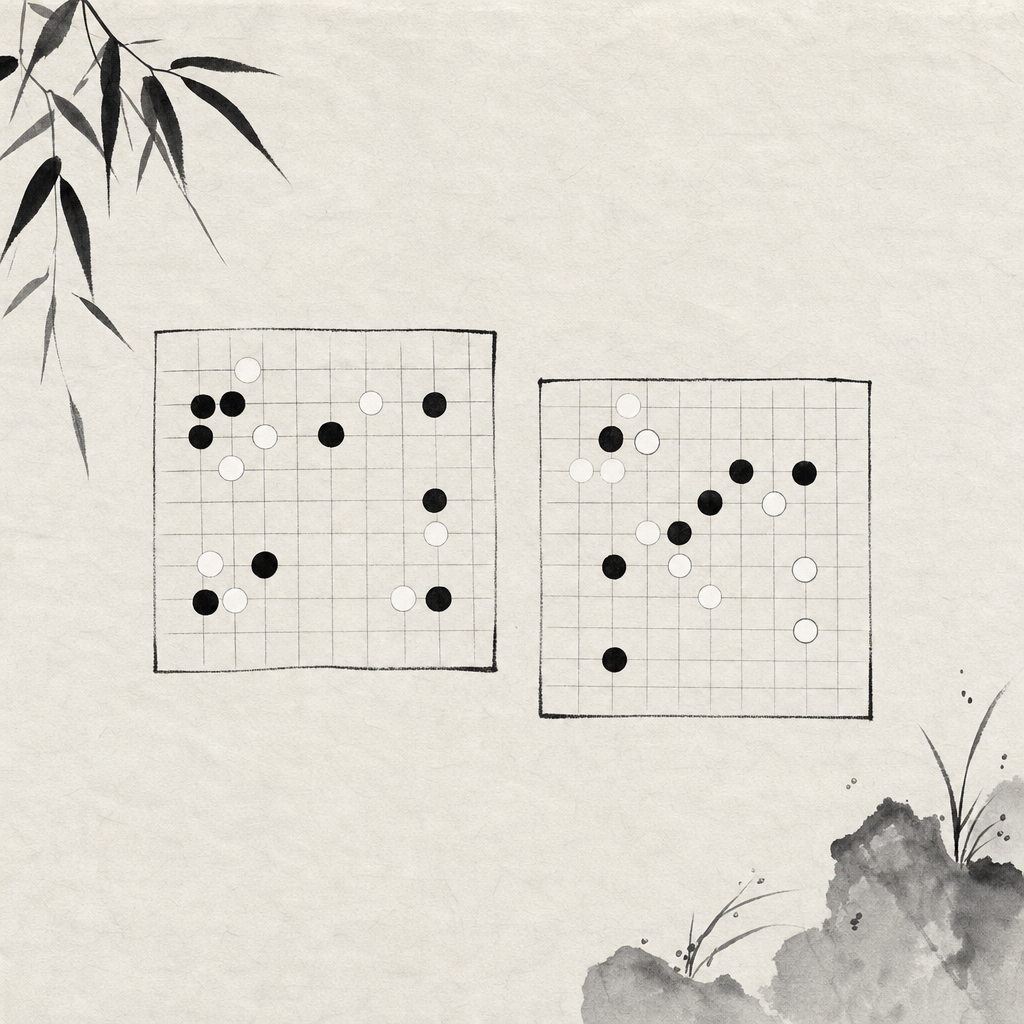
What makes Gomoku so welcoming is how quickly it pushes you into concrete questions. Can this become an open three? Does your opponent’s four-in-a-row have to be blocked? Can your next move create threats in two directions at once?
Say you place a stone near tengen, and your opponent does not immediately follow the line. Very soon, you can see the pattern lengthening. Three stones across, two on a diagonal, an empty point left on the other side: the position tells you plainly that the next move is not casual. You are fighting for initiative.
Gomoku first teaches you to see threats.
The hard part of starting with Go: the answer is often not in front of you
Go can also begin quickly, but it does not always explain itself quickly. You may think capturing three stones means profit, only to discover that your opponent has built thickness outside. You may think a safe corner is enough, only to realize at the count that the whole center is gone.
That is not a flaw. Go’s refinement lies in long-range cause and effect. The value of a move often appears many moves later. If you like that slow unfolding of judgment, the game can hold you for a long time.
Your time budget may decide whether you keep playing
Many people do not dislike Go; they simply have not left enough time for it. The 19×19 board is vast. The opening, contact fights, middle game, and endgame all require patience. Even a beginner’s chaotic game can drag on.
Gomoku feels more like a modern, quiet, carefully polished practice ground. You can finish a game quickly, review one or two key moments, and start again. Beauty is reason enough, but clear feedback is what makes you return.
If you are one of these three people, the choice gets easier
If you are a complete beginner and want to build a basic feel for board games, Gomoku is like the first small wooden plank: direction, connection, blocking, initiative are all within reach. You do not have to memorize many concepts before you can learn from winning and losing.
If you already enjoy slow games and can accept spending a long time reviewing after a game ends, Go may suit you better. It is not in a hurry to give you answers. It gradually trains you to see the whole board, calculate trade-offs, and judge strength and weakness.
Do not pack Renju and Go into the first lesson
Gomoku also has a stricter branch: Renju. It adds balancing rules for Black, including forbidden moves, double-three, double-four, and overline; the rules of the Renju International Federation spell out these limits in detail.
But that should not be lesson one. At the beginning, first understand why an open three is dangerous, why a double-three is strong, and why play near tengen develops so easily. Once you can see threats reliably, then learn forbidden moves; otherwise the rules will feel like weight.
Starting well is not choosing the harder game. It is choosing the one you will come back to.
So which game is better for a beginner? If you want faster feedback, start with Gomoku. If you are ready to cultivate a much larger space slowly, Go is worth beginning. The quietest answer is to try a few games of each and let your hands decide.