
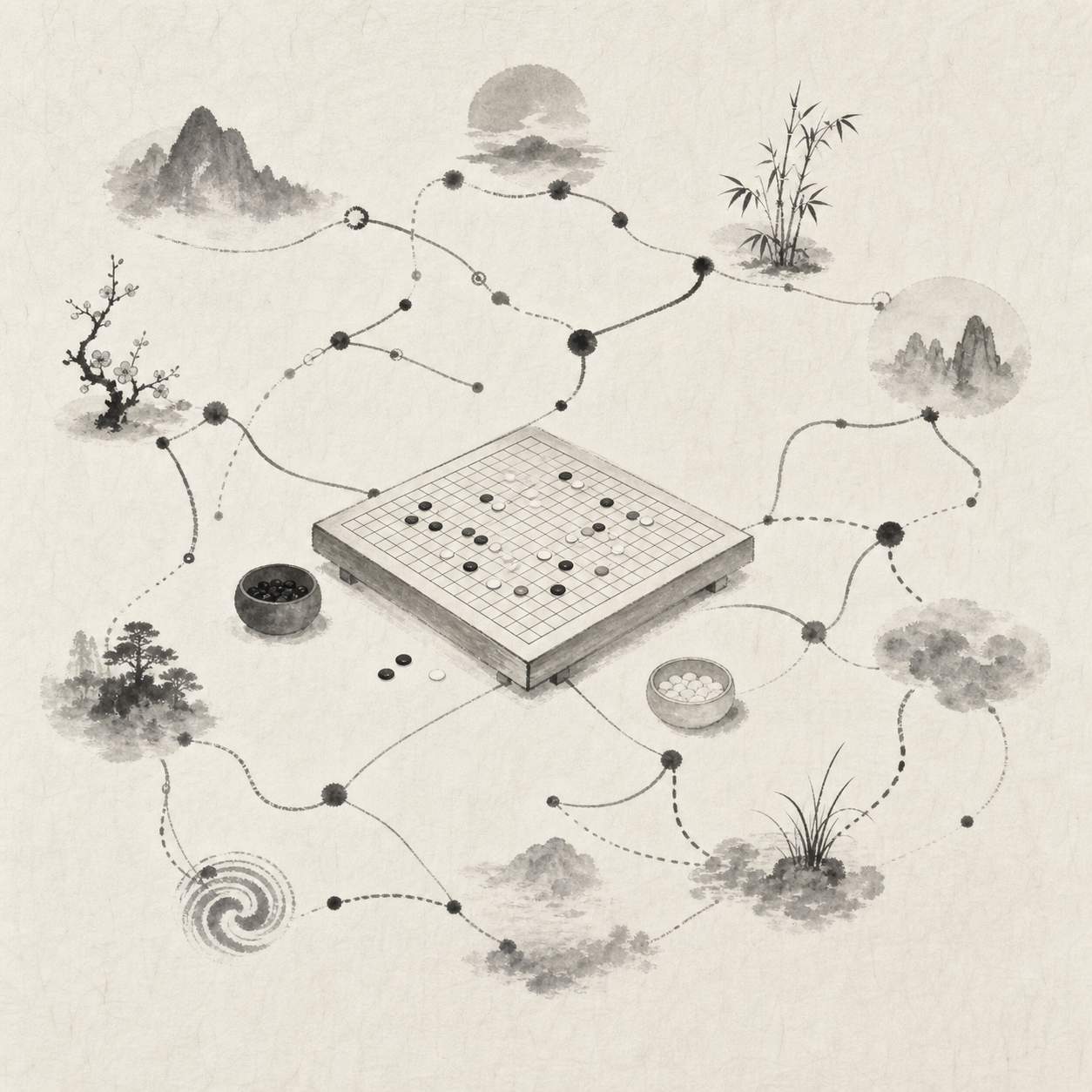
When you try to pin down a single Renju rule, the links can quickly pull you sideways: association pages, old news items, game databases, board tools. Each tells you something. None, by itself, gives you the whole picture. It helps to think differently. Treat public resources as a map. First locate the rules. Then see where the organizations, tournaments, game records, and tools sit around them.
A good entrance to that map is RenjuNet’s Websites page. It gathers international bodies, national associations, online play, downloadable tools, news, and rating links onto one plain page. It is modest, but useful as a first index.
Start with the board
When you read Renju material, the first step is to steady the board itself. The RIF international Renju rules are precise: the board has 15 vertical lines and 15 horizontal lines, making 225 intersections, with 5 reference points. The board color must also be distinct from the colors of the stones.
Those details can look elementary. In practice, they shape how you read diagrams. Someone mentions a double-three near the seventh line. Someone else marks an exchange around tengen. Without a stable 15-line board in your head, the variations scatter into fragments.
The rules page also defines row, unbroken row, five in a row, overline, four, straight four, three, double-four, and double-three. What is often called a forbidden move has to be read inside those definitions, especially the restrictions on Black’s overline, double-four, and double-three.
Treat terms as road signs
Terms are least useful when you only memorize their names. An open three is not just “something that can become a four later.” You have to see whether both ends still have space, and whether the next move creates an immediate threat. Read the rule definition with a board diagram, and the term lands on actual intersections.
A concrete position helps. After Black plays near tengen, suppose one move creates two open threes at once. A beginner may feel pleased: the position looks stronger. The rules ask you to look again. That move may be Black’s double-three forbidden move.
Rules are the map’s scale
Once you have that, game records and commentary become steadier reading. You stop asking only, “Is this move strong?” You first ask what shape it creates, whether it is constrained by forbidden-move rules, and whether White has a single necessary defense.
Associations show where sources come from
RenjuNet’s Websites page lists the Renju International Federation, along with organization links for Japan, Chinese Taipei, the Czech Republic, Korea, Poland, Turkey, Ukraine, and other countries and regions. Its value is that it helps you judge where a source comes from.
If an article discusses tournament rules, first see whether it points to the RIF or a relevant association. If a game record comes from a local event, the association page can often lead you to the original notice, schedule, or player information. When the source is clear, there is one less layer of guessing.
News and ratings provide the timeline
If you read only the rules page, Renju can seem frozen inside a fixed text. The same RenjuNet page also points to RenjuNews, Renju Rating, Renju Portal, and related entries. These are closer to a timeline: who is playing, which events have just ended, which names keep appearing.
Ratings cannot tell you whether a move is correct. They can tell you whose games to study first. If a player appears for years in high-level events and rating lists, that player’s opening choices, defensive rhythm, and handling of forbidden moves are worth reviewing on their own.
The Wikipedia overview of Renju is useful background reading. It explains that Renju developed from Gomoku, uses forbidden moves and opening rules to limit Black’s advantage, and also mentions world championships and computer Renju. Treat it as a guide. For exact rules, return to the RIF.
Databases turn the map into routes
Once you know the terms and the tournament entrances, it makes sense to move into game records, databases, and lesson material. RenjuNet points to resources such as GomokuWorld, Lijing Renju Classroom, and Renju Note. These are better for narrower questions: whether an opening is common, or why a particular defensive point was chosen.
When I search game records, I start with a small question. For example: after Black’s third move near tengen, how does White avoid giving Black a double-three opportunity? In each game, record only one defensive choice. Ten games read this way will leave more trace than a hundred games browsed without purpose.
Board tools put judgment back in your hands
Online boards and downloadable tools sit near the practice area of the map. Gomocup, playing platforms, and review boards each have their use. Some are good for testing programs. Some are good for setting out variations. Some are good for saving notes. When you choose a tool, first ask whether it lets you step back, mark points, and save positions easily.
During review, try not to look only at the result. Stop at a key position and ask three questions: Does Black risk a forbidden move? Does White have to defend a straight four? Will the next move create two threats? A tool’s job is to make those questions appear again and again.
If you simply want to set out a quiet game, WUZIQI can also serve as a lightweight board. After you finish checking the resources, return to the board and play that move yourself. Touch and rhythm help you remember the point.
Turn one link into your own route
The abundance of public material does not mean you have to read everything at once. A steadier route is this: use the rules page to set the coordinates, association pages to locate sources, news and ratings for the timeline, databases for samples, and board tools for verification. Let each stop answer one question.
The next time you meet an unfamiliar variation, start with the smallest doubt: Does this move create an open three? Is Black limited by the forbidden-move rules? Where have similar positions appeared in game records? Follow those three questions, and the resources stop being a pile of links. Look up one game. Then set it out once yourself.