
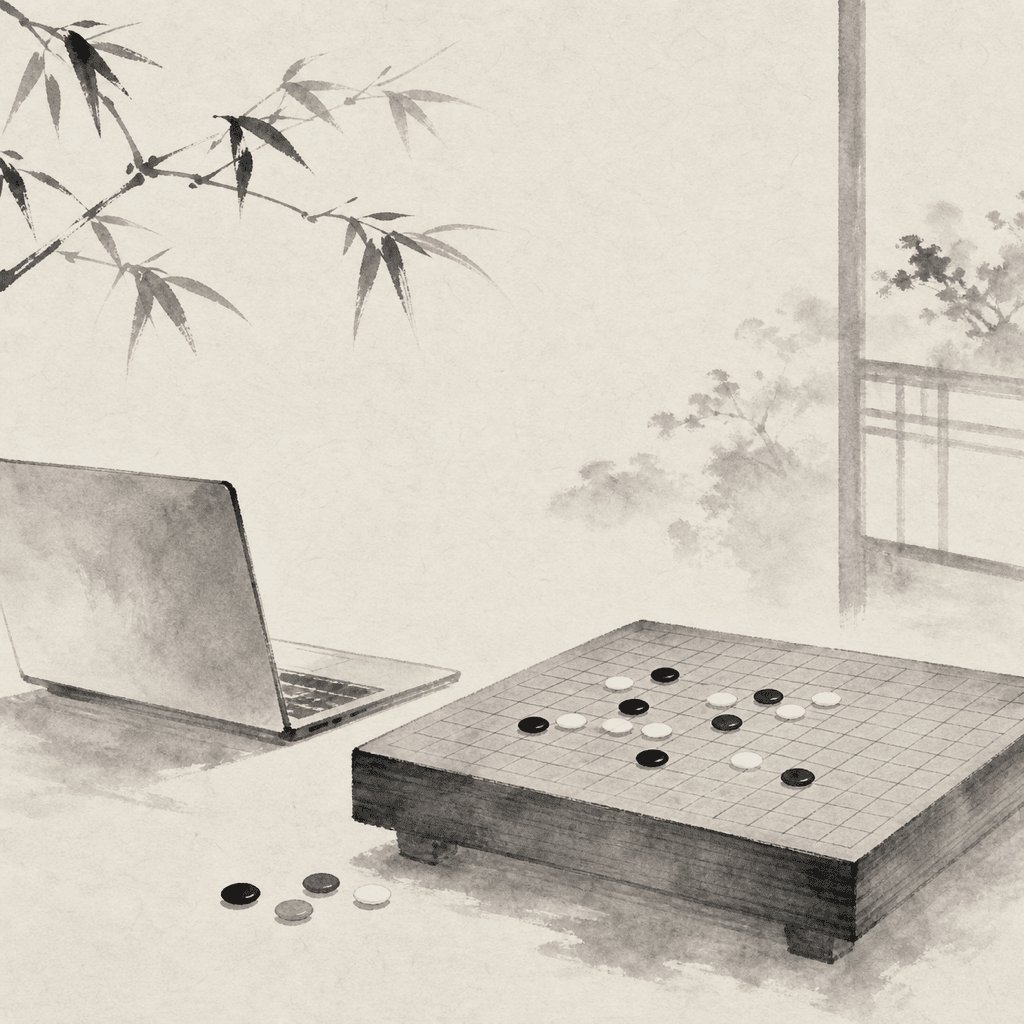
You may already have seen the registration notice and still not know where to begin: online, Swiss system, Taraguchi-10. Put together, the words feel like a position just after move five. The 2026 World Renju and Gomoku Youth Cup will be held online in late July. Rather than only saving the date, you may as well learn the format first. The game will feel calmer, and more exact.
This Youth Cup Is Not Just “Online”
According to the RenjuNet tournament page, the World Renju and Gomoku Youth Cup 2026 is scheduled for late July 2026, with the venue listed as online. The page also gives the rules, system, and organizer information. It is not merely a registration notice; it is a small map of the playing hall.
The first change in an online event is that space disappears. There is no unfamiliar tournament room, no sound of stones being placed at the next table, no slight pressure when an arbiter walks near. But another kind of pressure remains: in your own room, you have to hold your concentration until the last round.
For young players, this is practical. Over-the-board events often test how well you adapt to a setting. Online events test self-management: connection, device, clock, review materials. Any one detail can change the feel of a game.
Taraguchi-10 Pulls the Opening Back From Memory to Choice
The tournament page links its rules to the Taraguchi-10 rule. If this is the first time you have seen the name, start with the central idea: the opening is not just a memorized line. Through the proposal and selection of fifth-move candidates, both sides have to take on judgment again.
In Renju, opening rules are never decorative. The moves after tengen decide whether the shape quickly enters a familiar road. Taraguchi-10 matters because it makes that road less smooth. You cannot simply say, “I know this opening.” You also have to say, “This is where I am willing to take the game.”
An opening is not memorized. It is chosen.
Take a simple scene. If Black wants to push the game toward a strong attack, Black will often look for a rhythm in which shapes keep forming in sequence. White, among the candidate points, may choose a point that better limits the space for an open three. That open three is not a slogan. It is a threat that may come due two or three moves later.
Swiss Pairings Keep Every Round Alive
The system listed on RenjuNet points to a Swiss format. Its virtue is that not everyone has to play everyone else, yet after several rounds, players with similar scores are gradually paired together. One loss does not eliminate you. One win does not make you safe.
That matters especially in a youth event. Meeting a strong player in round one is not the frightening part. The harder question is whether you can recover your rhythm in round two. The result of one game enters the pairing system; the next opponent, in turn, tests what you have just corrected.
The restraint of the Swiss system is that it does not manufacture dramatic elimination. It is more like a net that slowly tightens. In the second half, most of the players around you have scores close to yours, and the details of the game become increasingly expensive.
In an Online Hall, Check Order Before Feel
Many people assume that, for an online event, knowing how to play is enough. In fact, the first task is plainer: confirm your account, device, power supply, connection, camera or supervision requirements, and the way the tournament platform works. The board can be modern. The procedure cannot be improvised.
The easiest mistakes are often not in the brilliant moves, but in the small things: failing to notice byo-yomi when it is your turn, leaving a review window open, or discovering just before the start that the browser permissions are wrong. In an official game, these little pauses can disturb a position that had been calm.
If a parent is present, it is best to keep help technical. Once the game begins, let the child face the position, the clock, and the mistakes alone. That is worth more than one extra reminder to “watch for the double-three here.”
To Feel Renju’s Tension, Learn the Forbidden Moves
The World Youth Cup is labeled Renju and Gomoku, but once you enter the Renju context, forbidden moves cannot be avoided. Black is restricted by overlines, double-threes, double-fours, and related rules. On the surface, some routes are removed. In practice, the first-player advantage is being polished more finely.
A point that looks like a beautiful attacking move, for instance, may form two open threes at once. For White, that is danger. For Black, under Renju rules, it may be a forbidden move. If you watch only for who connects five first, you will miss the truly tense part of the game.
This is also the subtlety of Taraguchi-10 when it meets the forbidden-move rules. The earlier the opening choice, the clearer the later routes constrained by forbidden moves become. Whether a move is refined is not only a question of whether it is strong now, but whether it will trap its own player ten moves later.
When You Watch, Track Three Things: Opening, Pairings, Time
If you simply want to follow this online cup in late July, you do not need to study every opening pattern at the start. Watch the opening first: do the first moves lead toward central pressure, or toward expansion on the wings? Every shift around tengen reveals something about the players’ temperaments.
Then watch the pairings. In a Swiss event, the table numbers in later rounds often say more than a single result. When players on the same score meet, they tend to be more careful. A player trailing by a point may be more willing to take risks, create a four-three, play a four-in-a-row, or string threats together.
Finally, watch the clock. Online play lacks the face-to-face atmosphere, but byo-yomi makes tension very visible. When a child suddenly slows down in a winning position, it is often not because the win is unclear, but because they are checking for a forbidden move, a counterkill, or an overlooked defense.
Time exposes the real judgment.
For the exact schedule, rely on the RenjuNet tournament page and the Taraguchi-10 rule page. You can mark the date now, then choose one or two games and watch them all the way through. Do not hurry to judge strength. Watch how each choice carries the game to its next layer. In July, try one game.