
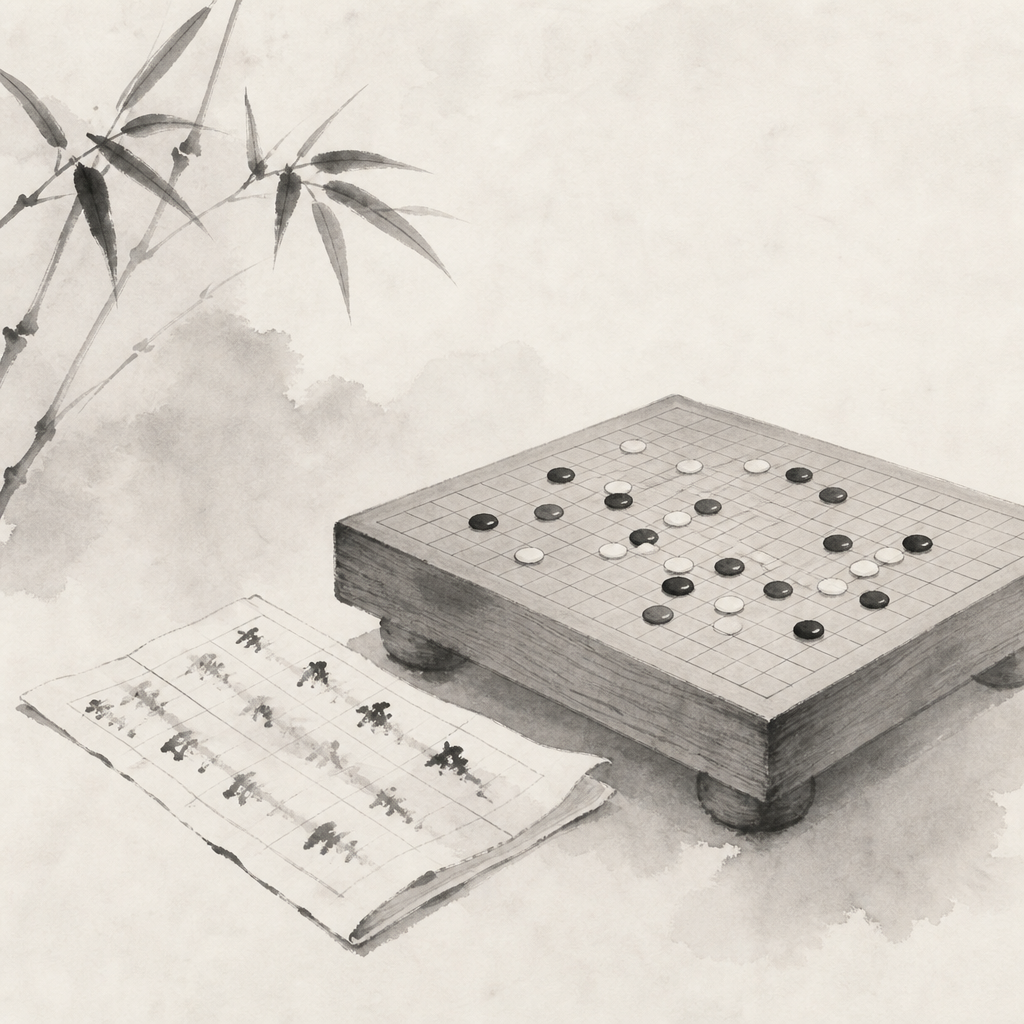
You open a Swiss-system standings table. The top three players all have 5 points, but only one is listed first. Instinct asks: if they are tied, why are they not co-leaders? Start with the Gomoku Ukraine Cup 2026. The answer is not a simple verdict on who is stronger. It is in the way a Swiss system quietly, precisely orders strength of opposition, schedule pressure, and fine margins.
A tied table first asks who took the heavier road
The Gomoku Ukraine Cup 2026 was held in Ivano-Frankivsk, Ukraine. It used Gomoku Swap2 rules and a Swiss format, with a time control of 20 minutes plus 30 seconds per move. Fifteen players took part, and 49 games were recorded.
The striking detail at the top is not just the champion’s name, but the fact that the first three players all finished on 5 points: Yuri Verholiak, Bohdan Ostrovskyi, and Dmytro Skrypnyk. Yuri Verholiak was placed first on tiebreaks.
A table like this has a particular feel. It is not as cleanly decisive as a knockout bracket, and not as even-handed as a round robin, where everyone faces the same field. It is more like a route map refined round by round: the same score, but not the same road.
The Swiss system keeps pairing nearby scores
A Swiss system is not a round robin in which everyone plays everyone else. It usually pairs players with similar scores in the next round: if you keep winning, you are more likely to meet others who are winning; if you lose, you are more likely to fall into another band of similar scores.
So the same 5 points can carry very different histories. One player may have reached the top boards early and absorbed round after round of high-score pressure. Another may have stumbled in the middle and climbed back from a lower band. The finish is the same. The slope is not.
That is part of the format’s appeal. It does not pretend the ground is perfectly level. But it tries to preserve information: whom you faced, how many points they later scored, and what kind of pressure surrounded your wins and losses.
A tie is not the end of the question. It is the beginning.
Tiebreaks are not mysticism. They measure opposition
The first common way to separate tied players is to look at the overall results of their opponents. The simplest version is this: if you reached 5 points by playing opponents who also went on to score highly, then your 5 points weigh more.
This is not an excuse being made for the winner. It is a way to fill a natural gap in the Swiss system. With only 15 players, not everyone can play everyone else. You and another 5-point player may have shared only part of your opposition.
On the board, the idea is even easier to feel. Winning a game in which your opponent, playing second, had to defend against an open three again and again, and winning a game in which your opponent collapsed early on the edge, both give you 1 point. But in the standings’ afterlife, those games are not entirely silent.
A three-way tie is not always solved by head-to-head results
Many people look first for direct encounters: A beat B, so A should be ahead. The instinct is natural, and often useful. But with three tied players, head-to-head results can form a circle: A beats B, B beats C, and C beats A.
Even without a circle, the direct meeting may not exist. In a Swiss event, two players who finish on the same score may never have faced each other. They are compared on the same table through their separate chains of opponents.
So tiebreaks are not replacing the games themselves. They are answering a different question: when the games have not produced a single clear answer, what else does the schedule tell you?
Compared with a round robin, Swiss rewards the weight of the path
Another table from the same week helps calibrate the feeling. The RenjuNet Youth World qualifying tournament 2026 Group F was held in Anji, China. It used Taraguchi-10 and a single round-robin format.
In that table, Fan Xuanzuo finished first with 6.5 points, followed by Lei Juan with 5 and Song Xiaoying with 4.5. The advantage of a round robin is clarity: everyone faces the same group, so the comparison is more direct.
The Swiss system offers something else. With a larger field and limited rounds, it brings high scorers together more quickly, while giving lower scorers games against opponents near their own score. It gives up a little neatness for a more efficient competition.
A tied table also reveals steadiness beyond one game
In Gomoku, a single game can turn on one shape: an unseen double-three, a premature four-in-a-row, an ignored extension near tengen. One game is sharp. A standings table moves more slowly.
Swiss tiebreaks work in that slower register. They will not tell you whether a particular move was best. But they do record the density of opposition through which you kept your score. Staying upright for several rounds in the high-score band is itself a form of steadiness.
So when I read a tied table, I try to be less impatient about whether someone got lucky, and more patient with the route. A ranking is not a sentence handed down. It is more like a board polished again and again.
Next time, read the top three as routes
Return to the Gomoku Ukraine Cup 2026. The three 5-point players were ordered, but that does not mean the second and third players were not strong enough. It means that, on this Swiss-system table, Yuri Verholiak had the stronger tiebreak profile.
If you want to see it more closely, open the original standings and click through the tied players’ games one by one. Look at which round each one met the high scorers, whom they lost to, and whom they beat. After a few minutes, the table stops being a string of numbers and becomes a set of roads.
What the Swiss system sees is the road you traveled.
The next time you see three players tied in a Gomoku event table, do not stop at the total score. Follow the chain of opponents, then return to the board and play out a game. By then, you will understand a little better how a tournament separates players in the fine print.