
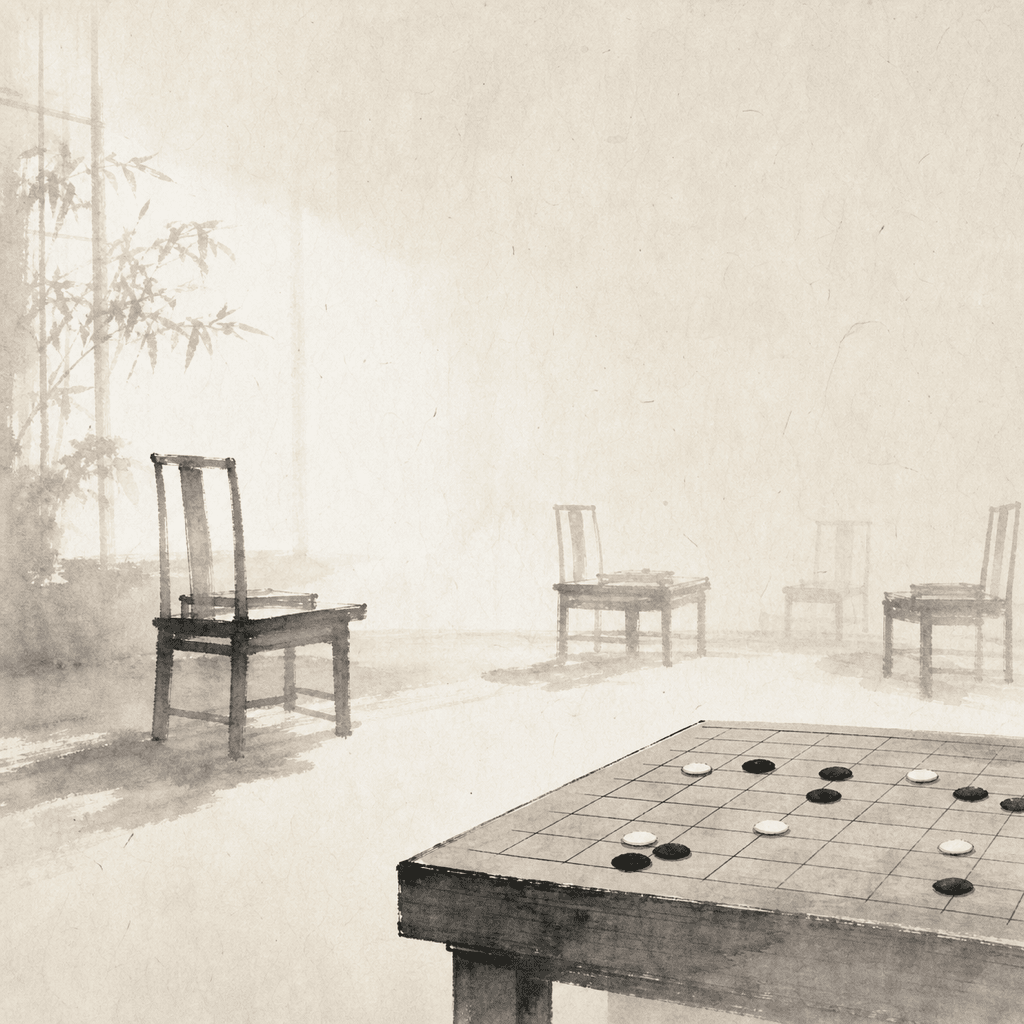
When you watch a game between strong young players, the first ten moves can look almost quiet. And yet the position may already be leaning one way. At this World Youth Renju Championship in Dalian, the answer is not only in who won. It is also in the way Taraguchi-10 breaks opening initiative into smaller decisions. It is quiet, and very precise.
Dalian was about more than the winners
According to the RenjuNet event page, the 2026 World Youth Renju Championship was held in Dalian, China, from July 5 to 9. The opening rule was Taraguchi-10, and the event was listed as a RIF Title Competition. The format was a mixed system, with a time control of 60 minutes per player plus 30 seconds per move.
The public results are worth recording. In Group A, Ling Shijie finished first with 6 points, followed by Zhao Yun and Heo Jeong-bin, both on 5 points, in second and third. In Group B, Zhong Yuyang took first with 6.5 points, Chen Haoyuan was second with 5.5, and Kang Tingrui third with 5. But this article is more interested in how they entered a game.
Taraguchi-10 turns the opening into a storyboard
In the rule description, a Taraguchi-10 opening begins at tengen. The first stone is placed at the center, followed by several opportunities to swap; after the fourth move, Black may propose ten possible fifth moves.
This is not simply “more choice.” It is closer to taking an opening that might once have arrived in a single rush and cutting it into visible judgments: whether to swap, which shape to accept, whether to push the fifth move toward something sharper. Each step leaves a trace.
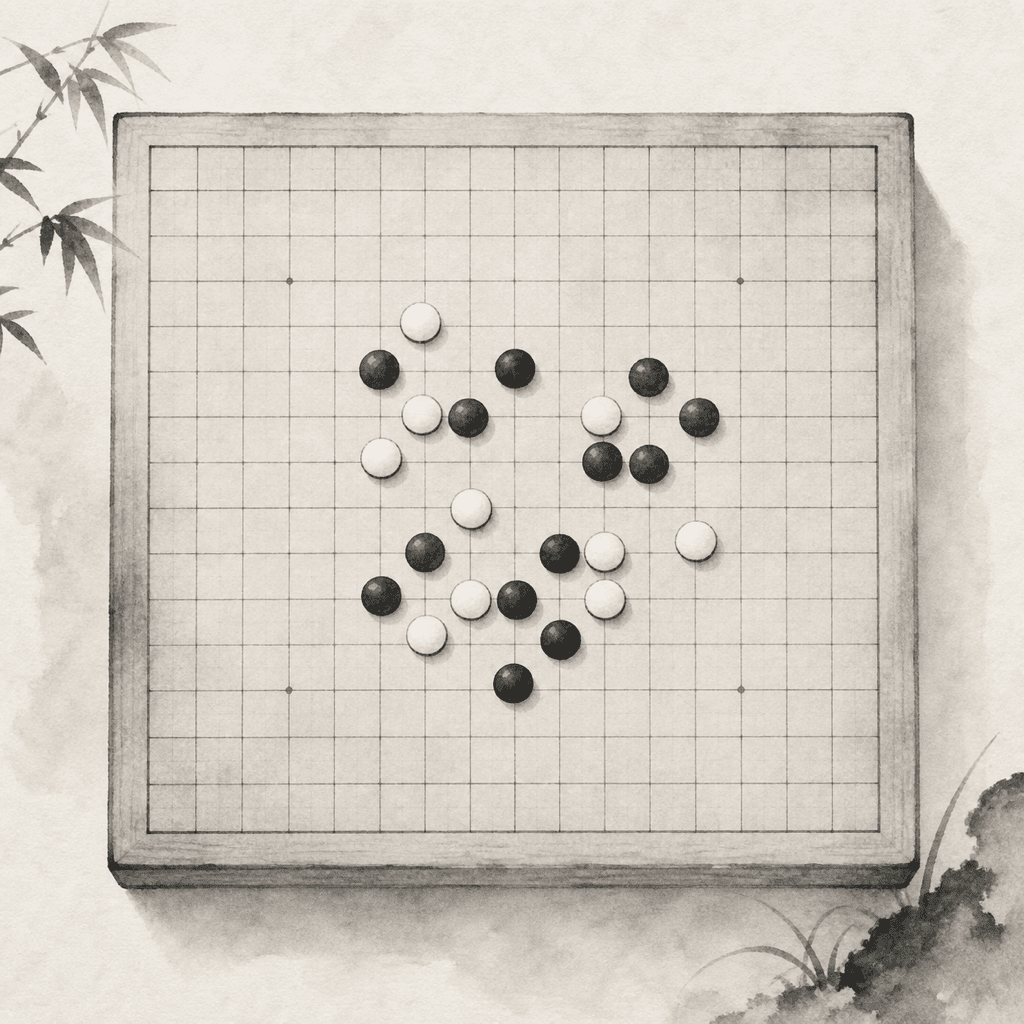
For spectators, that storyboard is helpful. You do not have to understand every pattern at once. You only need to ask one question: after this move, who is more willing to keep going in the current direction? The answer often appears before the evaluation does.
A good opening makes the choices clear
Ten fifth moves test taste and restraint
The most conspicuous feature of Taraguchi-10 is that, at a specific stage, Black offers ten candidates for the fifth move. The number sounds large, but it does not encourage showmanship. On the contrary, those ten points expose a player’s preferences in shape.
Some fifth moves push the game toward early contact, with the shadows of open threes and four-in-a-row threats appearing almost immediately. Others leave more empty space, asking both sides to fight first for direction rather than calculation. What is valuable in a youth event is that young players must stay calm inside that choice.
If you usually play free opening, you may treat the fifth move as a search for the “strongest point.” In a Renju context, the better question is: will this point bring later forbidden moves, double-three risks, and the tempo of initiative into the game all at once? A point that looks elegant may also be a hidden nail.
The youth section shows style taking shape
Youth tournaments are easily written as lists of future stars. That is lively enough, but it misses a layer of texture. The most interesting part is how, under the same rules, a player gradually reveals the kind of chess they play.
Faced with the same swap choices, one player prefers to preserve complexity while another grinds the position into a clearer structure. Faced with the same ten fifth moves, one seeks initiative while another first seeks a position that is not bad. These differences exist in adult sections too. In youth play, they are simply more transparent.
So Dalian was not an isolated news item. It was more like a polished sample, showing where modern Renju training has moved: not toward memorizing more variations, but toward knowing, before the variations appear, what kind of position you are willing to bear.
When you watch or review, start with three things
If you want to learn from these games, you do not need to calculate every move to the end. In the opening, watch three things first: where the swaps happen, how the fifth-move candidates are distributed, and on which move the two sides make their first real contact.
- Swap points: They show whether both sides accept the current structure, and who is more willing to take on the later complexity.
- The fifth move: Do not look only at how far it is from the center. Look at whether it makes routes to open threes, double-threes, and four-in-a-row threats appear early.
- First contact: If contact comes too early, the game turns toward calculation; if it comes later, directional sense and shape judgment matter more.
These three things are simple, but they can turn a game from an unreadable professional record into a chain of choices you can follow. You will notice that strong players are not astonishing on every move. They simply rarely let their choices get dirty.
Beyond results, rules shape a tournament’s mood
A time control of 60 minutes plus 30 seconds per move gives players time to enter the details of the opening. It does not amplify instinct the way blitz does, and it does not press every branch into a research problem the way very long time controls can. It gives young players a space that is modern enough, and restrained enough.
That is what makes the meeting of Taraguchi-10 and a youth championship interesting. The rules do not play the moves for the players, but they keep asking them to account for themselves: do you want sharpness or stability; do you want initiative now, or do you wait for the opponent to reveal a direction first?
When the rules are quiet, style speaks
Turn a news game into your own opening lesson
Tournament news passes quickly. The list of champions remains on the page. What is more useful for an ordinary player is to treat the Dalian youth event as an opening lesson: watch how young players choose shapes within the frame of the rules, and notice where you would start to hurry.
Next time you face the early changes after tengen, slow down a little. Do not begin by asking whether there is a forced win. Ask first where this choice is taking the position. Beauty is not always decoration. Sometimes it is the moment judgment becomes clear. Play one game and you will know.