Why is your clock still running after you have set the stone firmly in place? In an over-the-board Renju tournament, letting go of the stone and completing the timed move can be two adjacent but distinct moments. First learn the difference, then practice placing, releasing and pressing the clock with the same hand as one clear sequence.
When the Move Ends—and When Its Timing Does
Article 6 of the international Renju rules archived by RenjuNet says that a move ends when the player lets go of the stone. If the player chooses to pass, the move ends with a clear declaration of the pass. For an ordinary move, the decisive moment is when your fingers have completely left the stone.
If the stone has touched an intersection but your fingers are still gripping, pressing or steadying it, the move has not yet ended under Article 6. Only after your fingers have fully withdrawn is the action on the board complete. The clock must still be handed over.
Article 14.4 is narrower. When officials must determine whether a required number of moves was completed within the allotted time, a player's final move counts as complete only when that player stops the clock. This provision serves a specific time-control review. It does not rewrite Article 6's definition of when a player has let go of a stone, nor does it by itself establish that a winning move under a 12-plus-5 control is valid only after the clock is pressed.
Press the Clock With the Same Hand
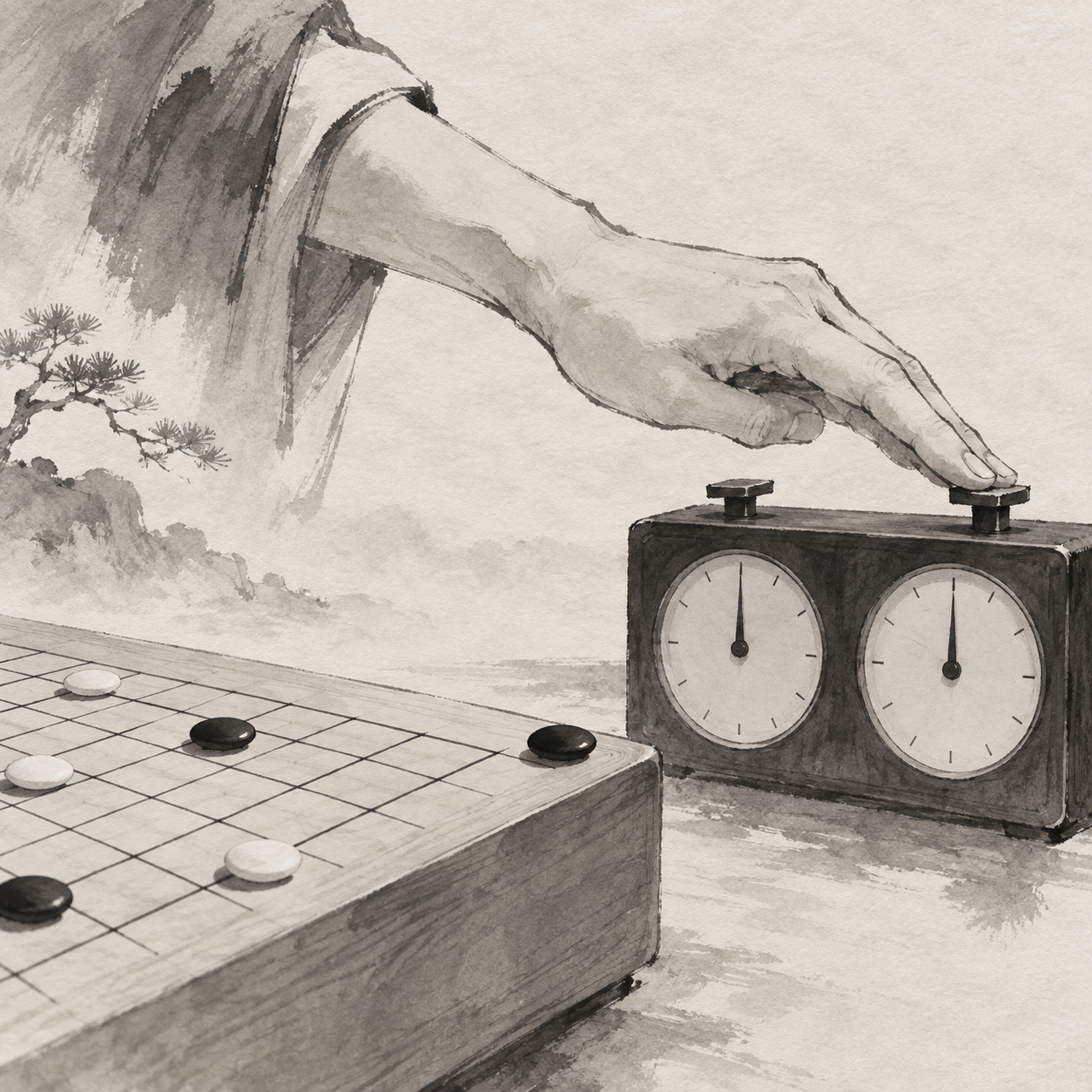
Article 14.3 gives a precise basic sequence: complete the move, then use the same hand that played it to stop your clock and start your opponent's. A typical two-sided tournament clock may switch both sides with a single press, but the exact action depends on the equipment in use.
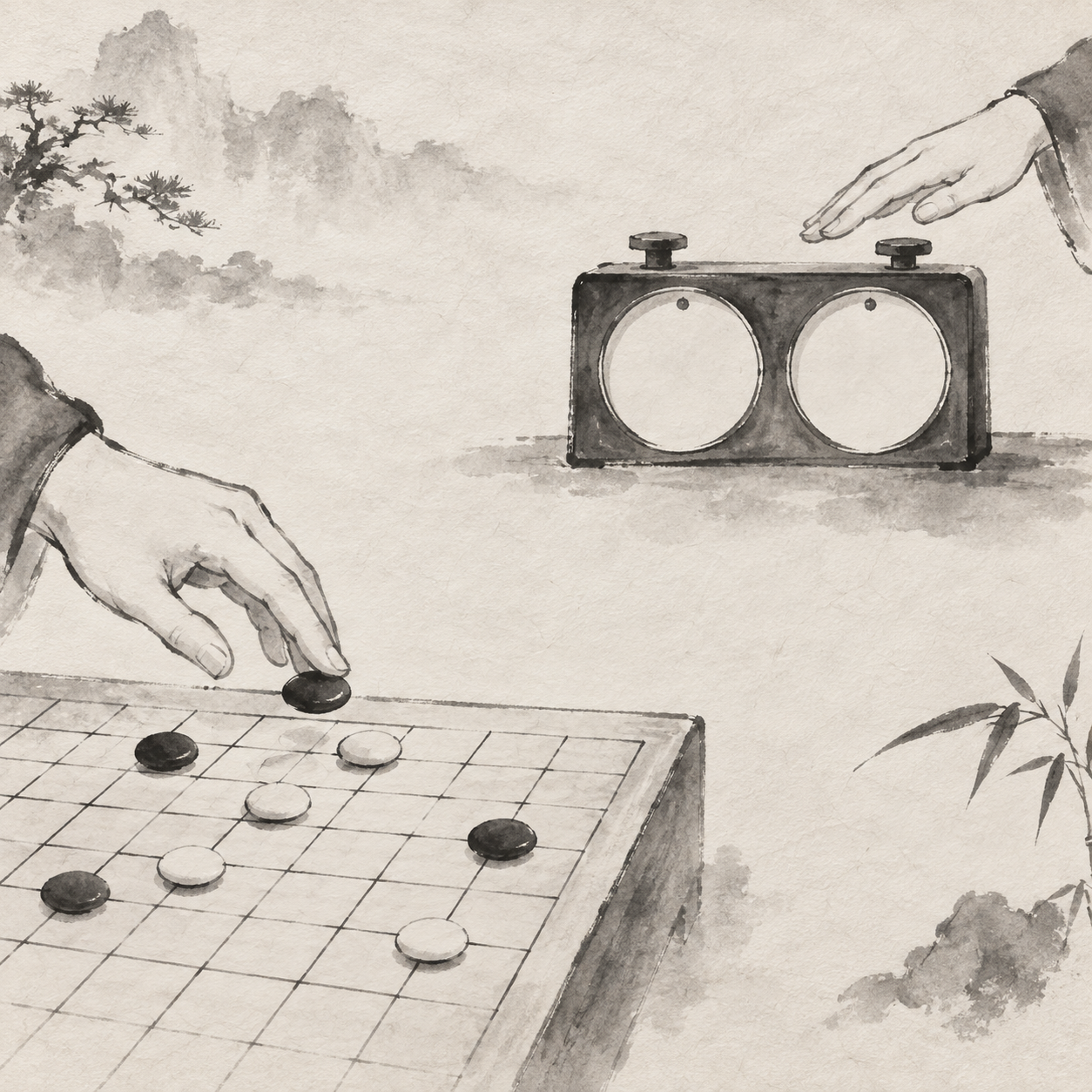
You can break the motion into four steps: pick up the stone, place it on an intersection, let go completely, then move the same hand to your clock button. During practice, keep your other hand away from both board and clock. The boundaries become easier to see, and there is less chance of confusion when both hands approach the equipment.
Press the clock immediately after letting go of the stone. If your hand lingers over the board while you study the position, your own time continues to run; delaying the press may also obstruct your opponent. Your opponent may think at any point, but the transfer of the clock should be prompt and unmistakable.
Twelve Plus Five Is a Tournament Listing
The Upsala Renju Open tournament listing gives the date as September 13, 2026, and the time control as “12min + 5s/move.” That tells you the control listed for this event: 12 minutes plus five seconds per move. It is not a result or an eyewitness account of play.
This notation usually means that each player receives 12 minutes of base time, with a five-second increment for every move. In practice, letting go of the stone determines when the board action ends; pressing the clock stops your timer and transfers the turn's timing to your opponent. The actions should follow one another, but the concepts remain distinct.
The tournament listing does not identify the clock model or its exact settings. Nor does it say whether the first move receives the five-second increment or when the device adds that time. You should not use the listing to calculate the time remaining after the opening move. Before play begins, confirm the clock's display and settings at the venue.
The stone leaves your hand; the clock passes next.
After a Missed Press, Separate Fact From Dispute
If you forget to press the clock, the board and timer briefly fall out of step: you have already let go of the stone, so the move has ended under Article 6, but your clock is still running. Article 14.3 expressly recognizes that a player may forget to stop the clock. The rules will not complete that handoff for you.
Your opponent is not required to remind you. Even if your opponent sees that your clock is still running, nothing requires a warning. Do not build your clock routine around courtesy prompts. Each time your fingers leave the stone, confirm that the same hand has completed the button press.
Simply noticing a missed press does not mean a dispute has already arisen. If either player contests whether the clock was pressed, what the display showed, the time-control status or a related ruling, notify the arbiter or tournament director immediately and follow the event's procedure. Do not reset the clock, add time or agree to replay the move on your own.
Check Which Rules Actually Apply
The rules page cited here says that the text was adopted on May 2, 1996, and slightly amended on May 3, 1998. It is useful for checking the precise scope of Articles 6, 14.3 and 14.4. But it is an archived rules text, not a guarantee that it serves as the current, complete and universally applicable handbook for every modern tournament.
Time controls also vary by event. The Upsala listing gives 12 minutes plus five seconds per move; the 2026 Beijing Renju Championship Group A listing gives 30 minutes plus 15 seconds per move. Both are published event arrangements. Neither supports the conclusion that every tournament in 2026 uses the same clock configuration or identical time-control procedures.
Practice the Three Distinct Moments
For your first drill, ignore the position and repeat the motion on an empty board. Place each stone accurately on an intersection, make sure your fingers have fully withdrawn, then press the clock with the same hand. Slow down enough that an observer can tell whether you are blending any of the three moments together.
Before your next practice game, confirm the time control and clock settings with your opponent or the arbiter. Then focus on the three moments: placing the stone, letting go and pressing the clock. Letting go completes the physical move. When a required number of moves must be reviewed against an allotted time, the clock press may also determine completion under Article 14.4. Keep that distinction clear and your routine will become steadier—and any dispute easier to describe precisely.