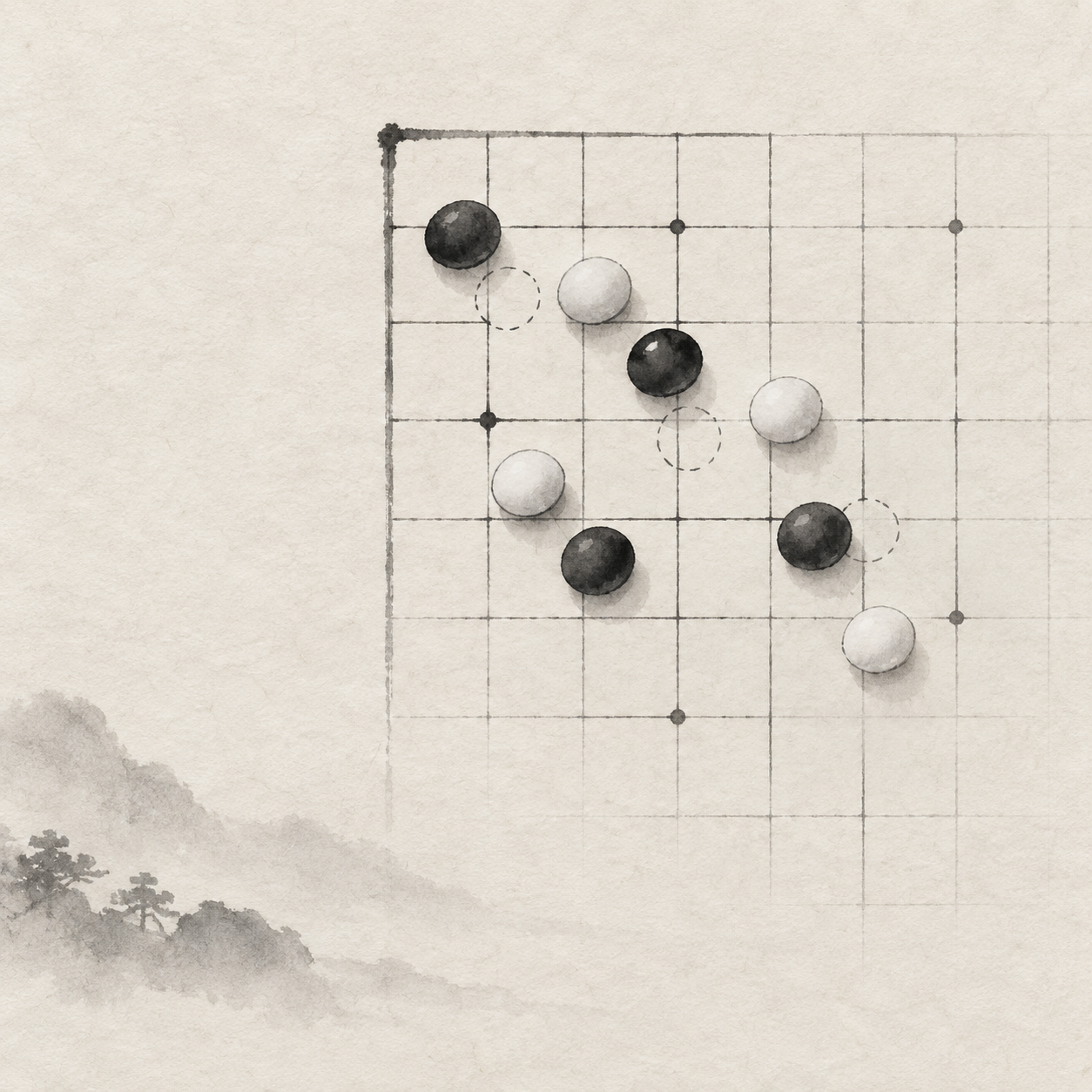
Suppose you lean over the board and your sleeve brushes it, sending several stones away from their intersections. Do not hurriedly replace them from memory, and do not begin arguing over who touched what. Whether the game can continue depends on whether the original position remains identifiable, who caused the displacement, and whether Gomoku or Renju rules apply. Preserve the evidence and ask the referee to oversee reconstruction of the position.
First decide: adjustment or reconstruction?
If a stone is merely askew but still clearly occupies its original intersection, and every stone can be matched unambiguously to its point, the task is usually an adjustment of the stones. Article 5.5 of the RIF Gomoku Rules says that only the player whose clock is running may adjust improperly positioned stones. Article 3.3 of the official Gomoku rules also says that a stone may not be moved elsewhere once released.
Renju uses different language. Article 7 of the RIF Renju Rules allows the player to move to adjust one or more stones that remain on their intersections, but the opponent must be informed before they are touched. In practice, you might say, “I am only straightening this stone.” That is advice for avoiding a misunderstanding, not an additional procedure imposed by the rules.
If stones have left their intersections, two have crowded into the same area, or it is no longer possible to tell directly which points were occupied, the matter becomes a disturbed position. Straightening stones that still sit on identifiable intersections is not the same as losing the connection to their original points. The latter should be restored under the referee’s direction.
At the board: stop touching and call the referee
As soon as you notice the displacement, take both hands away from the board and ask your opponent not to tidy anything. Determining responsibility is the referee’s job. Yours is to describe what you saw, which stones plainly moved, and whose turn it was before the incident. State the facts without assigning blame to yourself or your opponent.
Article 5.9 of the Gomoku Rules says that when an interruption is required, the referee pauses both clocks. A player may stop both clocks and seek assistance only when a referee is needed to address a violation or improper situation. Once both clocks have stopped, the position on the table must be covered, and the referee decides when play resumes. This article governs interruptions and calls for a referee; it does not establish that the clocks remain stopped throughout every reconstruction.
Use the scoresheets, but treat them as evidence
The scoresheet is usually the best place to begin. Article 7 of the Gomoku Rules requires every move to be recorded accurately and legibly when the event regulations call for notation, and the record must remain visible to the referee. Renju Article 13.1 likewise requires both players to record every move. Under Article 13.2, a player with five minutes or less remaining may temporarily cease recording and should complete the record as soon as possible, if feasible, after the time-pressure period ends. Under Article 3.1 of the RIF International Tournament Rules, in the Renju events covered by that document, a player may stop recording only when there is no per-move increment, or the increment is under fifteen seconds, and the player has less than five minutes remaining. None of these conditions may be omitted, and an exception from one ruleset cannot be extended to every event.
In practice, reconstruction can begin with the last position both players accept, replacing the stones move by move. At each step, check the color, intersection, turn number, and any color-swap or proposal information from the opening stage. Under Gomoku Article 10.13, both players must assist the referee in reconstructing the position, but the referee ultimately decides which version to accept.
Recollection can supply additional clues: perhaps one stone blocked a particular four-in-a-row, or the previous move created a threat from a certain direction. Memory, however, is easily shaped by the position now on the board and cannot be treated as a flawless copy. If the players’ accounts conflict, give the differences to the referee rather than taking turns demonstrating competing versions on the board.
Gomoku: read interruption and repair timing separately
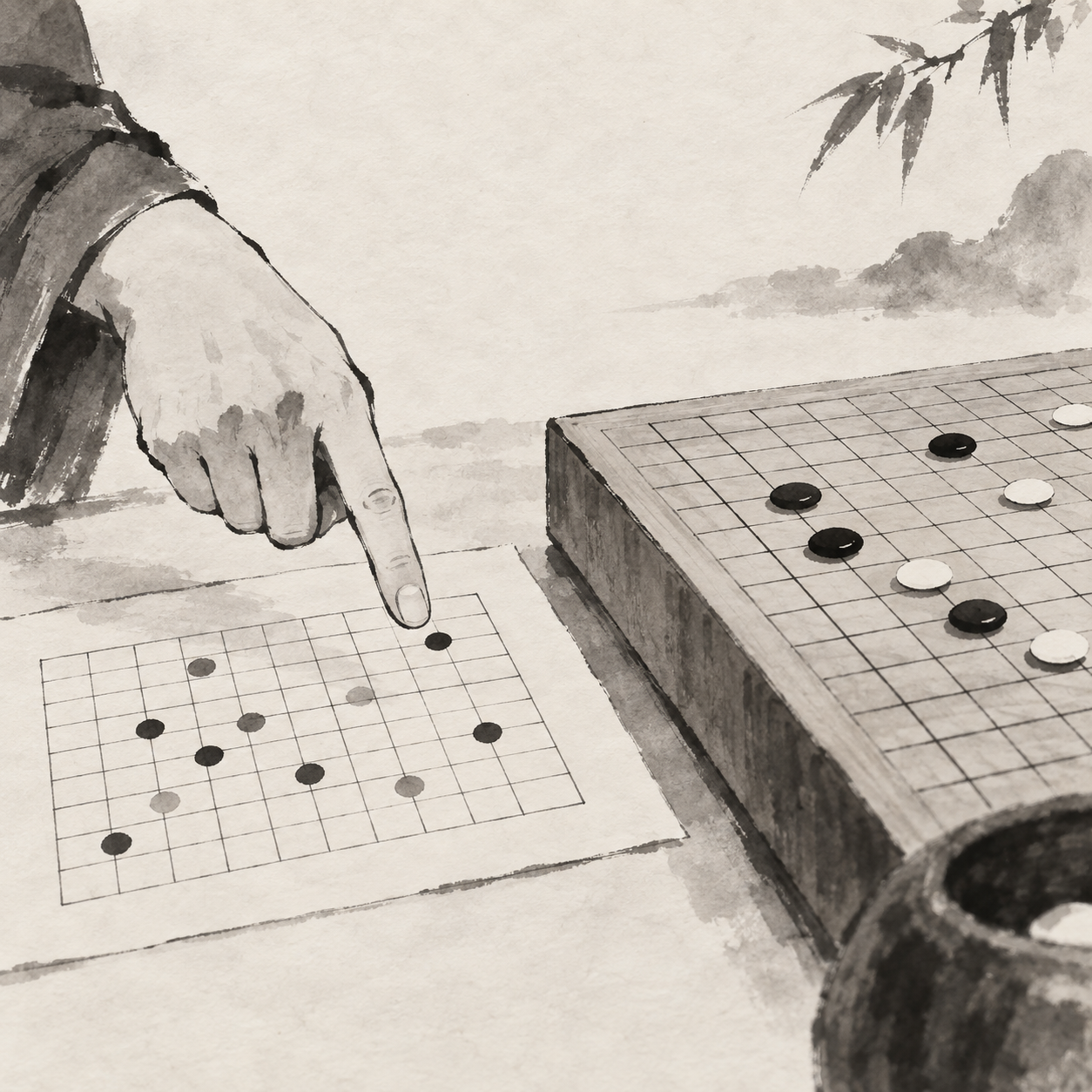
Article 6.2 of the RIF Gomoku Rules is specific: when a position has been disturbed through one player’s fault and can be restored, the repair must be completed while that player’s clock is running. Article 5.9 first governs the temporary interruption, the call for a referee, and the covering of the position. Once responsibility has been established, Article 6.2 determines whose time is used for this repair. It is therefore inaccurate to say that the clocks always remain stopped during reconstruction.
If the position cannot be restored after being disturbed by the responsible player, Article 6.2 says that player loses. If restoration is impossible and neither player is responsible, Article 6.3 says the game is not counted and must be played again. The result is an annulled game and a replay, not a draw. The players should not improvise an agreement to clear the board and continue or simply record a draw.
Responsibility might involve a cuff, a hand, or a stone container, but the disturbance might also result from a struck table or some other outside interference. The direction in which the stones rolled rarely settles the question. The referee must hear both accounts, examine the records, and decide whether restoration is possible. Preserving the scene is therefore more useful than quickly pointing a finger.
Preserve the position first; let the referee decide responsibility.
Renju: similar result, but not the same clock rule
Article 8 of the RIF Renju Rules requires scattered, mistakenly removed, or incorrectly placed stones to be restored to their positions before the incident, after which the game continues. If a player is responsible and the position cannot be reconstructed, that player loses. If reconstruction is impossible and neither player is responsible, the game is annulled and a new one is played. Here too, the result is not a draw.
Renju Article 8 does not contain the Gomoku Article 6.2 instruction to repair the position while the responsible player’s clock is running. The Gomoku timing mechanism therefore cannot simply be imported into Renju. Renju provisions on interruptions and clocks appear separately in Articles 14.6 and 14.7; their application should be determined by the event organizer or referee under the rules governing that competition.
Before play: confirm the rules and keep records usable
The RIF Gomoku Rules govern official RIF competitions, and organizers may also adopt supplementary regulations. A casual gathering described as “five in a row” does not automatically invoke the entire RIF ruleset. Before play, confirm the event discipline, rules edition, notation requirements, clock procedures, and who has final authority. Knowing those details keeps familiar habits from being mistaken for rules when something goes wrong.
Do not take photographs during play without first checking the event’s electronic-device policy. Gomoku Article 10.7 permits an event to restrict or prohibit electronic devices. The RIF International Tournament Rules apply to the Renju international championships listed in that document, and Article 2.2.4 requires electronic devices to remain unused during play and to be switched off before the round begins. If information about the scene needs to be preserved, ask the referee to follow the event procedure rather than reaching for your phone. Before your next game, quietly ask the organizer how you should summon a referee, handle the clocks, and reconstruct the position if stones are displaced.