
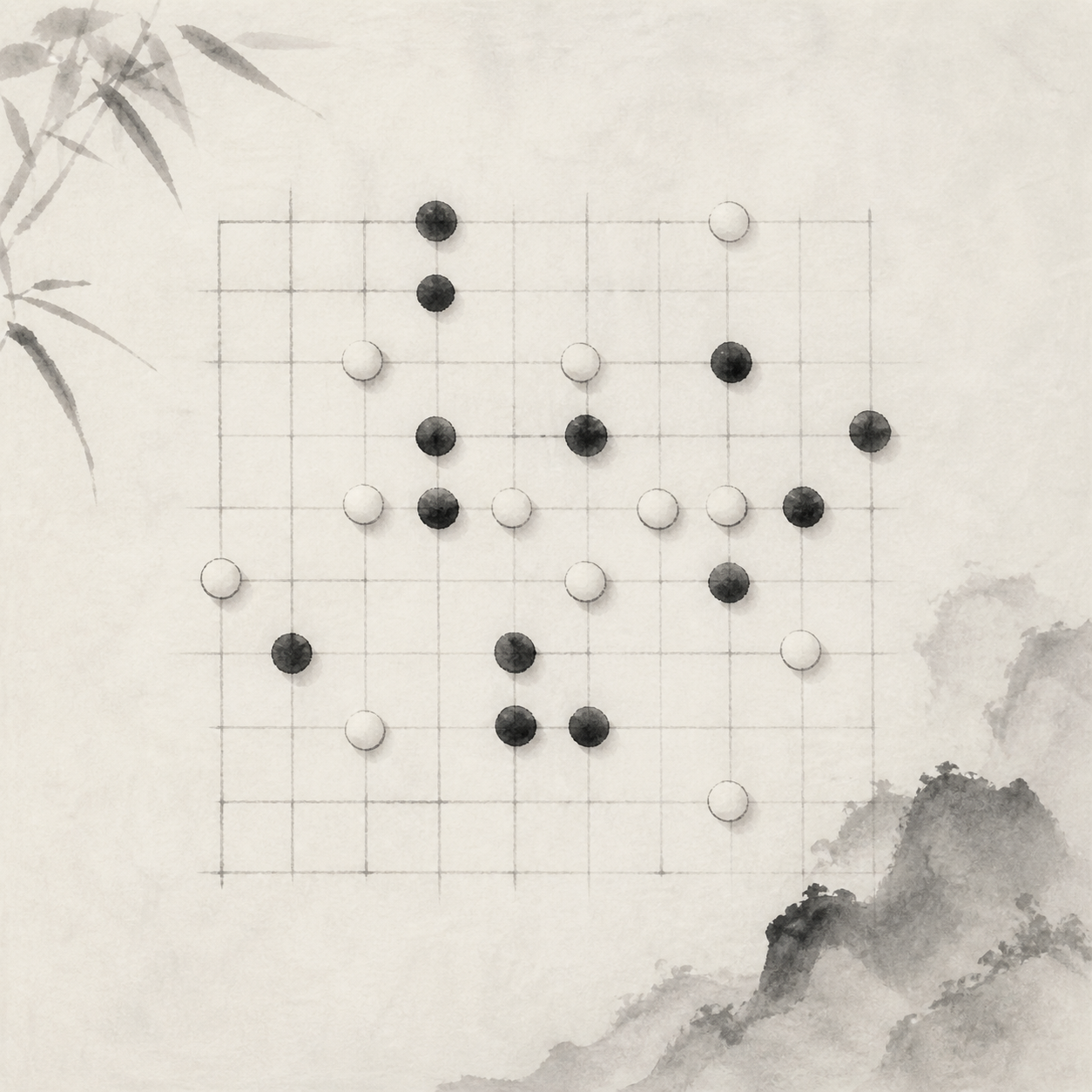
You stare at the board. You are one move from five, and then you notice your opponent’s diagonal is faster. This is a common way to lose: the local position is clear, but the whole-board tempo was never counted. Put Gomoku inside the m,n,k game framework, and many judgments become more concrete.
m,n,k compresses the rules into three numbers
An m,n,k game is a way to describe a family of abstract games: two players take turns placing stones on an m-by-n board, and the first to make a line of k horizontally, vertically, or diagonally wins. Tic-tac-toe can be written as 3,3,3. Free-style Gomoku is often written as 15,15,5.
Those three numbers look dry. They are not. m and n define space; k defines the distance to victory. The larger the space, the more room threats have to bend around. The shorter the winning distance, the heavier a single move becomes.
15×15 gives five-in-a-row room to breathe
Gomoku is usually introduced as five in a row. Traditionally it is played with Go stones on a 15×15 board, though 19×19 boards also appear historically. By the rules alone, both work. In the feel of reading, the difference is plain.
On a 15×15 board, the distance from the center to the edge is moderate. A move near tengen can quickly touch the horizontal, vertical, and both diagonal lines. As the position expands into the middlegame, the boundary begins to matter, forcing you to ask which lines still have room.
Board size changes speed
k=5 turns the open three into language
When the goal is five in a row, three stones already start to speak. An open three is not merely “two moves away.” It asks the opponent to decide at once: will the next move create a four-in-a-row, and can the other end still be sealed?
That is why the term open three is so exact. Its point is that both ends still breathe, and the follow-up has not been crushed in either direction. Another three-stone shape may be much quieter: with a closed three, the defender has already taken away one end.
Edges and corners cut branches, and speed up judgment
In the center of the board, a stone usually participates in potential lines in four directions. Near the edge, the available directions shrink. Some threes that look shapely are, in practice, unlikely to grow into a double threat.
This is also why beginners often misread edges and corners. They are not automatically bad points. They shorten variation. When you already have a main attacking line, pressure near the edge can sometimes be cleaner.
Imagine this position: Black has formed a diagonal three in the upper-right area. White looks only at the empty points in the center and may think there is still time. But once that diagonal approaches the top edge, White has fewer endpoints to block, and the next four-in-a-row becomes more direct.
The double-three is a branching problem inside m,n,k
In 15,15,5, the strongest moves often come from forks. The danger of a double-three is that one move creates two routes nearing five in a row at the same time. The defender has only one move, and cannot slow both sides at once.
Seen through m,n,k, a double-three occupies two winning channels in the same space. The more open the board, the more easily those channels separate. Near an edge, the channels are compressed, and the quality of the double-three tends to fall.
Rule variants change the same set of parameters
Free-style Gomoku places 15,15,5 in its simplest form: first to make five wins. Renju adds limits such as first-player forbidden moves and opening protocols; RenjuNet is a useful background reference for the rules.
Those rules do not make m,n,k irrelevant. They are more like constraints added to the same sheet of graph paper: some forks are no longer legal, some openings require an exchange of choice, and so the first-player advantage is reduced while the center of reading shifts.
Once you see that, rules debates become less emotional. You can ask a more precise question: which path to five does this restriction suppress? Does it make early play near tengen more restrained, or bring edge fighting into the game sooner?
Three questions can reframe a game
The next time you watch a Gomoku game, start with three questions. How much board space remains? How many moves is the current threat from five? Once this line approaches an edge or corner, do the defensive points increase or decrease?
The questions are plain enough. But they move a lot of vague feeling onto the board. You will notice earlier why a move is slow, and you will see faster why a certain open three must be blocked immediately.
Read the space before you read the moves
m,n,k is not a formula laid over Gomoku. It is a ruler. After you have measured a few games with it, the 15×15 board looks clearer: tengen, edges, open threes, and double-threes all come into better focus. Try one game tonight. Start by counting distance.