
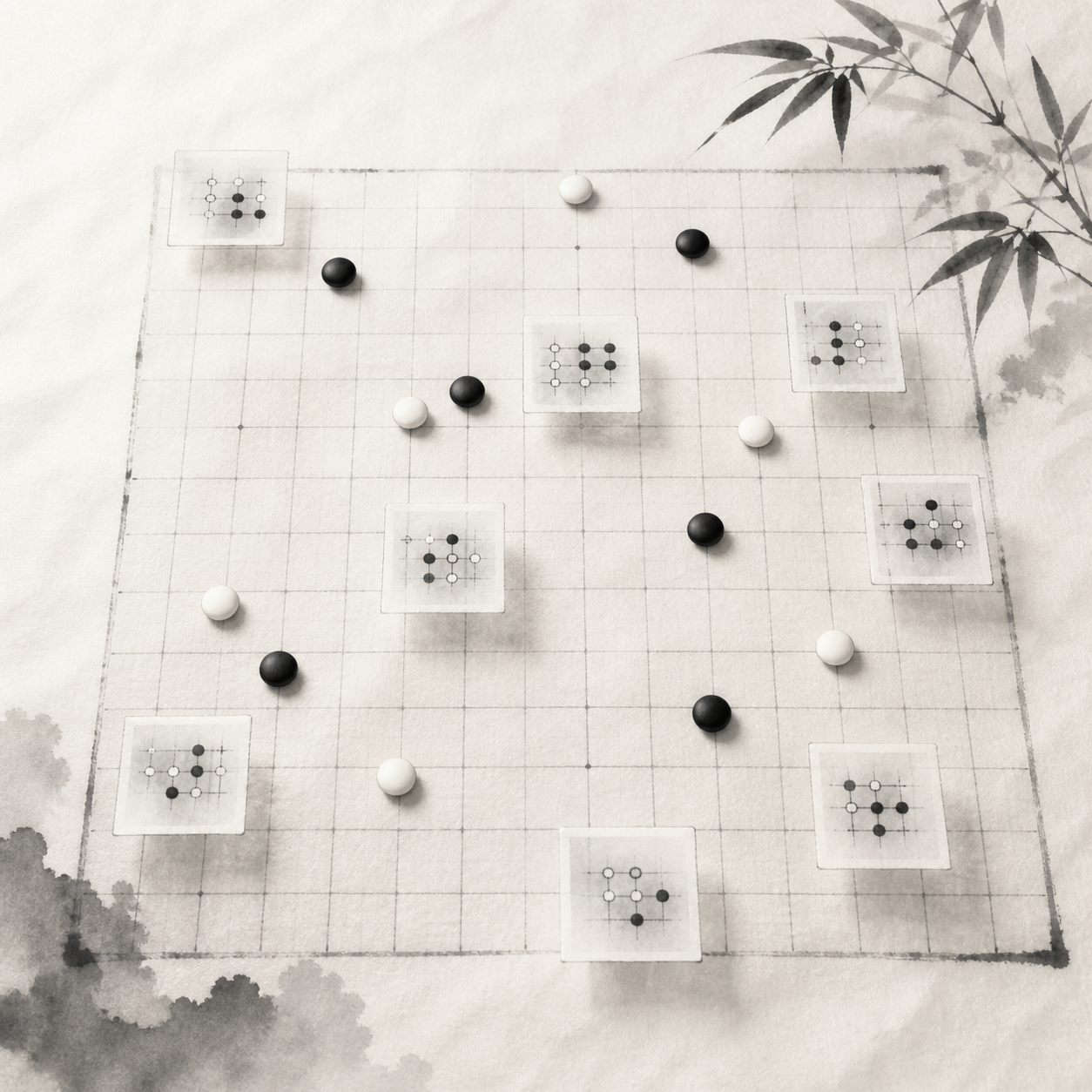
You may have seen this in review: a board that is still wide open, yet oddly slow to read; another game packed tight, where the key points have narrowed to two or three. Strong engines face the same problem. The Rapfi paper brings a quiet question into view: playing strength does not come only from larger networks. It also comes from handling the local shapes that appear again and again on the board with less weight and more accuracy.
Speed Often Starts Small
A Gomoku board looks like a single whole. Computation, though, is full of neighborhoods. The four or five intersections around an open three matter more urgently than a dozen empty points far away; a defensive point next to a four-in-a-row can decide the life or death of the very next move. Human players naturally narrow their field of vision when reading. Engines are looking for a similar economy.
The direction discussed in the Rapfi paper is to encode local patterns into a form that can be reused more easily. The paper calls this a pattern codebook, and pairs it with incremental updates to reduce the cost of recalculating from scratch after every move; see the related experiments and system description in the Rapfi paper. The board is not being simplified away. The work is in organizing the shapes that keep coming back.
Why Local Shapes Keep Reappearing
Gomoku’s winning condition is clean: make five in a row. But clean rules generate a great many similar small shapes. Open threes, blocked threes, four-in-a-rows, open fours — behind those names are arrangements of nearby empty points, your stones, and your opponent’s stones.
Take an open three. When you see three of your stones in a row with both ends still open, your first instinct is usually to inspect the extension points on either side. If a nearby diagonal is also taking shape, that local area is no longer just a three. It may point to a double-three, a chain of threats, or even a forbidden-move judgment.
That is why local shapes deserve to be treated on their own. Many points on the board do not have equal value. Their value comes from the combinations of stones around them. The faster those combinations are recognized, the fewer empty roads the search has to travel.
Speed is hidden in repeated shapes
Incremental Updates Are Like Changing One Note in Review
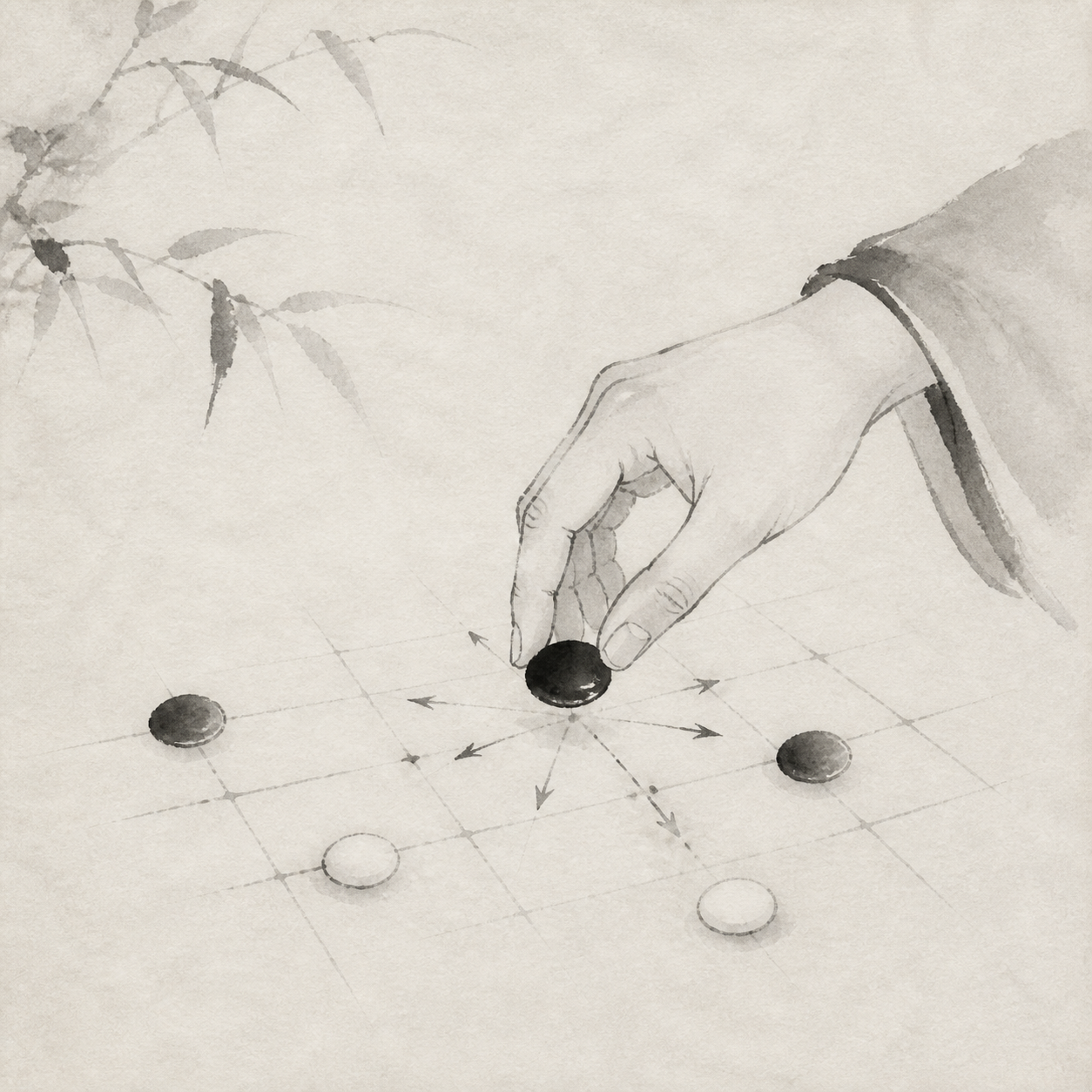
After a stone is placed, has the whole board changed? In a rules sense, yes. In local relationships, only a ring around the move has changed. The horizontal, vertical, and two diagonal lines through the new stone are different. Faraway shapes remain what they were.
Incremental updating is built on that fact. After each move, only the affected local encodings and related evaluations are updated; the rest is kept. For an engine designer, this is a plain kind of restraint: do not touch what has not changed.
Threat-Space Search Told Us This Long Ago
This local awareness is not new. In 1993, the Victoria program combined threat-space search with proof-number search in the paper Go-Moku Solved by New Search Techniques, producing a solution for free-style Gomoku. Its central concern was also threats: which moves force a reply, and which branches can be set aside for the moment.
From Victoria to Rapfi, much of the technical machinery has changed. The pressure points on the board have not. A four-in-a-row must be answered; an open four is more urgent still; double threats compress the set of choices. The stronger an engine becomes, the more reliably it must read this kind of force.
Rules Change the Weight of a Shape
The same shape can mean different things under different rules. Renju uses a 15×15 board, stones are placed on intersections, and Black is restricted by forbidden moves such as overlines, double-threes, and double-fours; a basic explanation is available on the Renju International Federation rules page. These rules directly affect how an engine evaluates local shapes.
Consider a common situation: Black appears able to create two open threes, but under forbidden-move rules, that move may not be legal. For a human player, this is the moment when a beautiful move turns bad. For an engine, it means the local encoding must carry the meaning of the rules. Recognizing the shape is not enough; the engine must know whether that shape is usable in the current rule set.
What Players Can Learn from Engines
You are not going to maintain a codebook in your head. But the engine’s method points to a practical habit: read the place that changed first. Where did the last stone land? Which four lines were rewritten? Where did a gap appear? Where did an escape point disappear?
That is more reliable than sweeping the whole board without a plan. In the middlegame especially, when stones crowd the board, your attention is easily pulled toward distant patterns. Check locally along the last move first, then put the result back into the full-board position. You will miss fewer direct threats.
The same idea applies to board-interface design. Markers, hints, and review tools that unfold around the last move are closer to the real path of reading. Good assistance does not have to be loud. It only has to make clear what just changed.
Read what changed first, then read the whole board