
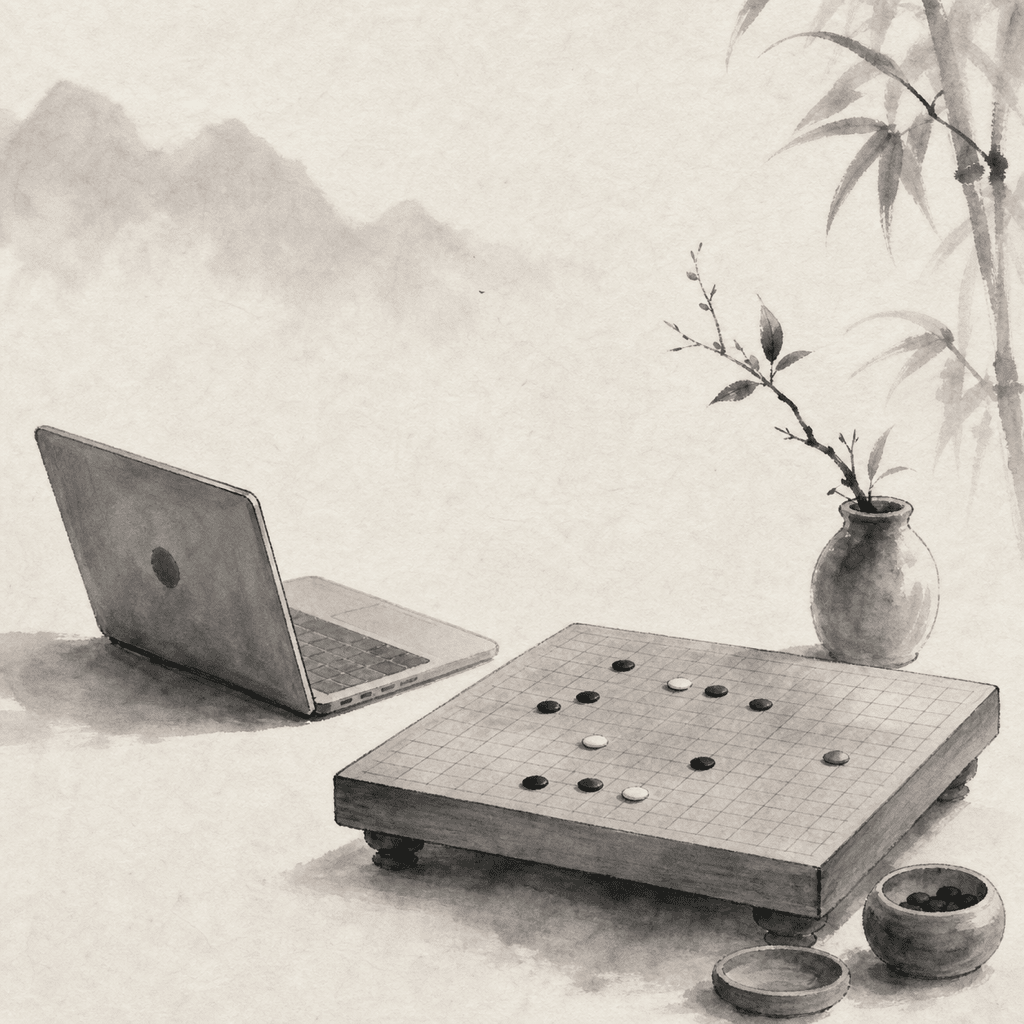
When you open the schedule, today’s entry does not make much noise: an online cup for young players, beginning with a registration page in Tallinn, a gathering on Zoom, and a board on vint.ee. The World Renju and Gomoku Youth Cup reminds us that a young player’s first international lesson is often not how to win a game, but how to place a stone within a clear and trusted order.
What begins today is not an ordinary online game
The RenjuNet event page lists the World Renju and Gomoku Youth Cup (online) as running from July 24 to 30, 2026, with Tallinn, Estonia, named as the location. The format is Swiss, the rules are Taraguchi-10, and the results count toward ratings.
Those details may look matter-of-fact, but they determine the texture of the tournament. This is not an improvised match arranged on short notice; it is an international youth event organized by the RIF, vint.ee, and the Estonian Renju Union. Online is merely the venue. Order is still the playing hall.
An online arena breaks ceremony into small gestures
An over-the-board tournament has a check-in desk, an arbiters’ table, the sound of clocks. Online play breaks these rituals into smaller parts: players must register in advance, assemble at the designated communication site, and complete every round on the same playing platform.
For young players, that fragmentation is itself a kind of training. It asks you first to clear the desk, then to settle the mind. The screen will not keep your attention for you. The rules will.

Taraguchi-10 makes the opening more than memorization
The tournament uses Taraguchi-10. For readers less familiar with Renju rules, it may help to think of it as a framework that gives the opening both more constraint and more room for choice. Its purpose is not to create complexity for its own sake, but to keep the game from being carried away too early by fixed answers.
Youth tournaments especially need that balance. The rules must be rigorous enough for results to mean something, yet spacious enough for young players to show judgment on the board rather than merely display memory.
Rules are not a restraint; they are what make the game legible.
The Swiss system lets young players come into view gradually
The virtue of the Swiss system is that it does not rush to let one game decide an entire fate. Across multiple rounds, players meet opponents near their own performance range; levels separate gradually, and form has a chance to be seen.
That matters in youth competition. Young players often fluctuate more than adults: one game may open beautifully, while the next suddenly slackens in the middlegame. The Swiss system does not erase volatility, but it gives volatility room to correct itself.
Time control teaches a player how to breathe
The event page specifies a time control of 30 minutes, with a five-second increment per move. It is not luxurious, but it is enough to let a player pause at a critical point: Am I defending, or am I giving my next move something to echo against?
The beauty of Gomoku often appears there. Not every move needs to be sharp. Some moves simply polish the position until it becomes calmer, clearer, more readable. If a young player can learn that rhythm under limited time, the reward will last longer than a single result.
Online competition also needs boundaries
The RenjuNet page makes a special note that the Zoom link is for players and coaches only; other spectators may watch through the designated livestream channels. It is a small reminder, but a necessary one. The openness of a youth tournament does not mean the absence of boundaries.
A good online event separates watching, officiating, and accompaniment. Spectators have a place to watch, coaches have a place to wait, and only then does the player have a board clean enough to play on.
A cup tournament reveals the infrastructure of youth development
This online cup is not far removed from the World Team Championship to be held in Yerevan in August. One is an online youth event; the other, an adult team competition. Seen together on the same annual calendar, they show that the international system for Gomoku and Renju does not run on champion stories alone.
It looks more like infrastructure: event pages, rule pages, arbiters, pairings, platforms, livestreams, registration deadlines. None of it is romantic on its own. Together, it gives a young stone somewhere to be seen.
Beauty begins with an order you can trust
WUZIQI has always favored the quiet board. Today’s online cup has a similar temperament: it lowers the noise and brings the rules, the time, and the ways of watching into plain view.
If you feel like playing a game today, you might begin the same way: set the time, clear the table, read the rules carefully. Beautiful games often begin with an order that can be trusted.
Only when a game is quiet can a young player hear himself think.