

When you see tournament results, the first question is usually simple: who won? But Gomocup 2026 is worth reading beyond the champion’s name. The more revealing story sits in the updated downloads, Elo ratings, rule groups, hardware limits, and validation tools. It is a restrained sort of board, laying out, square by square, how Gomoku engine competition is becoming more finely grained.
AlphaGomoku Takes the Top Spot
Gomocup 2026 was the 27th edition of Gomocup, held from June 5 to 7, 2026. The official page has updated the results, downloads, and Elo ratings. That makes this more than a stand-alone announcement of a winner. It is a set of data you can revisit, compare, and study.
The official results page lists ALPHAGOMOKU, by Kozarzewski, as the champion. JAX finished second, and EMBRYO third. Even the top three tell a clear story. The gap among elite engines looks less and less like the old question of whether a program can calculate at all. It is more a question of whether it can prove itself steadily under the same conditions.
That is part of what makes Gomocup interesting. It places abstract playing strength inside a concrete setting: the same servers, the same limits, the same entry points into the rules. The board is quiet. The results are not.
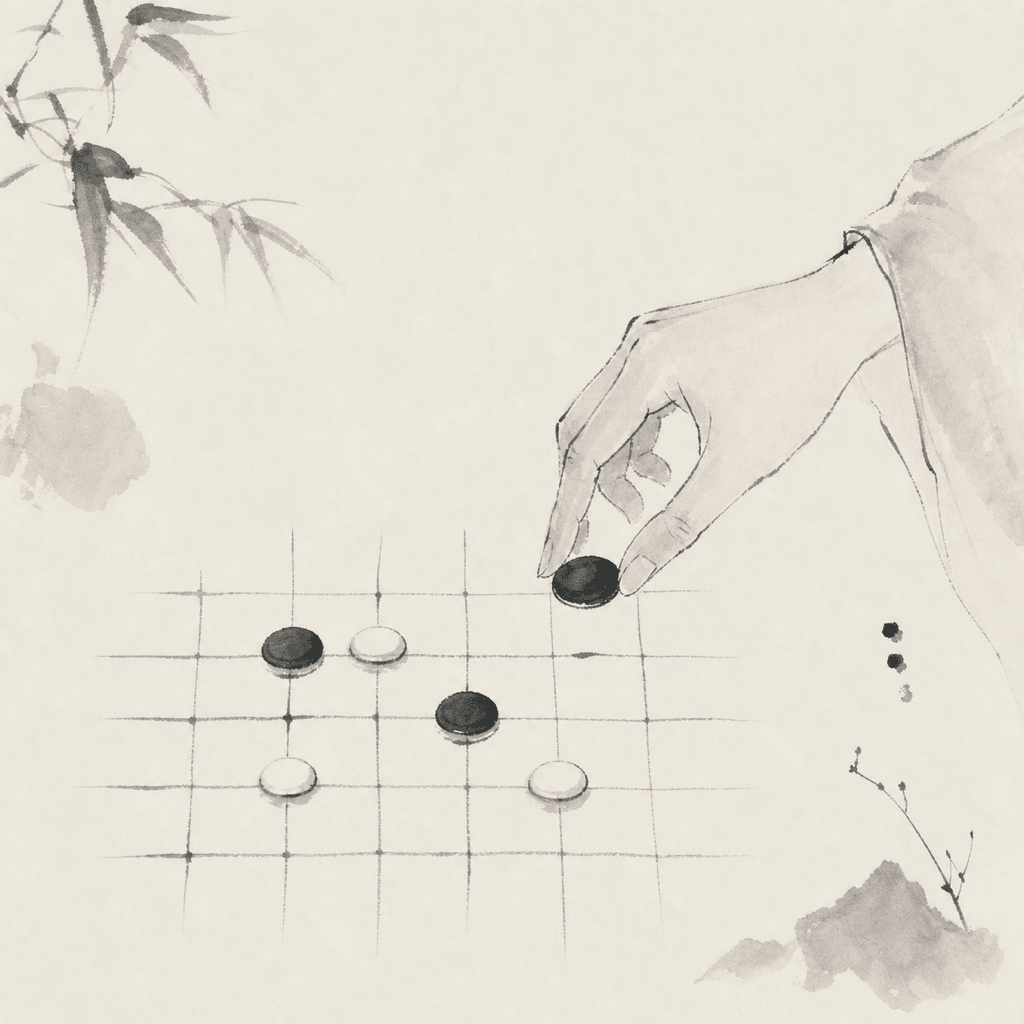
One Hardware Setup Makes the Chess Matter More
This year’s tournament used four identical Tencent Cloud SA9.8XLARGE64 servers, running Windows Server 2025 Datacenter x64, with 32 vCPU AMD EPYC 9K65 and 64GB RAM. That sounds like engineering detail. It is also what gives the results their texture.
If the hardware varies too much, the games pick up noise: thread scheduling, memory pressure, machine state. Any of it can change the course of a game. A unified environment is not decoration. It makes the tournament more modern, and more trustworthy.
The memory limit remained 1 GB, and the AI size limit remained 256 MB, the same as in 2025. That continuity matters. When the boundaries stay stable, progress becomes easier to see. The point is not to win by getting bigger. It is to keep refining inside a fixed space.
Stable boundaries make progress legible.
Six Rule Groups, Six Different Tests
The Gomocup 2026 leagues included Freestyle 20x20, Freestyle 15x15, Fastgame, Standard, Renju, and Caro. The Unlimited tournament was not held, for a simple reason: there were no valid submissions.
These names are not mere labels. Freestyle is closer to open attacking and defensive judgment. Standard emphasizes a different set of constraints. Renju puts forbidden moves at the center of the calculation. If an engine can run only along one path, its rhythm may warp as soon as it is moved to another rule track.
There is a lesson here for the reader, too. In ordinary Gomoku, you may be used to seizing the initiative and making an open three. In Renju, some attacks that look elegant can become liabilities. Rules are not background. They change the weight of every move.
Prepared Openings Push the Game Deeper
The official notes say the organizers prepared openings for each rule set. The opening selectors included Alexander Bogatirev, Zijun Shu, and Qichao Wang.
That is subtler than choosing where the first stone goes. Prepared openings can keep games from falling again and again into a few familiar lines. They also force engines away from templates and into positions that actually require judgment. A position may appear to contain only one four-in-a-row threat, while a double-three exchange sequence is hidden underneath.
A good opening is like a hand placed lightly on the board. It does not play the game for you. It brings you to a position with tension, where the choices that follow begin to have texture.
Submissions Rise, and Validation Moves Forward
The official site also notes that this year set a record for new submissions, and that a beta automated validation tool was introduced to check protocol and rule support. To an observer, that may not shine as brightly as the champion’s name. For the tournament itself, it is infrastructure.
What engine competitions fear most is not losing. It is being unable to confirm why something lost. An unstable protocol, incomplete rule support, inconsistent handling of edge cases - all of these can make a game unreadable. The point of an automated validation tool is to smooth out those rough places first.
This is a more refined kind of competition. It does not dress up noise as drama. It lets the drama happen on the board.
The Names Change, and So Does the Ecosystem
Examples of updated or new programs mentioned on the official page include AlphaGomoku, ANGEL, DDQK-Conquer, Embryo, Figrid, Kanec, Katagomo, and Chloris. The list itself is long. More interesting is the density of participation behind it.
As new submissions increase, the pressure on strong engines changes. They do not only have to beat old rivals. They also have to face new styles that have not yet been fully studied: more aggressive opening choices, more conservative defensive plans, or unusually deep optimization for a particular rule group.
The Elo update is like a thin line running through all of this. It cannot explain every game. But it can connect the changes that accumulate year after year. Rankings show the present. Rating curves show time.
The Real Message Is Verification
So what does Gomocup 2026 tell us? It tells us, of course, that AlphaGomoku stood at the front of this year’s field. It also tells us that JAX and Embryo remain high-level contenders. But the deeper point is that the tournament is breaking “strength” into more pieces that can be checked.
Unified hardware means verifiability. Continued limits mean comparability. Rule groups mean localization. Prepared openings mean control. Automated tools mean screening. None of these items makes much noise. Together, they make the results sturdier.
A good result must first survive a second look.
If you play Gomoku, you can look at your own games the same way. Do not only ask, “Did I lose?” Ask where the position stopped being verifiable. Did you miss an open three? Did you mistake a four-in-a-row for a real attack?
Next time you play, slow down. Treat the board as a small experimental record. Every move should have a reason. Every reason should be something you can check afterward. Then, beyond winning and losing, the game itself becomes better to look at.