
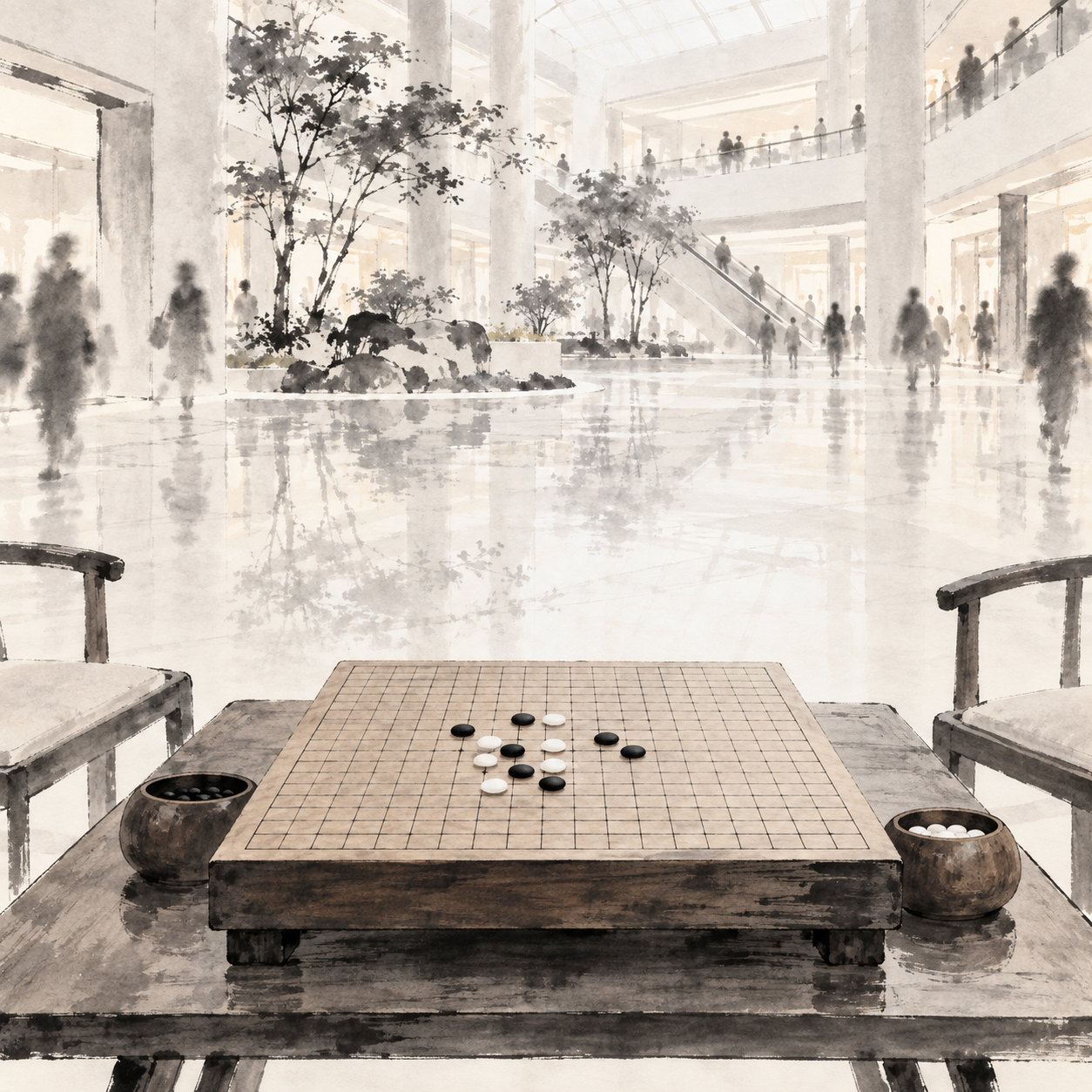
You are walking through a mall when you hear a stone touch a board. Then you notice the tables in the mall atrium, with someone waiting to try a game. You might stop to watch or sit down for a few moves. Farther in, matches proceed by round. It is all Gomoku, but before you take a seat, you need to know which kind of table is in front of you.
One September, Two Tables
According to a Fenghuang.com report on the event, an open tournament and board-game festival for chess, Gomoku and international draughts took place on September 26–27, 2026, at Fanhu Wanda Plaza in Wuhan, Hubei. The competition occupied the mall’s indoor atrium. Nearly 1,000 enthusiasts from Wuhan, Huangshi, Jingzhou, Jingmen, Suizhou, Tianmen and local universities took part in seven rounds over two days. Inside the competition area, matches followed a schedule. Nearby, passersby could stop and try a game.
According to the event record on the Chinese Renju site Wulin Qishi, the Beijing Chess Academy held the 2026 China Sports Lottery Cup Beijing Gomoku Championship on September 12–13 at the Beijing Zhongcheng Tiantan Holiday Inn. Two hundred players competed in nine groups over seven rounds. Here, you sat at a tournament table according to the event schedule. The hotel was the venue; it did not determine how the game was played.
What the Mall Atrium Adds
The Fenghuang.com report described an arena where little could be heard beyond stones landing and clocks ticking softly. In its Gomoku matches, the report said, skillful Renju moves came quickly and a game could turn within a few moves. The formal competition in the atrium had its own rhythm. Players had to keep their attention on the board and the clock. Look only at that part of the atrium, and it hardly resembles a noisy shopping trip.
The same report described the festival beside the competition: a place to try board games, a space for traditional crafts and a cultural display, all open at once. More than a dozen nearby merchants participated, and organizers distributed over 2,000 invitations. The Gomoku try-it table, called the “Renju Challenge Table,” drew lines of children; collecting stamps could earn them board-game-themed gifts. One parent who had brought a child to compete said they had ended up spending the afternoon in the activity area. That easy-to-enter space sat right beside the formal matches.
When foot traffic reaches the board, a beginner gets a chance to sit down
The Hotel Table Has Boundaries
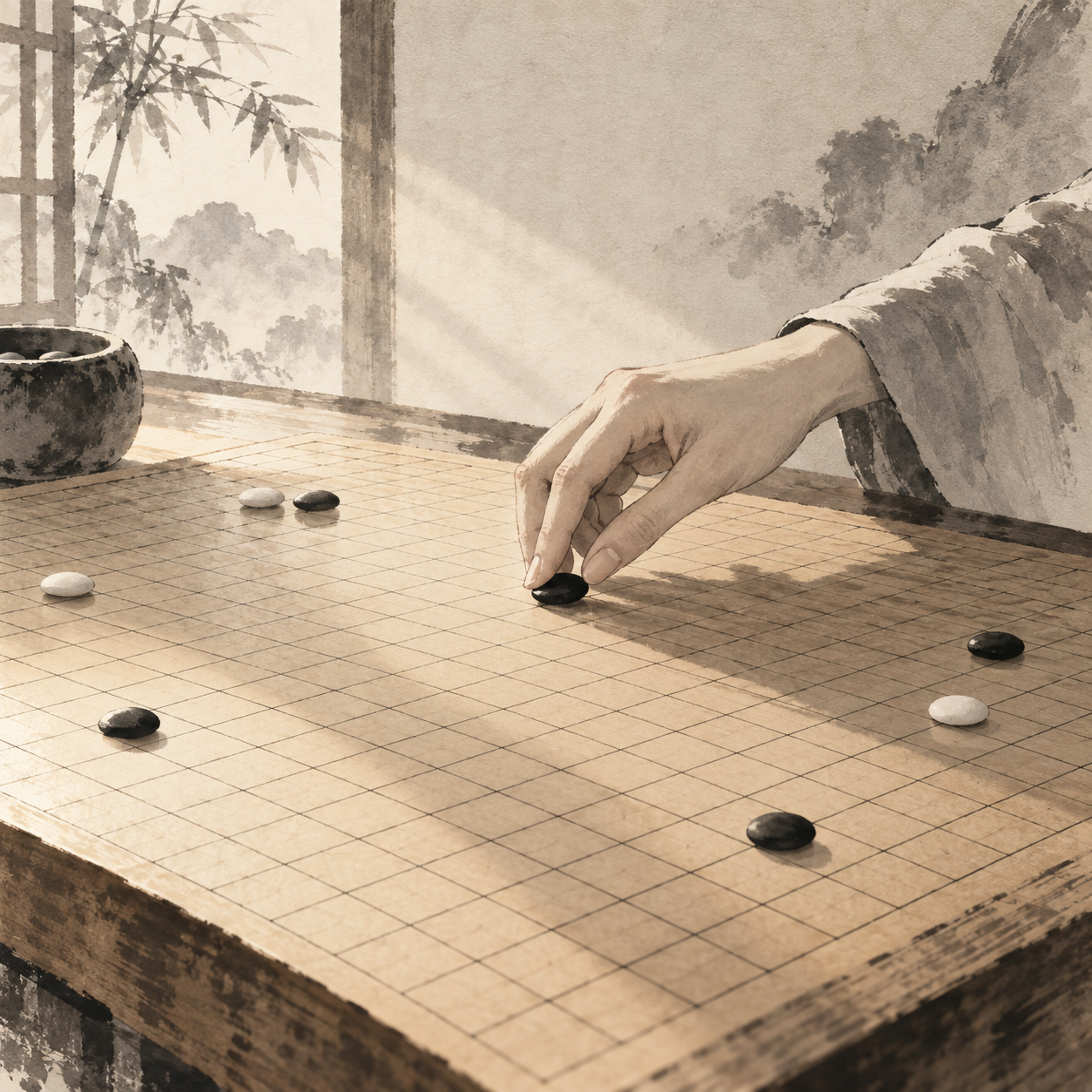
The Beijing championship had 200 players, nine groups and seven rounds. If you were competing, your first questions would be which group you belonged to and where you were playing this round. Only once seated would you turn to your next move. Groups and rounds make each game part of the same event. The casual invitation to sit down whenever you have time does not carry over to a tournament table.
Quiet is not exclusive to hotels: stones and clocks could also be heard in the Hubei mall atrium. The clearer difference lies in the movement around the tables. In one place, scheduled matches sat beside activities and displays where passersby could stop. The account of the other describes a hotel championship organized by group. The venue tells you where to find the board. The table’s purpose tells you how to approach it.
Two Tables, Different Rules
At a try-it table, you can get your bearings, place a stone and try to make a line. If your opponent blocks you, you can pause and ask why. There is room here for someone holding a stone for the first time; you need not enter a seven-round tournament to begin. When another person is waiting, a simple explanation of the move in front of you may be enough to help them take a seat, too.
A tournament game, by contrast, must follow the event rules. Those may specify openings, forbidden moves or countdown timing; the event regulations and group instructions are the authority. Available public reports do not say which opening rules or timing method the Beijing championship used, so there is no basis for supplying them. Before bringing a familiar move from the try-it table into a formal match, check the rules.
Why Events Enter Shopping Districts
An August 30, 2025, State Council General Office policy on expanding sports consumption and advancing the sports industry (State Council General Office Document No. 31 of 2025) called for continued development of branded events that bring sports into scenic areas, streets and shopping districts. Shanghai’s sports development plan for the 15th Five-Year Plan also supports bringing sporting events into those spaces. Such policies address the connection between events and public places. They do not prescribe opening rules or timing for a board-game tournament in a shopping district.
A Henan sports bureau update republished by the General Administration of Sport of China on January 23, 2026, said that at a provincial sports meeting the previous day, Henan had proposed holding at least 30 provincial-level sporting events in scenic areas, streets and shopping districts. A Xinhua report published on the administration’s site on September 9, 2026, also noted that 11 of the 25 regional stops in the 2025 regular season of China’s 3x3 Basketball Super League (Chao San) took place in central urban shopping districts. During an event at Zhangjiagang Jinmao Lanxiucheng in Jiangsu, foot traffic reached 153,600 visits and sales totaled 12.52 million yuan. These are examples and figures from shopping-district sports events, not evidence of Gomoku events’ impact.
Before You Sit, Look at the Table
If you stop at a try-it table, let the first task be simply picking up a stone. Watch how others play, then take a few turns yourself. If a rule is unclear, ask about it during the game. At Hubei’s festival, the Renju Challenge Table gave children a place to line up and play, and parents accompanying competitors a place to linger. The activity area let people who had not entered the tournament encounter a board.
If you are competing, find your group and assigned table, read the applicable rules, and check this round’s timing and result-recording requirements. The report says the Beijing championship had nine groups and seven rounds; it does not give each group’s opening or timing rules. At the venue, the event instructions still govern. And if you enter the competition area of the Hubei mall atrium, the presence of a try-it table outside it does not make a tournament table open for a casual game.
After the Bustle, the Quiet Remains
Even if you have only come to watch, you can distinguish the tournament tables from the try-it tables before deciding where to stop. Where children line up to play, you can ask why a move was blocked. Where players are in a scheduled match, save the conversation for outside the game. The Hubei event put both scenes inside one mall. Foot traffic could bring you to the board; the quiet around a move still belonged to the people playing.
Know what the table is for before you sit; then check the rules for the round