
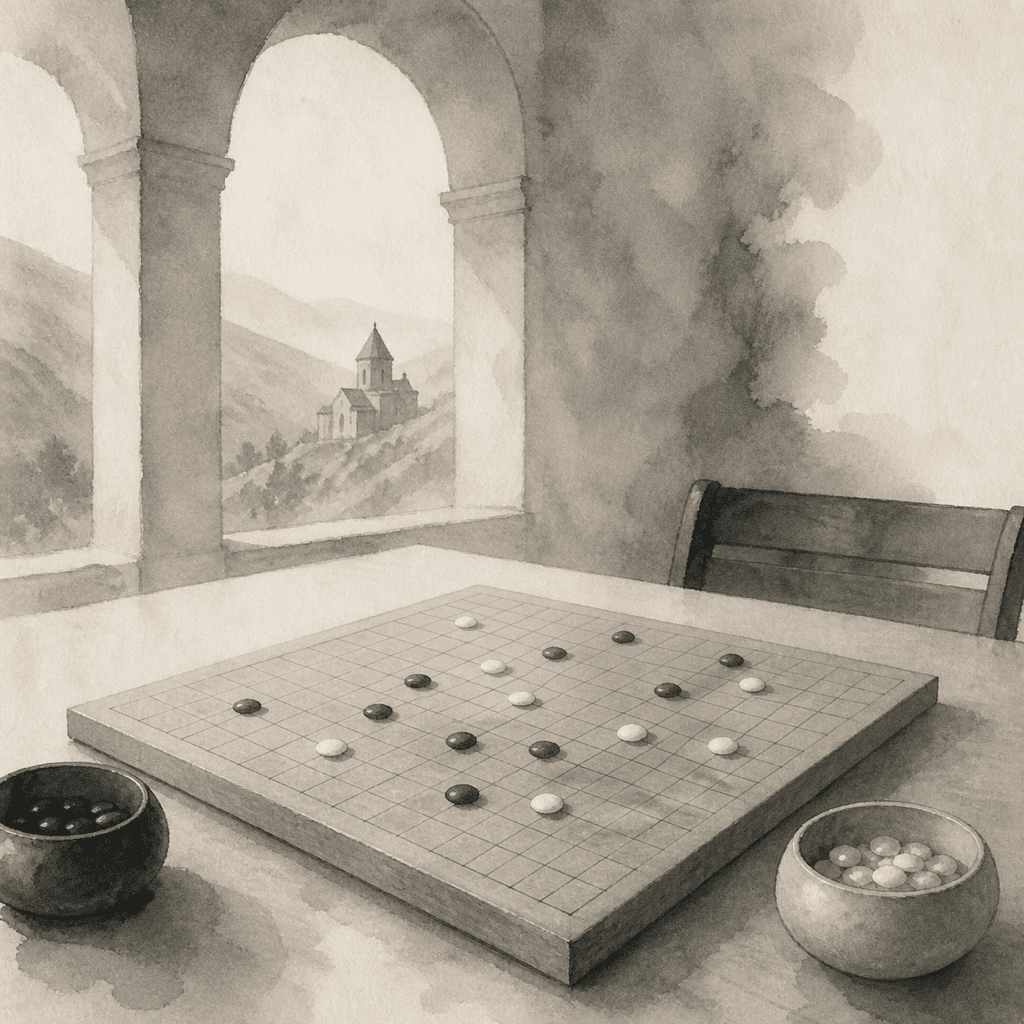
You open a team world championship stream. The board is still empty, and already you feel half a step behind: Why does the game not begin with Black and White taking turns, but with one player placing a set of stones and the opponent choosing what comes next? That is Swap2. In August 2026, the Gomoku Team World Championship will begin in Yerevan, Armenia. What determines whether you can follow the first ten minutes is often not the place name, but this quiet, restrained, oddly tactile opening rule.
First, the stage: Yerevan, five days, a team match
RenjuNet has listed the event details for the 2026 Gomoku Team World Championship: it will run from August 15 to August 19, 2026, at the Chess House in Yerevan, Armenia, at 50a Khanjyan Street. The event is organized by the RIF and the Armenian Renju Federation, and the discipline is listed as Gomoku - Swap 2, rated.
This is not a stage built only for individual brilliance. A team consists of 4 regular players and up to 2 substitutes; the format is round-robin, with a time control of 120 minutes per side plus 30 seconds per move. What you will see is not one isolated game, but an entire team distributing risk, patience, and judgment under the same rule.
Why Swap2 changes the viewing rhythm
The virtue of an ordinary alternating opening is that it is immediately legible. Black starts, White answers, and you can quickly move your attention to concrete shapes: tengen, diagonals, open threes. Swap2 is different. It postpones the question of who plays Black and who plays White, turning the opening into a small negotiation.
So the first stretch of a broadcast may not look like a conventional attack. It can look more like a hand adjusting the dimmer. One player offers a position. The other asks: Is this more comfortable for Black, or for White? If neither side has been given a bargain, the game begins to show its refinement.
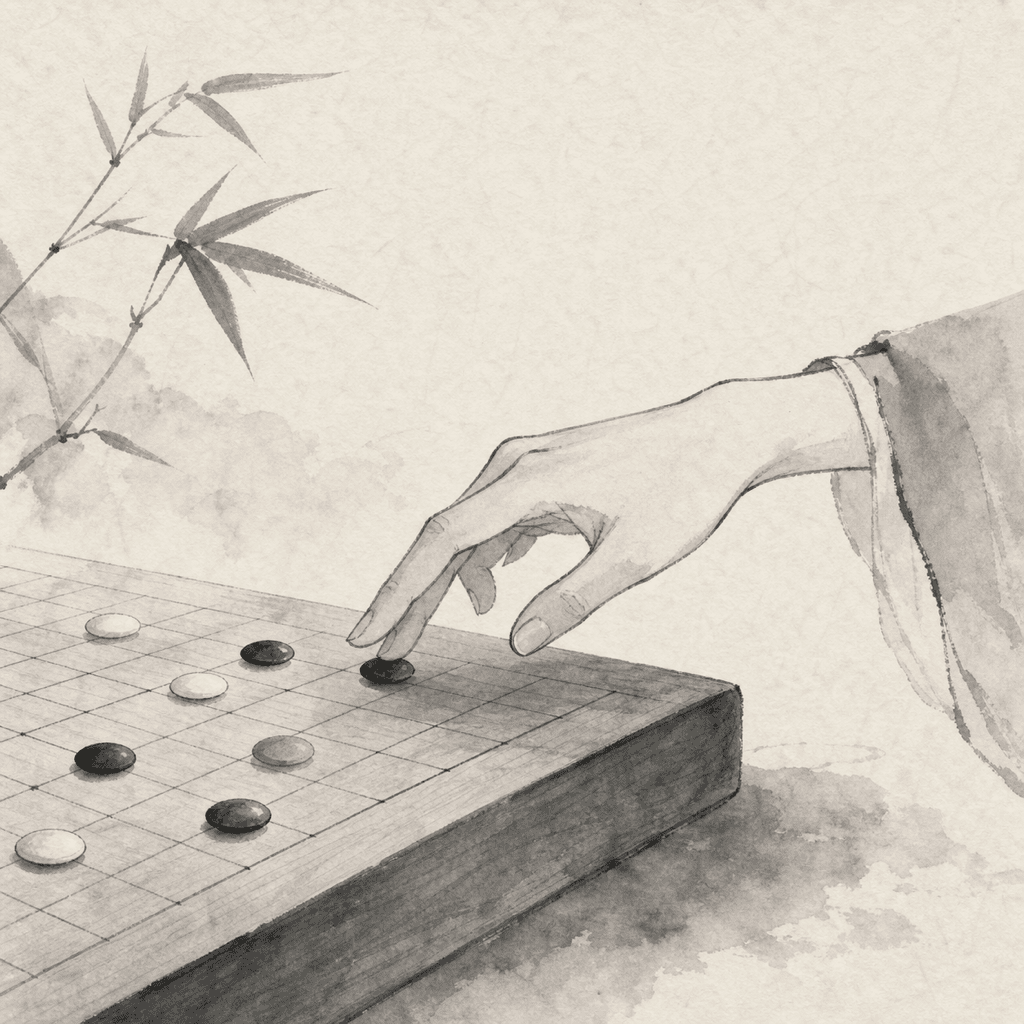
The RIF definition of Gomoku Swap2 can be summarized this way: the first player places stones according to the rule; the second player may choose to continue as White, swap colors, or add more stones and let the opponent choose the color. The details are governed by the RIF rules page, but for watching, this is enough to hold on to: color is not a birth certificate. It is the outcome of a negotiation.
Swap2 turns first-move advantage into a multiple-choice question.
The first choice: keep it, or swap
Suppose the first player sets up an opening that looks solid. The second player is not asking, “Do I like this shape?” The real question is: “If I take White, can I hold it; if I swap into Black, am I better off?” It is a quiet step, but it decides the whole game’s atmosphere.
If the position is plainly favorable for Black, the second player may swap. If it only looks good for Black but lacks substance, he may be willing to stay with White. The opener, then, cannot simply place a position he knows well. He has to offer one that does not let the opponent profit too easily. Beauty can be a reason. In competition, though, beauty still has to survive the choice.
The second choice: add stones, and make the opponent decide
The most interesting part of Swap2 is that the second player does not have to choose a color right away. He can add stones, make the position more complicated, and then force the first player to choose in return. The gesture is like turning a teacup half a rotation: no announcement, but the feel has changed.
Say the initial position gives Black a comfortable diagonal. After White adds stones, the other side of the board may suddenly contain a possible open three route. The first player now has to re-evaluate: Will Black be tied down? Can White seize the tempo? Only here does the viewer really enter the heart of Swap2.
In team play, Swap2 is roster management too
In an individual event, Swap2 mainly tests one player’s opening preparation. In a team event, another layer appears: different playing styles are magnified. Some players are good at calmly absorbing equality. Others like to sharpen the position. Coaches, or team planners, often have to consider who is best suited to handle uncertainty in the first ten moves.
The 2026 event uses a lineup of 4 players plus up to 2 substitutes, and a round-robin format means there is little room to hide from one round to the next. If a team has a weakness in its Swap2 preparation, opponents will probe it again and again. If the preparation is sound, the opening can become a stabilizer.
That is also why the rhythm of a team world championship can be more watchable than a single game. You are not only watching one player solve one position. You are watching a team sustain the same quality of judgment across multiple boards. Much of modern Gomoku’s beauty is hidden in that unshowy repetition.
Team play tests steady judgment.
When you watch the 2026 championship, start with three things
First, see whether the initial placement is moderate. Too favorable for Black, and it is easy to swap; too deliberately balanced, and it may lack initiative. Second, see whether the added stones create a new threat, rather than merely filling more of the board. Third, see whether the player choosing the color quickly reaches familiar shapes.
If you want to prepare a little before the event, read the tournament page, then look at the Swap2 rule explanation. RenjuNet’s event history shows that the Team Gomoku World Championship has had its own continuity since 2016; going to Yerevan is simply the next step in that line. The next time you watch a broadcast, do not rush to find the winning move. Try starting with the first set of stones.