
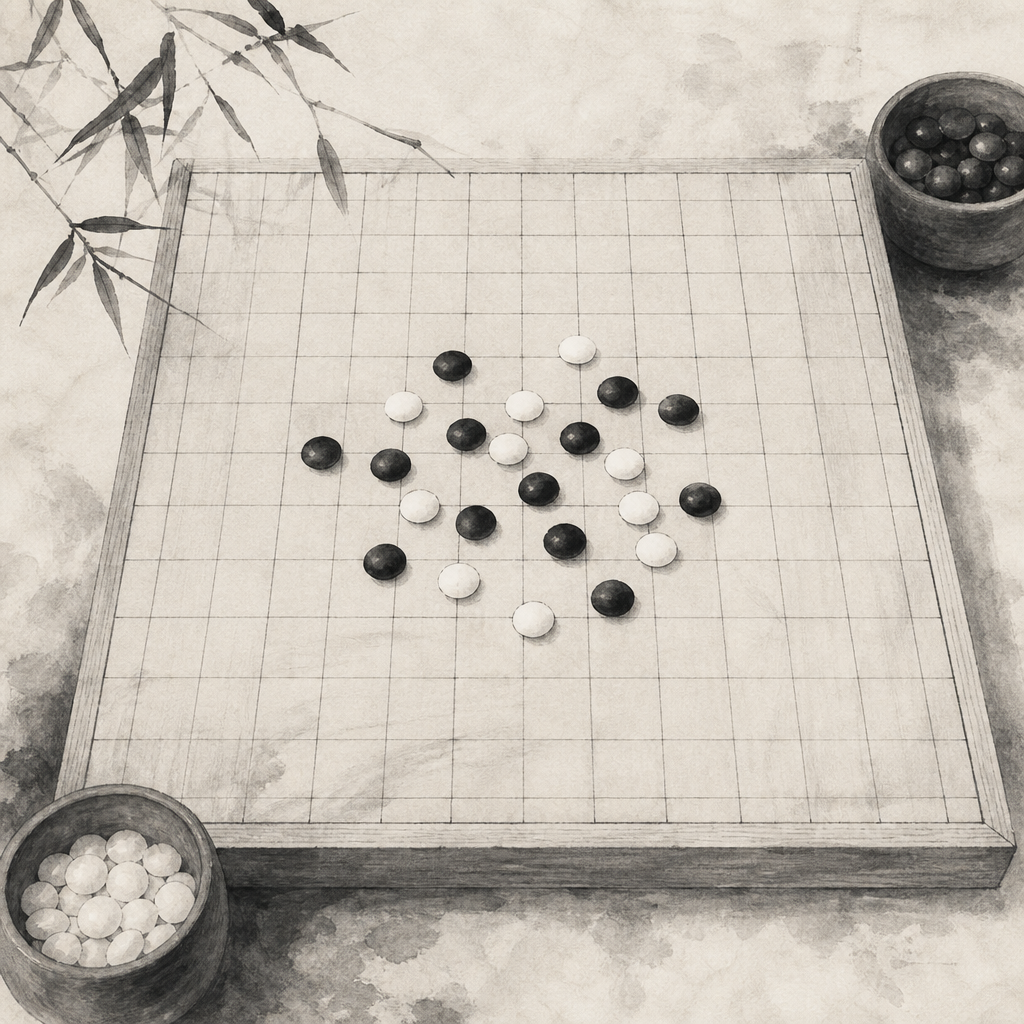
You may think Gomoku is only about your own next move. In team play, that is usually the first thing to break. In Yerevan, what you see on the board is not just winning and losing, but the weight of teammates, the pressure of the round, and the measure of the exchange rule. The game feels more restrained, and more layered.
Team play changes the game before it changes the schedule
The 2026 World Team Gomoku Championship is already on RenjuNet’s calendar, set for Yerevan, Armenia, from August 15 to 19. The point of team play is not that the board changes shape. It is that every move has to serve both your own position and the rhythm of the whole squad.
In a single game, you can narrow your focus until it is almost tunnel vision, pushing the attack as hard as it will go. In team play, that urge often has to slow down. You are not only playing an opponent. You are also fitting yourself into the team’s larger plan.
That is the temperament of team play: it turns a quick win into a safe one, and sharpness into rhythm that lasts. The sooner you accept that, the easier it is to read.
Swap2 makes the opening about more than first move
This event uses Gomoku Swap2. For many players, that means the opening is no longer just about moving first and answering second. It becomes a sequence with real choice: the first player lays out a structure, and the second player decides whether to swap, or how to steer the position toward a more comfortable shape.
So the opening looks calmer, but it asks for more judgment. You are not only trying to find a pretty start. You are also estimating whether it hands your opponent an easier reply.
In team play, the opening is about restraint before it is about force.
That is one reason Swap2 fits team play so well. It makes the old idea that the opening decides everything feel too simple. You have to think earlier about whether a move is meant to make you comfortable, or to make the team position more balanced.
Round-robin makes every move heavier
The official information lists the event as a round-robin, with 120 minutes plus 30 seconds per move. That is a long clock, long enough for a game to grow a second and third layer of meaning.
In that kind of format, haste is rarely an advantage, and an open three is not just a sign to lash out. You have to ask first: is this move creating a real attack, or is it building a smoother road for your opponent?
The weight of team play is not only about time. It is also about responsibility. You care more about whether the endgame exchange is clean, whether the defense leaves a backup, whether one forceful attack will affect the next pairing.
Yerevan will magnify the atmosphere
RenjuNet’s page places the World Team Renju Championship ahead of the World Team Gomoku Championship, both at Chess House in Yerevan, at 50a Khanjyan Street. The setup is direct, and it has ceremony: one city, one chess house, two world-class team competitions.
It naturally shifts your attention from a single game to the event as a whole. What you start seeing is not only results, but the order of the schedule, the venue, the rules, and the quiet discipline between teams.
The hard part is fitting judgment into the team
In individual play, you can let your judgment run all the way out. In team play, you also have to leave room for your teammates. When it is time to press, you press. When it is time to pull back, you do it cleanly. That sense that you cannot only think about the immediate position is what makes team play so compelling.
I would call it a more refined board sense: not less sharpness, but sharpness placed in a better position. The best attack is often not the loudest move. It is the one that serves the whole board best.
The best attack often starts by making room for the whole board.
Before you watch, slow your eye down
If you are going to follow this year’s Yerevan team championship, try adjusting your gaze first. Do not only watch for brilliant tactics. Watch the exchanges in the opening, the way the pace opens and closes, and the unspoken coordination between teammates.
You will understand more easily why team Gomoku is so compelling. It does not magnify individual heroics. It sharpens judgment, patience, and boundaries together. Once you see that layer, every game will taste different.