
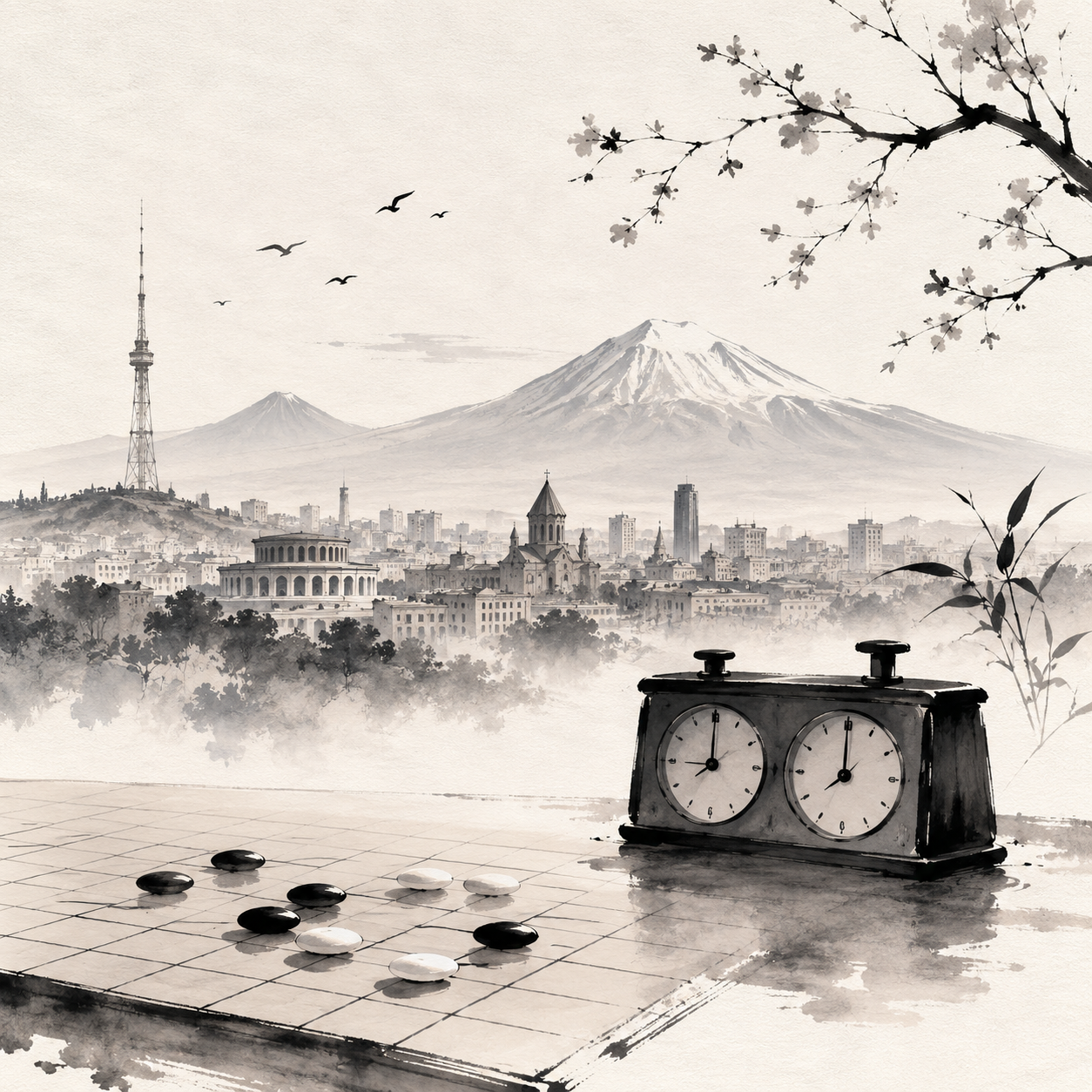
You open the calendar and first see Yerevan in August. Then you notice two “Team World Championship” entries almost touching each other. It is easy to pause: Is this one event, or two rule sets, two teams, two ways of seeing the board? If you usually play Gomoku but have heard about Renju’s forbidden moves and opening rules, this is a calendar worth reading slowly.
According to the coming rated tournaments listed on the RenjuNet tournament page, the 2026 Team World Championship will be held in Yerevan, Armenia, from August 8 to 16. Immediately after that, the Team Gomoku World Championship will also be held in Yerevan, from August 15 to 19. The names are close, the dates are adjacent, and the venue is the same. The real interest lies precisely in those overlaps.
First, separate the two schedules: August 8-16 and August 15-19
The first stretch is the Renju Team World Championship, listed by RenjuNet as Team World Championship 2026, running from August 8 to 16. The second is the Gomoku Team World Championship, listed as Team Gomoku World Championship 2026, running from August 15 to 19.
That means the two events overlap on the calendar between August 15 and 16. For a spectator, this is not an anomaly that needs an instant verdict. It is a clue: for that week, Yerevan may become the shared center of the world Gomoku community.
Why Renju and Gomoku belong in the same conversation
Many fans begin with free-style Gomoku. They learn four-in-a-row, open three, double-three, and only later hear about Renju. Renju is not simply “the same game, but more complicated.” It has forbidden moves for Black, opening regulations, and a more exacting design for balance. Change the rules, and you change how a team prepares.
Still, the two games share much of the feel of the same 15-by-15 board. Whether a point has open-three potential, whether a defensive move leaves a four-in-a-row counterattack, how teammates read the temperature of a position, these habits illuminate one game through the other. Watch Renju first, then Gomoku, and it becomes easier to understand why the same stone carries different weight under different rules.
The same stone grows heavier when the rules change.
The tension of team play is not only in one board
An individual event is like a line. A team event is more like a net. The steadiness of board one, the risk-taking of board two, the readiness of a substitute, the captain’s read on the opposing lineup, all of it changes the atmosphere of a round. You are not just watching a single game. You are watching several people carry one board together.
Imagine a simple scene: a player with Black gains the initiative early near tengen, only to find that two teammates are already locked in difficult defense. At that point, he may not choose the sharpest line. Team points may matter more than an elegant individual win. Restraint is sometimes harder than attack.
That is also what makes team competition worth watching. It has the edge of sport and the polish of detail; clock pressure, yes, but also board numbers, score sheets, and the tactile little ritual of the pregame handshake. It is good to watch. That is reason enough.
Start with Renju, then turn to Gomoku
If you plan to follow only part of the schedule, I would start with the Renju team event on August 8. Not because it is more “advanced,” but because Renju forces many Gomoku assumptions back into focus: which open threes are truly dangerous, which double-threes cannot appear under the rules, which natural-looking attacks are held down by the system itself.
When the Gomoku team event begins on August 15, your eye will be sharper when you return to free rules. How does Black handle the first-player advantage without the pressure of forbidden moves? When must White’s defense shift from blocking points to counterattack? That before-and-after comparison has more flavor than a results table alone.
RenjuNet’s calendar also points to a denser 2026
The two Yerevan events are not appearing in isolation. The same RenjuNet tournament page also lists several events in May 2026: the Chinese National Championship 2026 in Suizhou, the 64th Meijin preliminary in the Tokyo area, Team World Championship Qualification in Taipei, Ukraine Cup Renju/Gomoku, and Youth World qualifying tournaments in Anji.
Those names are scattered across different cities, but together they say one thing: by the time August arrives, many teams will already have passed through round after round of regional events, qualifiers, youth competitions, and national championships. The Yerevan team events are not a festival that begins out of nowhere. They are the confluence of the preceding months of the calendar.
The RenjuNet homepage also notes the scale of its database: 157,194 games, 3,569 tournaments, and 7,020 players. The numbers do not need exaggeration. They simply remind you that behind the game records, calendars, and names is a road built over time. To watch modern competition is also to read that road.
Do not confuse the computer event with the team worlds
Another related 2026 marker is Gomocup. According to Gomocup News, the Gomocup 2026 announcement was published on April 6; the event will be held from June 5 to 7, with submissions due by May 29 at 23:59 UTC. The page also mentions the requirement for a clean Windows system, the allowance for multiple rule-specific executables, and the use of Swap2 in the unlimited tournament.
What an ordinary fan should watch in August
Do not try to understand every game record from the start. Look first at the lineups, then the board order, then the score shifts after each round. The story of a team event is often not in the most brilliant game, but in the board that was supposed to be steady and suddenly gives way.
As you watch, pay special attention to three kinds of positions: whether the opening builds a rhythm around tengen, whether the middlegame produces tension around open threes and double-threes, and whether someone chooses a conservative point in the closing phase for the sake of the team score. These questions are specific enough to follow, and durable enough to reward attention.
A good schedule makes you want to watch slowly.
For now, the confirmed information should be read from the RenjuNet tournament page: Yerevan will host the Renju and Gomoku Team World Championships consecutively in August 2026. If registration details, formats, team lists, or organizer news appear later, attach them to this timeline. It will be clearer than reading scattered updates.
As the dates approach, choose one evening and set up the key game you most want to revisit. Watch less of the noise, and more of why one stone landed where it did. One game is enough.