
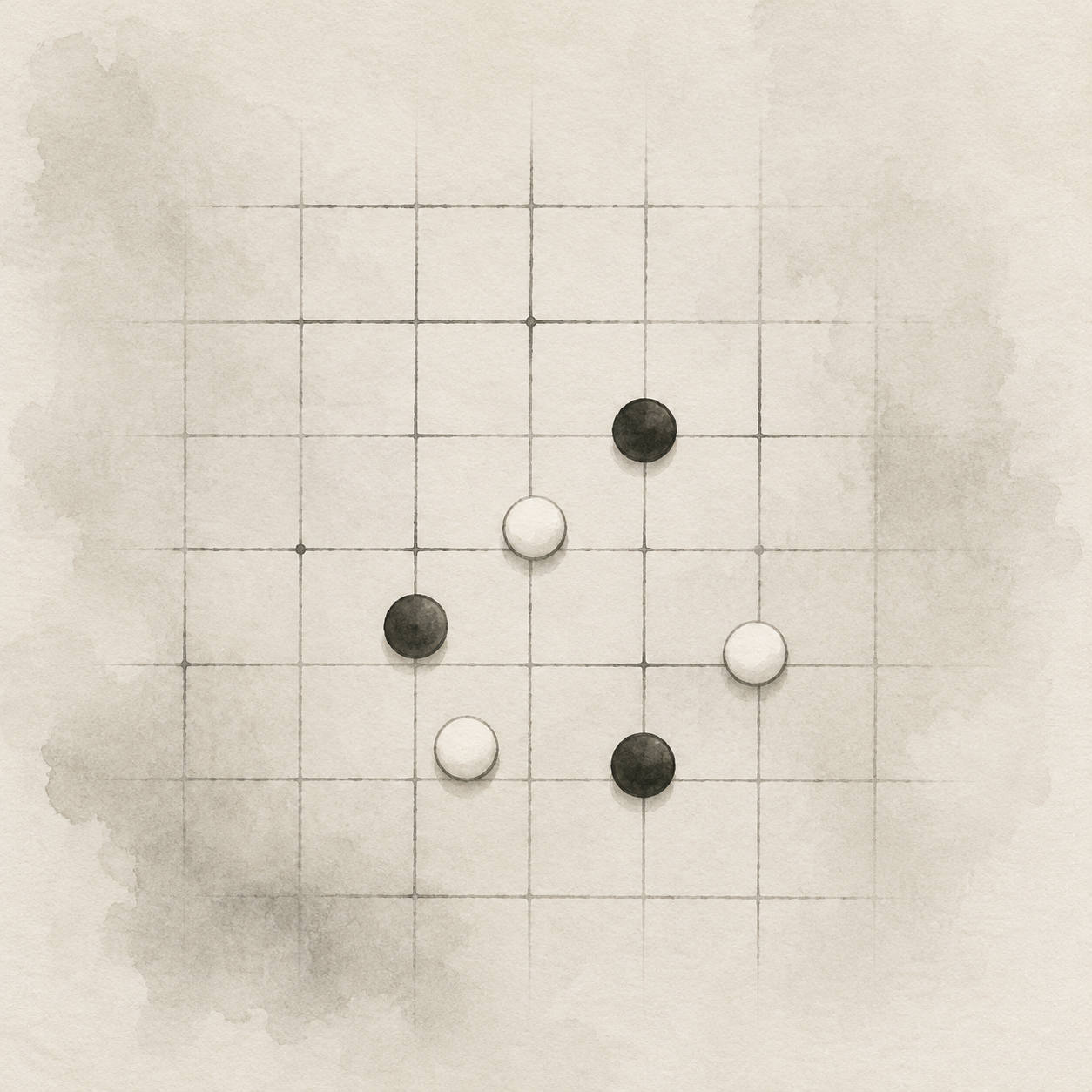
Why can a game feel suffocating almost from the start, even when you have barely made a mistake? In free-style Gomoku, Black moves first, creates the first threat and forces the first reply. If both players are precise enough, that first-move advantage becomes hard to ignore. Renju restricts Black not to punish the first player, but to restore the game to something calmer, finer and more worth watching.
The trouble with free-style Gomoku often begins at tengen
The most natural first move is tengen. It sits at the center of the board and reaches in every direction, opening the horizontal, the vertical and both diagonals. To a beginner, it is simply “playing in the middle.” To someone who can calculate, it is a way of claiming future space before the game has even begun.
The rule of free-style Gomoku is plain: the first player to make five in a row wins. Plainness gives the game speed. It also gives it a bias. Every time Black makes a threat, White must answer. If Black can pose two problems in succession, White may have to watch one of them become decisive.
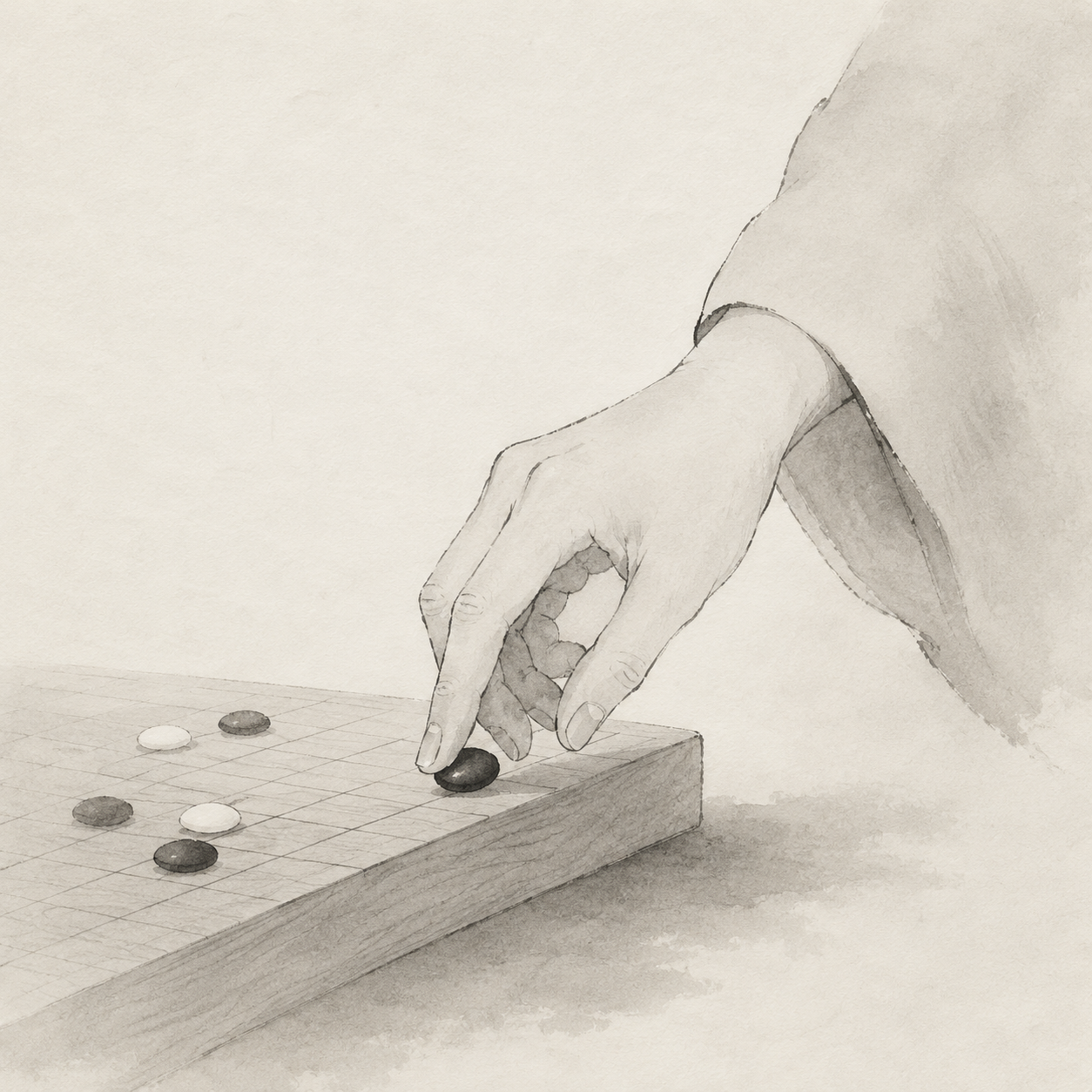
Black’s advantage is not a feeling. It is tempo.
The first-move advantage is often misunderstood as simply having “one extra stone.” The more important thing is tempo. Black asks first; White answers first. When the question is sharp enough, the answer stops being a choice and becomes an obligation.
Suppose Black makes an open three. White has to block its line of extension. On the next move, Black changes lines and makes another open three. White chases again. On the surface, the players are taking turns. On the board, the pressure is moving in one direction.
The power of the first move is not the extra stone. It is asking first.
Forbidden moves weaken the cheapest wins
Renju’s best-known constraint is Black’s forbidden move. The common forbidden moves for Black include the double-three, the double-four and the overline: Black cannot win in these ways and, under the rules, may lose by making them. RenjuNet’s rules explanation treats them as part of what separates Renju from ordinary Gomoku.
A double-three means one move creates two threes that can grow into open fours. White can block only one side; the other keeps expanding. A double-four is blunter. One move creates two fours at once, almost writing the answer directly onto the board.
The overline can seem stranger: if Black has made six or more in a row, why is that not a win? Because Renju is not chasing “the more, the better.” It asks for an exact five. It removes the crude overflow and makes victory land in a more disciplined place.
Opening rules limit the most perfect script
Forbidden moves alone are not enough. The strongest openings for Black often steer the game, within the first few moves, onto well-mapped roads. So Renju also has opening rules: prescribed placements, swaps and choice mechanisms that keep one side from simply laying out a prepared script.
RenjuNet’s introduction to openings lists the opening systems used in different eras. You do not need to memorize their names. What matters is their direction: they stop Black from easily getting the smoothest, cleanest, hardest-to-refute start.
The rules are strict, but they have an elegance
The first time you hear about forbidden moves, they may feel awkward. Why can’t Black play that? Why can White do something Black cannot? The asymmetry is not intuitive, but it is honest. It admits that Black is already better positioned to control the tempo, and therefore must carry extra constraints.
One thing I like about Renju is that it does not pretend the board is naturally fair. It puts the imbalance in plain view, then repairs it carefully with rules. Beauty is reason enough to play. But the condition of beauty is that both sides still have room to breathe.
Real fairness sometimes has to be asymmetrical.
Solved-game research makes the first-move problem harder to miss
One often-cited background point is L. Victor Allis’s 1994 solving work: on the standard 15-by-15 board, with no forbidden moves, the first-move advantage was analyzed systematically, and the conclusion that the first player can force a win has been cited ever since. The proof details are not needed here. For an ordinary reader, the point is simpler: this body of work makes Black’s opening pressure difficult to dismiss.
For background reading, you can start with the overviews of Gomoku and Renju. They are not answer books for the game in front of you, but they do explain why Renju developed forbidden moves and opening rules.
Even casual games can borrow Renju’s way of seeing
You do not have to switch immediately to formal Renju rules. Even in a casual game of free-style Gomoku with a friend, you can borrow its perspective. When Black keeps creating threats, do not ask only, “Where should I block?” Ask also, “Why does Black always get to ask first?”
It is a small exercise, but it changes the feel of the game. You begin to notice the board’s remaining space, instead of staring only at the immediate four-in-a-row. Renju’s value may lie there: it pulls victory away from the fastest route and back into a more interesting process.
Restricting Black lets the game keep growing
Good rules are not only referee’s clauses. They are a form of design. They determine a game’s breathing, its speed, its texture. Free-style Gomoku is a sharp little knife. Renju gives that knife a sheath.
So when Renju restricts Black’s perfect opening, it is not thinning out the beauty of the game. It is delaying a conclusion that arrives too early. The next time you see a double-three, a double-four or an overline, pause for a second. That is not fussy rulemaking interrupting the game. It is the game asking for more possibility.