
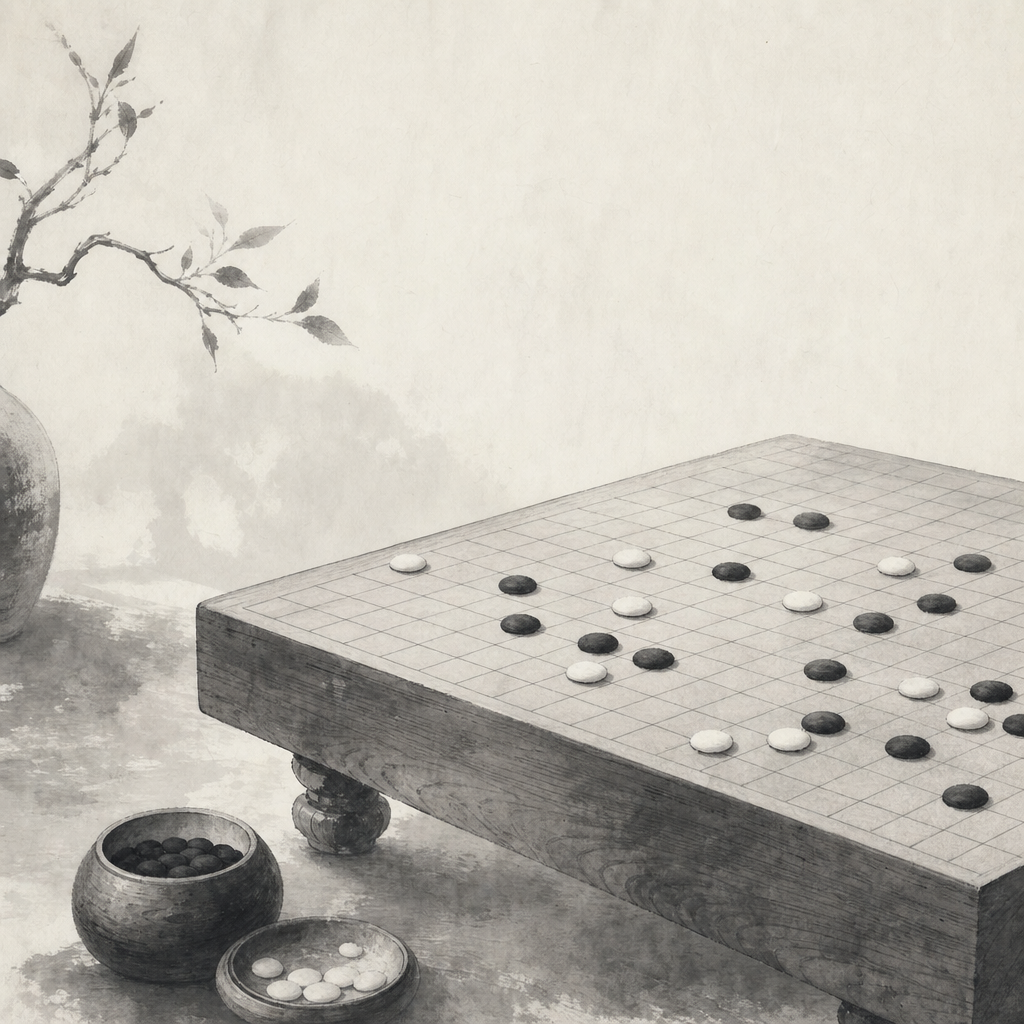
You keep seeing Taraguchi-10 on tournament pages, yet the name itself gives away little of how the game changes. It is not as visibly shaped as an “open three,” nor as instantly tense as a “forbidden move.” It is more like an unseen hand, burnishing the choices, swaps and tempo of the first few moves. To understand it, begin with White’s fifth move.
Taraguchi-10 Is Not a Pattern Name, but an Opening Procedure
Many players, on first hearing Taraguchi-10, assume it refers to a fixed shape. In fact, it is closer to a procedure: the first few moves establish a framework according to the rules, after which White chooses the fifth move from several candidate points, sending the position in different directions. The name sounds severe; on the board, it is delicate.
In RenjuNet’s explanations of special opening procedures, rules of this kind are placed at the level of “how to start a game of Renju,” rather than at the level of any single joseki-like answer. In other words, you are not memorizing a solution. You are learning a way for Black and White to enter the middlegame on more balanced terms.
That is where the tactile quality of Taraguchi-10 lies. It does not hurry victory and defeat to the front of the stage. It first opens the space, letting both sides confirm, on the same board, where the sharp edges are and where the excitement is merely decorative.
The Fifth Move Turns an Abstract Rule Into Concrete Feel
The fifth move matters because it often determines the tone of the position. A point close to the existing stones tightens the game; a point set slightly farther out gives later attacks more room to bend. What you are seeing is not simply “the fifth stone,” but White’s first complete sentence about the whole game.
If White chooses a point close to Black’s stones, for instance, Black must soon decide whether that proximity can be used to build an open three or the prelude to a four-in-a-row. If White chooses a slightly more distant point, Black’s direct attack may be stretched out, while White gains a chance to turn defense into restraint. Change one move, and the whole game breathes differently.
The fifth move is not a patch. It is a key signature.
Swapping Makes the First-Move Advantage Less Blunt
One of Gomoku’s oldest problems is Black’s first-move advantage. If the opening is too free, a strong player can easily let the initiative from the first move keep compounding. If the restrictions are too rigid, the game loses its natural variation. Taraguchi-10 tries to stand in the middle.
The swap here is not a ceremonial formality, but a transfer of pressure. After the first few moves, both players have a chance to reassess color, shape and future risk: Am I willing to take this side? Can I endure the counterplay at that point? That hesitation makes the opening more modern, and more restrained.
When Reading the Position, Look First at Tempo, Not for the Kill
Beginners looking at this kind of opening often start by searching for four-in-a-row threats and forced wins. The trouble is that the early phase of Taraguchi-10 does not always give you answers that quickly. It is asking something else: who can seize the tempo first, and who is forced to keep repairing shape in response?
One practical test is continuity. If one side can expand along two lines with every move, the tempo is in that player’s hands. If the other side is only blocking an immediate threat each turn, then even with the same number of stones on the board, the position has already tilted. Read the tempo first. The killing move will arrive a little later.
Among the Ten Choices, What You Are Really Comparing Is Risk
“Ten openings” sounds like ten roads. In practice, it is more like ten arrangements of risk. Some points look stable because they cling to existing structure; yet they may also reveal direction too early, letting Black borrow the force of the shape. Some points look loose, but give White an extra place to turn later.
You can ask three questions of every fifth move: What is the most natural attacking line it leaves Black? What does it make White most want to do next? If Black does not cooperate, does White have a second plan? These three questions will outlast any memorized “recommended point.”
Why Recent Tournaments Still Choose Taraguchi-10
Looking at RenjuNet’s tournament listings, both the 2026 Dalian Youth World Championship and the 2026 Yerevan World Team Renju Championship list Taraguchi-10. There is no need to read this as a matter of news-cycle heat. What is more notable is that the system can serve different age groups and different formats, giving games a sense of balance from the very beginning.
For spectators, that also makes the games easier to watch. Not because every game is complicated, but because after the first five moves, both players quickly enter a state of trade-off: take speed, or preserve flexibility; press the center, or turn to the outside. Watchability is itself a reason.
Balance does not make the game slower. It makes it more worth watching.
Practice Taraguchi-10 as a Quiet Form of Observation
If you want to become truly familiar with Taraguchi-10, you do not have to swallow every variation at once. Choose one fifth move and watch three games in a row: in the first, look only at Black’s sixth move; in the second, look only at how White defends; in the third, go back and find the first open three of the middlegame. Studied this way, the shapes will slowly settle.
The next time you see Taraguchi-10 on a tournament page, you will no longer treat it as just a rules term. You will know that those ten fifth moves are gently placing first-move advantage, swapping, tempo and position reading on the table. Find a game, and try one slowly.