
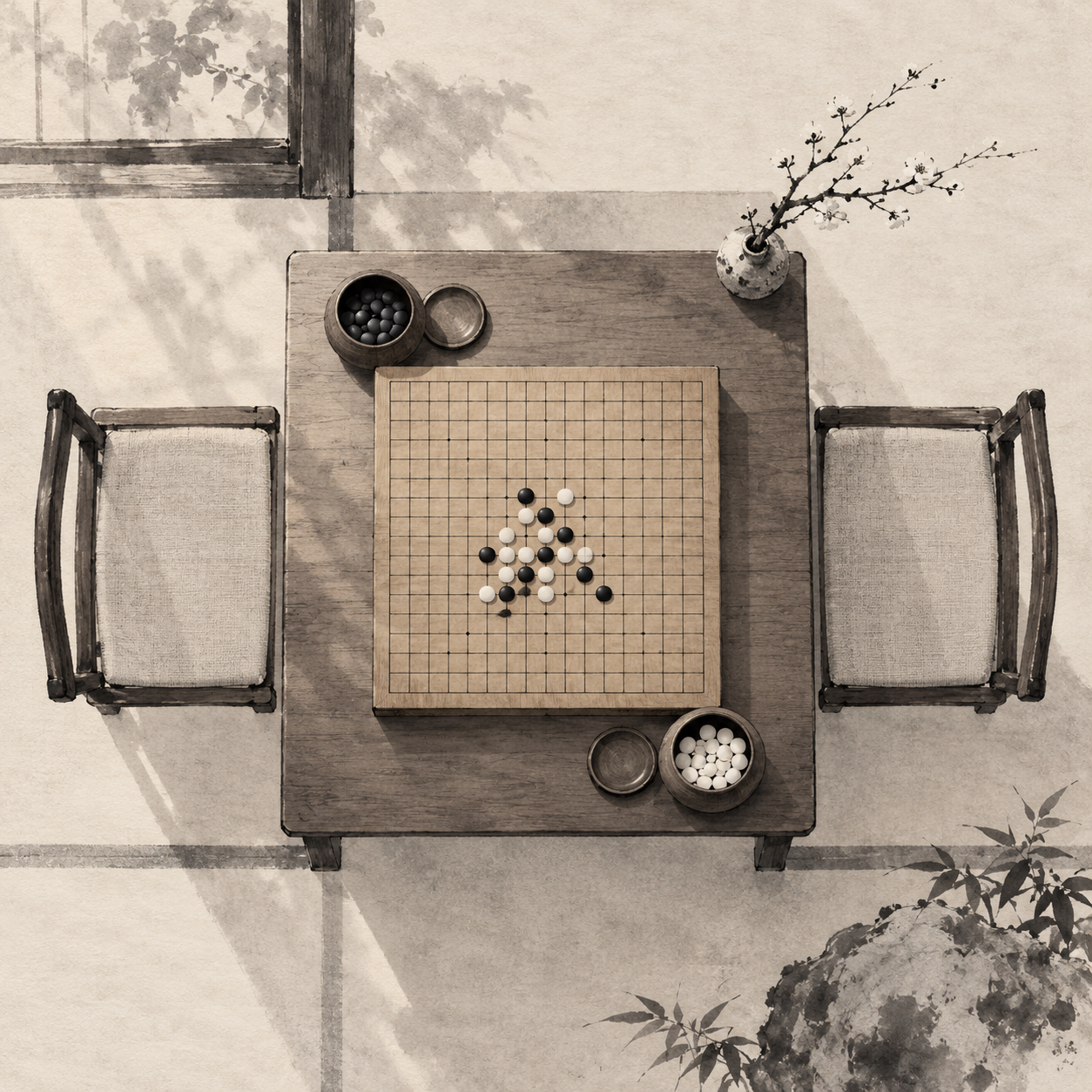
At the Shenzhen Chess Academy in Silver Lake, black and white stones mark the intersections of Gomoku boards. Games are still underway. This weekend, you can watch an elite tournament here, sit in on instructional games and hear talks about Gomoku. Beyond the tournament hall, a nationwide call for old records offers another way to look at the sport’s twenty years of official recognition in China.
This weekend at Silver Lake
From October 16 to 19, Silver Lake is hosting the China Sports Lottery 2026 Greater Bay Area (Shenzhen) Gomoku Elite Tournament and events marking twenty years of official recognition for Gomoku in China. The long name joins elite competition to public outreach. Walk up to a board and you see the first; head toward the instructional games and talks, and you find the second.
The tournament has eight rounds. Each player starts with 60 minutes and gains 30 seconds per move. There is time to think, but every move is still on the clock. The weekday format features 12 players on each side of a matchup; on the weekend, that rises to 15.
Among the players are He Shujun, Ling Shijie, Wang Qingqing and Zhang Yifeng, who have won world individual, world team or national individual titles. What you see at Silver Lake is not simply a commemorative display. These players take their seats, and the anniversary becomes a set of games in progress.
It began with official recognition
In 2006, the General Administration of Sport of China formally recognized Gomoku as a competitive sport. In 2026, that designation turns twenty. It gives the tournaments, the grading system and the work of developing players a shared starting point.
On October 10, the Board and Card Games Administrative Center of the General Administration of Sport issued Notice No. 392 of 2026, inviting the public to submit materials from those twenty years. It seeks documents left by tournament organizers, along with records kept by players, referees and coaches. You can follow that history beyond the playing hall, through a single page or an old book.
A record in four parts
The notice describes four areas of progress: tournament organization, dan-and-kyu grading, player development and international exchange. The tournament record has a clear timeline. Since the first National Mind Sports Games in 2009, Gomoku has been an official event at five consecutive editions. The notice also names the National Gomoku Championship and the National Youth Gomoku Championship.
The notice lists dan-and-kyu grading separately from competitive results. For one measure of player development, look to the younger players: according to the China Mind Sports Network, Shenzhen players won four gold medals and one silver at the 2026 World Youth Gomoku Championship. Those results give the word “development” particular players and games.
The same report says Shenzhen won the mixed-team division of the National Gomoku Team Championship. Team competition offers a different setting from individual play; international events take players farther afield. The notice’s four categories show up in rules and institutions, in tournaments at different levels, and in the games players actually contest.
Why ask the public for old records?
The call covers five kinds of material. Important documents include official papers, notices, regulations, reports and meeting minutes, as well as early development plans and management rules from associations and clubs. Tournament materials include photographs and video from past National Mind Sports Games, National Gomoku Championships and National Youth Gomoku Championships. What you have may come from a match—or from the work that happened before one could begin.
Materials relating to people include players’, referees’ and coaches’ work notebooks, officiating records, and footage of training and outreach. Historical materials include early books and periodicals, along with records of programs that brought Gomoku into schools and communities. Other objects and materials of historical value are welcome, too. A certificate tells you who won. A referee’s notes may show how the competition ran.
Submissions are due November 1, 2026, at zgqywzq@126.com. The notice says materials will be used only for anniversary activities and official project archives, not for commercial purposes. Contributors whose materials are accepted after review will receive a commemorative donation certificate. If you find an old document or recording, those are the terms you can check before sending it in.
A trophy records the result. A game record shows the moves.
Shenzhen’s part of the story
Shenzhen formed its Gomoku team in 2023 to prepare for the fifth National Mind Sports Games. For the city, a team meant players could train together. It also gave Shenzhen a local side for later matches and exchanges. The anniversary events at Silver Lake follow that beginning.
The China Mind Sports Network also reports that He Shujun and Ling Shijie, representing China in successive years, won the 2024 and 2026 World Gomoku Team Championships. The stage changed between Shenzhen’s preparations and those world events, but team competition remained part of the story. When you see their names at Silver Lake, you can trace some of the games that brought them here.
During the tournament, Zhang Wendong, director of the Shenzhen Mass Sports Promotion Center, put it this way: “We must not only go out to compete; we must also invite others in to exchange ideas.” Silver Lake gives that thought a practical form. Players have come to Shenzhen to compete, while space beside the boards has been set aside for instruction and conversation.
Another board, the same weekend
On the International Renju Federation’s calendar, the same weekend brings Piškohraní 2026 in Prague, scheduled for October 17 and 18. It is a rated tournament played under Swap2 rules. Put the two events side by side on a calendar and you see that, beyond the activities in China, international competition continues.
At Silver Lake, games between adult and youth players use the applicable opening rules. The Prague listing specifies Swap2. Opening rules are among the conditions players face as soon as they sit down. International tournaments and continuing competition at home have their own schedules, bringing players before different opponents.
What you can still see
The historical materials sought by the notice include early game records and teaching handouts. A game record lets you follow each stone in order. A handout preserves what someone once taught. Neither gives you a winner at a glance, as a champions’ list does. Both come from the particular places where Gomoku was studied and explained.
If you have a record or handout like that, you can submit it as the notice directs. One move on a Silver Lake board will lead to the next. A game record from twenty years ago can still be opened at its first move.