
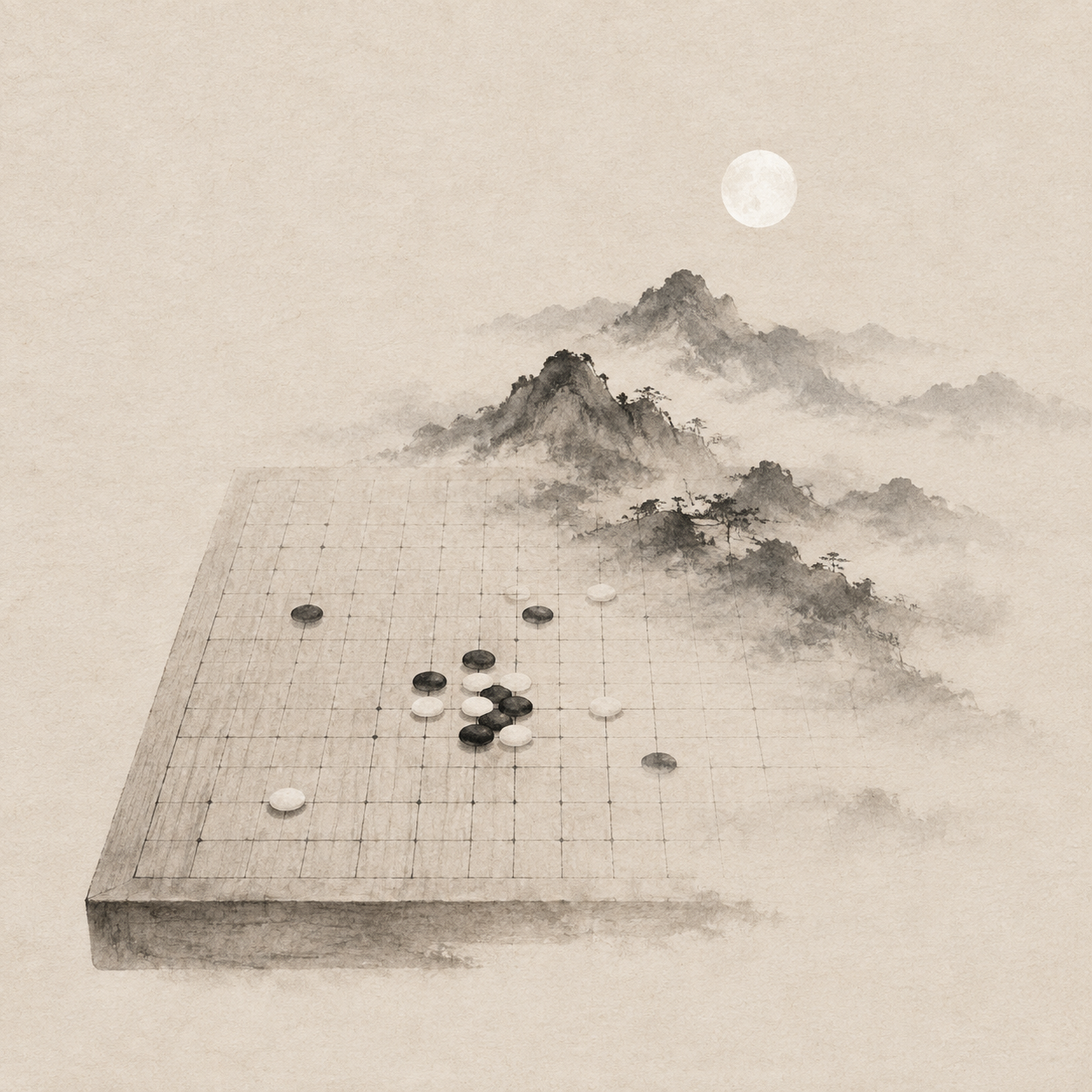
You place Black 1 at the center, White 2 beside tengen, then send Black 3 looking for a place of its own. It seems like only three intersections, but the game has already entered one of 26 named patterns: Kagetsu, Hogetsu or Chosei. Opening names are both an index to joseki and a surviving account of how players once saw mountains, moons and stars. The trouble is that not all of those explanations made it to the present.
Where the Number 26 Comes From
Renju’s opening rules are narrow: Black 1 must land on tengen, while White 2 and Black 3 must fall within one 「一間飛び」 (one-space jump) of it. Once rotations and mirror images are removed, the first three moves leave exactly 26 basic patterns. The Japan Renju Association calls them 「基本珠型」 (basic opening patterns), each with its own nickname.
Modern records usually begin with White 2. If it lands beside Black 1 on the same rank or file, it is called 直接打ち (direct placement), or choku-dome in Chinese usage. On a diagonal neighbor, it is 間接打ち (indirect placement), or sha-dome. Each group contains 13 patterns, making 26 in all. Numbers such as “Direct One” and “Indirect Seven” follow this system.
Classification Came Before the Names
The older system did not begin with White 2. It looked at the two black stones. If Black 1 and Black 3 lay on the same line and touched, the pattern belonged to 連 (Ren); if they shared a line with one empty point between them, it belonged to 間 (Ma); if they were neither aligned nor adjacent, forming a knight’s-move relation, it belonged to 桂 (Kei). These three relationships form the skeleton of the old names.
All eight Ren names end in “moon”: Kagetsu (花月), Hogetsu (浦月), Gingetsu (銀月), Shogetsu (松月), Kyogetsu (丘月), Shagetsu (斜月), Ungetsu (雲月) and Ugetsu (雨月). The Ma group ends in “star”: Chosei (長星), Kosei (恒星), Meisei (明星), Kansei (寒星), Sosei (疏星), Kinsei (金星), Zuisei (瑞星) and Ryusei (流星), later joined by Suisei (彗星) and Yusei (游星). The Kei group returns to “moon”: Kyogetsu (峡月), Keigetsu (溪月), Sangetsu (山月), Meigetsu (名月), Rangetsu (岚月), Suigetsu (水月), Zangetsu (残月) and Shingetsu (新月).
Who Named the “Stars”?
The “star” suffix has a clear date and signature. In March 1919, Uchida Kōseki named seven Ma patterns: Chosei, Kosei, Meisei, Kansei, Sosei, Shinsei and Zuisei. He added: 「但し七桂と区別する為に皆星の字を付したり」 (“To distinguish them from the seven Kei patterns, I gave them all the character for ‘star’”).
Ryusei was added later, expanding the traditional Ma group to eight. When the system shifted to direct and indirect placements, Suisei and Yusei joined the list, producing the ten names commonly cited today. Yamaguchi Yūsui traced this history in 珠型名の由来・平成版 (The Origins of Opening Names: Heisei Edition); the original text also notes that the additions and the change in classification did not happen at the same time.
Reading the Board as Mountain and Water
The fullest account of the “moon” names comes from Takayama Goraku, the first Meijin. In April 1911, he described the names alongside the “five Ren patterns” in 聯珠真理 (The Principles of Renju): Black 1 and Black 3 become mountains, while White 2 resembles the moon. Three stones turn into a miniature landscape.
Sangetsu is explained as 「月白、山巓に在り。故に山月と謂う」 (“The moon is bright and rests on the mountain peak; therefore it is called Sangetsu”). Kyogetsu and Keigetsu place the moon in a gorge and a stream valley. Meigetsu was originally Meigetsu in the sense of “bright moon,” when the moon has fully left the mountain; Rangetsu is the moment just after it departs. Suigetsu hangs above the water. Zangetsu rests on one peak but remains higher than another. Shingetsu has not yet left the mountain, which itself is low. Read in sequence, the names turn positional relationships into the moon’s journey through a mountain range.
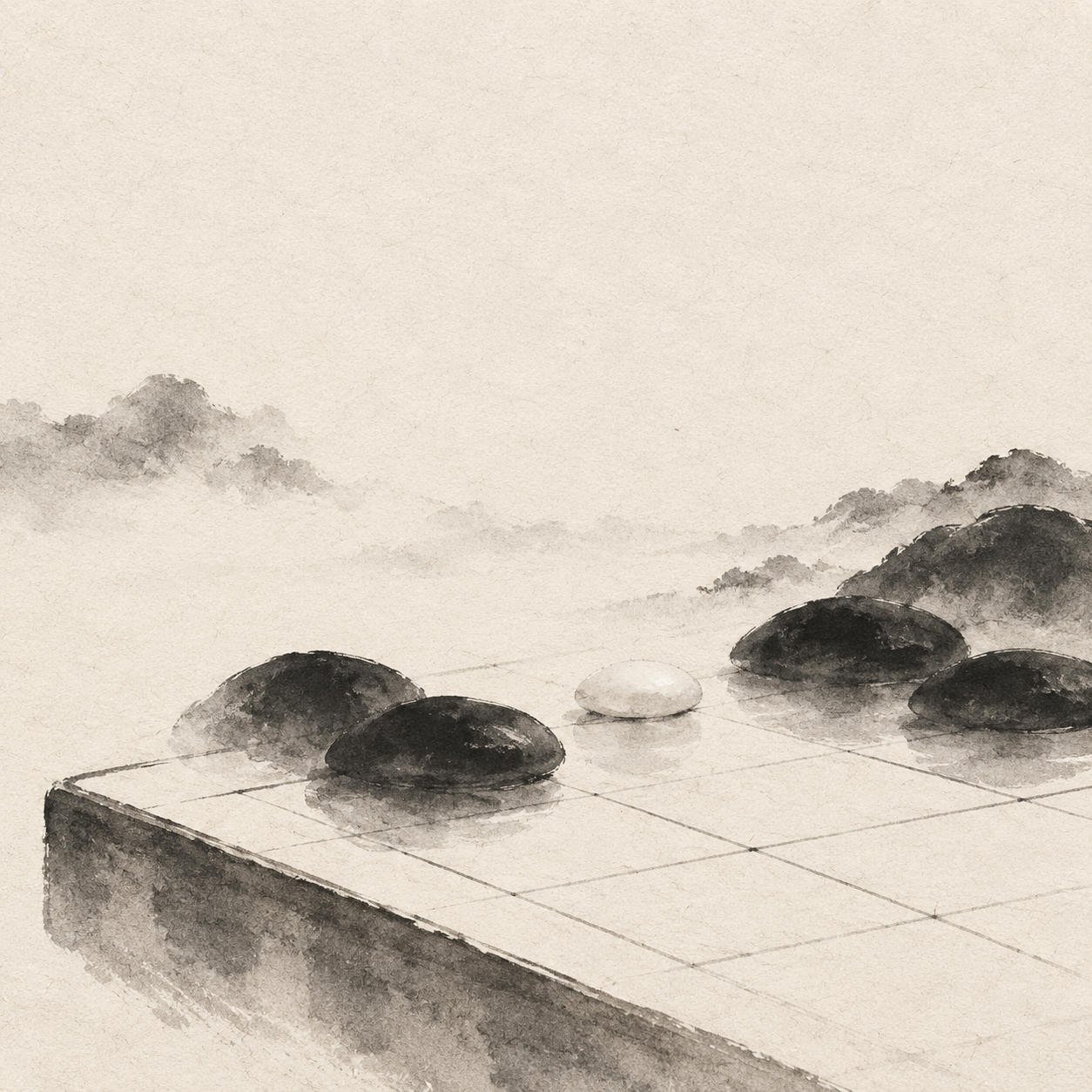
The black stones establish the mountains; the white stone becomes the moon. One name explains all three moves.
One Character Changed: From Meigetsu to Meigetsu
Meigetsu has a documented textual history. It was first written as 「明月」 (bright moon). In August 1924, Hashimoto Gomoku of Onomichi proposed the form 「名月」, because 「明月」 and 「明星」 had the same pronunciation and could be confused in speech and records. The form that survived preserves that small change, made to avoid a homophone.
Chosei, Suisei and Bōsei: Borrowed from Old Astronomy
Chosei’s explanation comes from the old encyclopedia 和漢三才図会 (Illustrated Compendium of Japan and China). It divides tailed stars into three types: Suisei, with a tail long as a broom; Bōsei, with a short tail and light spreading in every direction; and Chosei, whose light extends straight toward both ends, sometimes 「天に竟なり」 (“reaching all the way to the edge of the sky”). In older astrology, Chosei was also the most ominous type, so the name carries both a shape and an inherited judgment. Meisei is another name for Venus, while Shinsei is an old name for Mercury; later, Shinsei became Kinsei, today’s Direct Seven, Kinsei. These astronomical terms do not map neatly onto modern planetary names. To read the opening history, you have to keep the old meanings separate from later game-record numbers.
Half the Story Is Lost
A name can have a source without every name having an original explanation. In 珠型名の由来・平成版, Yamaguchi says that the surviving accounts come mainly from 聯珠真理. No complete old explanation remains for the Ma group; the interpretations he supplies are inferences drawn from the names.
He compares the work to excavating a broken clay vessel. You can fill the gaps with plaster so later readers can understand it, but you must mark what is conjecture. If an old book is found later and disagrees with the reconstruction, the account should be rewritten. Archived material preserves the same caution: record what is known, and do not fill what is unknown with legend.
What Are the Names For?
In practical study, an opening name is first of all an index to joseki. Say Kagetsu or Kosei, and you can enter the relevant first three moves, standard replies and variations through a single word. That is far easier to reuse in records, catalogs and conversation than repeatedly describing the positions of Black 1, White 2 and Black 3.
Among beginners, the three openings often singled out as easier for Black are Kagetsu, Hogetsu and Kosei. Yusei and Suisei, by contrast, were traditionally considered losing openings for Black. Japanese joseki often count only 24 patterns, while the International Renju Federation’s official system includes Yusei and Suisei, bringing the total to 26; RenjuNet’s opening table still presents the full range as Indirect One through Thirteen and Direct One through Thirteen.
An opening name is an index. Its history tells you how that index was once organized.
Next Time You See Keigetsu or Chosei
Chinese and Japanese Renju never developed separate naming systems. “Star” and “moon” are the Chinese characters preserved from Japanese naming, and Chinese players adopted the Japanese characters and pronunciation—for example, Kagetsu, Keigetsu, Ryusei and Yusei. When you see Keigetsu, think first of the knight’s-move relation between the black stones, then of the old image of White 2 entering a stream valley. When you see Chosei, remember that it belongs to Ma, named for a star’s light reaching straight toward the horizon.
The value of these 26 names lies in their double life. They mark the first three moves precisely, while preserving the way their namers once looked at a position. The next time an opening record gives you Kagetsu, Keigetsu or Chosei, you can read at least one concrete thing in the name: where the stones stand, and what remains knowable—or still uncertain—about the story behind it.