
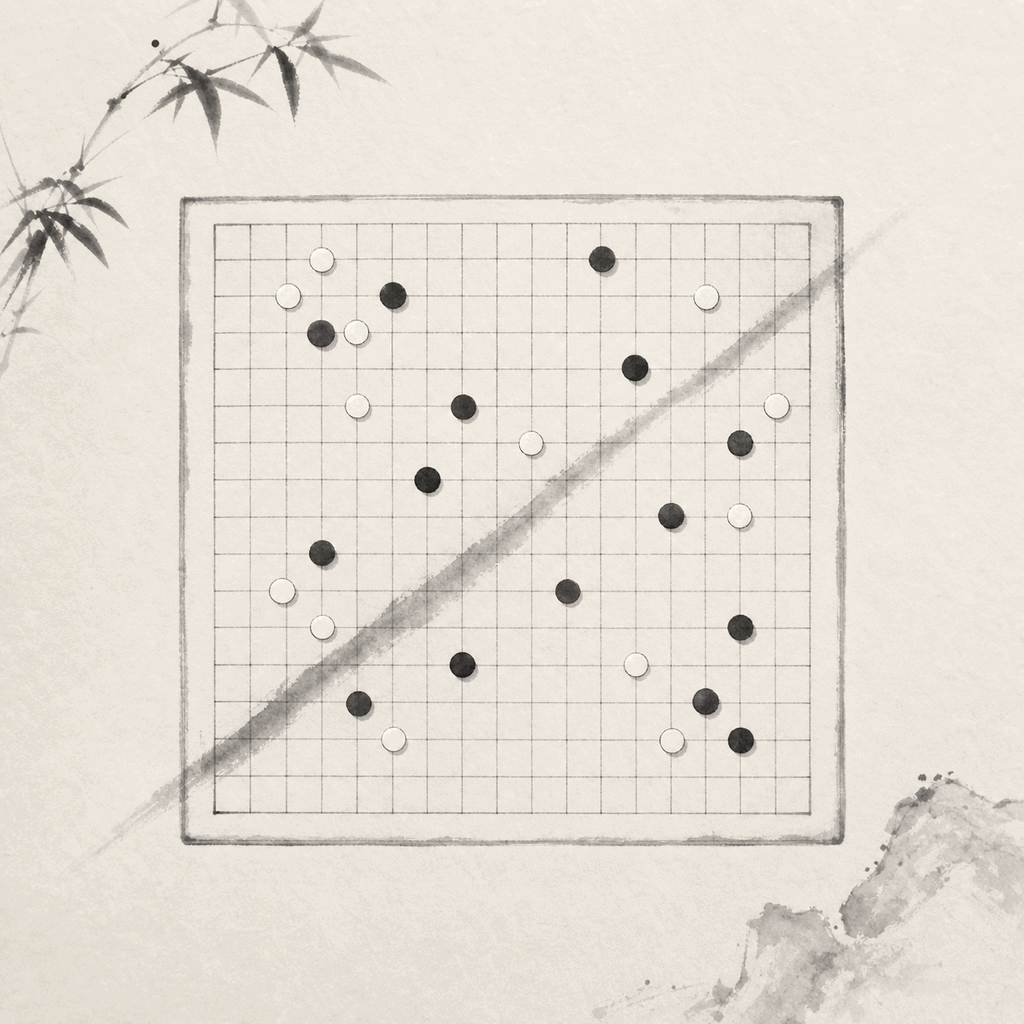
You are staring at the board, and still you miss the four your opponent has been growing on a diagonal. In review it is obvious. In the game it seemed to slide along the background. Often the issue is not that you calculated too slowly. It is that the board put too much in front of you at once.
Diagonals hide because they ignore the screen
A diagonal is easier to miss than a horizontal or vertical line. Rows and columns run with the edges of the screen, so the eye naturally sweeps along the grid. A diagonal has to cross intersections, line segments, and pockets of air between stones. It asks for more work.
Gomoku is usually played on a 15-by-15 board, with a plain objective: the first player to make five in a row wins. For background, see this explanation of Gomoku rules. The rules are simple. The visual task is not. You have to see direction, distance, and threat across dozens of intersections at the same time.
The classic miss happens when your opponent adds a stone along the lower-left to upper-right diagonal. You register an ordinary move. A second later you realize it has connected two loose points into an open three. Diagonal threats rarely arrive out of nowhere. They have simply been too quiet to notice.
White space gives the eye time to refocus
White space sounds decorative. It is practical. The board edge, the spacing between lines, and the air around stones all decide whether your eye can separate layers inside a mass of information. A crowded board makes every intersection shout.
To read a diagonal, your eye has to string together several points that are not adjacent in the usual way. If the lines are too heavy, the frame too tight, or the stone shadows too assertive, your gaze gets caught locally. White space helps you jump sooner to the next point that might matter.
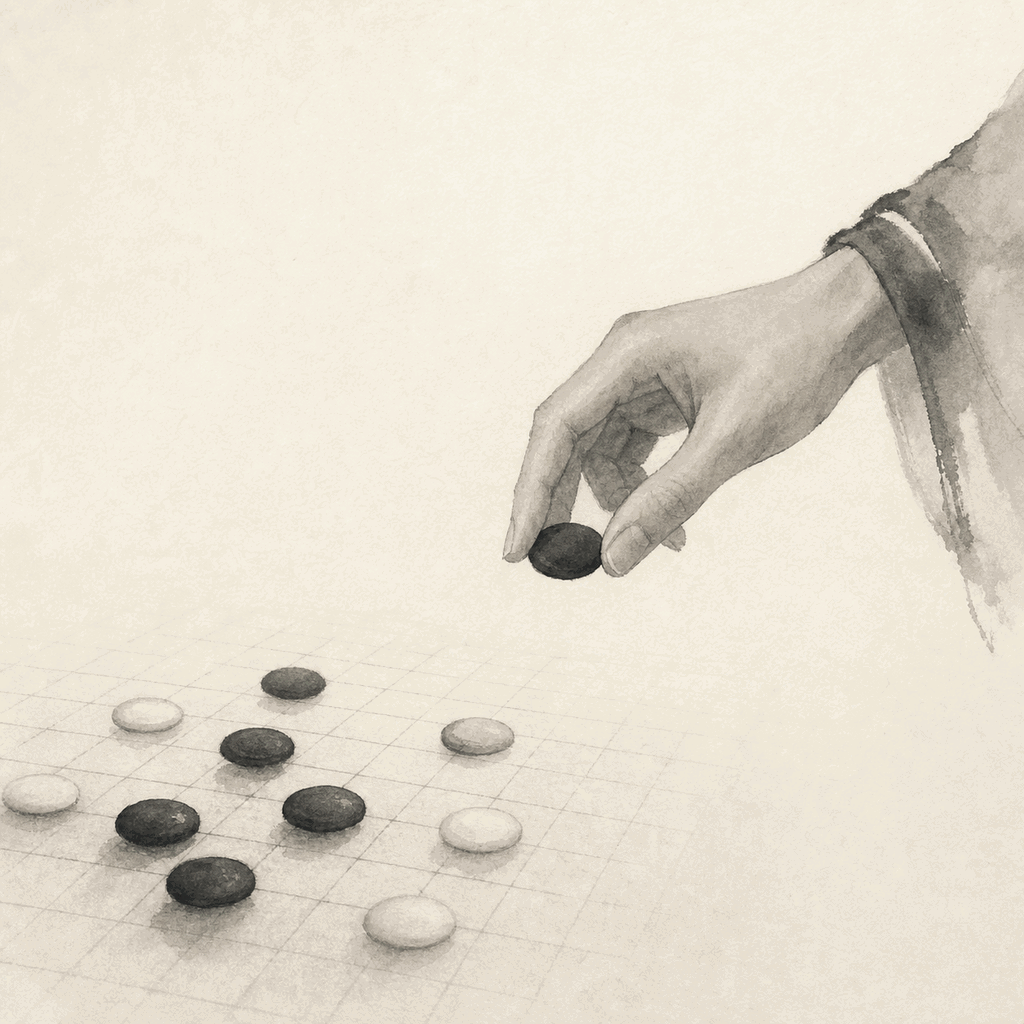
This is why some boards look beautiful at first glance and become harder to play on at the second. Pattern, texture, and frame all have presence; once the stones land, they compete with the background. Design has to serve shape reading. It especially has to let low-contrast diagonals be caught.
Diagonals need a quiet background
Loud lines break the relationship between stones
Board lines are there for location. They should not become the subject. When lines are too thick, intersections turn into little crosses, and the sense of continuity between stones is cut up. When lines are too dark, even empty points seem to carry weight, which can distort judgment.
Take a common position: Black has two stones near tengen, separated by one empty point on a diagonal, and White has just defended nearby. If the grid is heavy, you first see an even field of lines. If the grid is restrained, the empty point between the two black stones comes forward sooner. Shape reading happens in that order of arrival.
That does not mean the lines should be as pale as possible. Too pale, and you lose orientation; on a small screen especially, intersections become vague. The steadier answer is to make the lines clear enough to locate points, but never so strong that they overpower the stones’ shape and spacing.
Margins decide whether you see the whole threat
Many missed diagonals happen near the edge. When stones sit close to the border, the eye tends to stop, as if the threat ends there too. A narrow margin makes that illusion stronger.
Imagine a four that runs from the upper right toward the center, with one end pressed against the frame. If the border is tight, you are more likely to read it as a local exchange. If the edge has room to breathe, your gaze continues inward along the direction and sees what the next move demands.
In Renju, the board and the forbidden move rules make shape judgment more exacting; for background, see the RenjuNet rules explanation. In that setting, reading along the edge cannot mean looking at only one move. You have to ask whether a line can still extend, and whether it may create a double-three or a four-in-a-row.
When the board gets crowded, find direction first
After the opening, the board gets noisy. Black and white stones interlace. Local fights overlap. It is tempting to start calculating where to block next. Pause for half a second. Find the direction first.
One useful habit is to scan in four directions: horizontal, vertical, upper left to lower right, and upper right to lower left. In each direction, ask only one question: are three or more stones beginning to gather? Is that slow? At first, yes. After a few games, it becomes part of the game’s rhythm.
The value of the exercise is that it turns diagonals from something you check in passing into a fixed step. You will notice the extension of a blocked three earlier, and you will less often mistake an opponent’s diagonal four-in-a-row for an ordinary reinforcement. Once shape reading steadies, the move has somewhere to land.
Decoration should stay quiet. Information should speak plainly
Board design also runs into a smaller question: which visual elements carry information, and which only set a mood? If a supporting image is decorative, it should not take over the explanation. If it explains a shape, the reader should know what to look at.
This is also an accessibility issue. The W3C draws a clear distinction between decorative and informative images; see the WAI images tutorial. In a Gomoku article, a diagram caption should be specific. “Black forms an open three on the upper-right diagonal” is better than the vague “position diagram.”
A good caption leads the eye to the critical place. It does not make the conclusion for you. It simply tells you where to begin. Diagonals, especially, need an entry point.
A readable board makes threats surface sooner
White space, line weight, margins, and captions can seem minor. Together, they decide whether you see the stones first or get pulled away by the background. Much of Gomoku’s tension lives inside that sequence.
The next time you miss a diagonal, do not rush to blame your calculation. Go back to the move. Were the lines too heavy? Was the edge too tight? Was there enough space between stones for the relationship to show itself? Quiet the eye, and the shape appears earlier.
If you want to test it, one game is enough. Start near tengen and deliberately watch how the two diagonals change. By the teens, you will feel the difference more clearly: which threats your skill found, and which ones the board helped you see.