
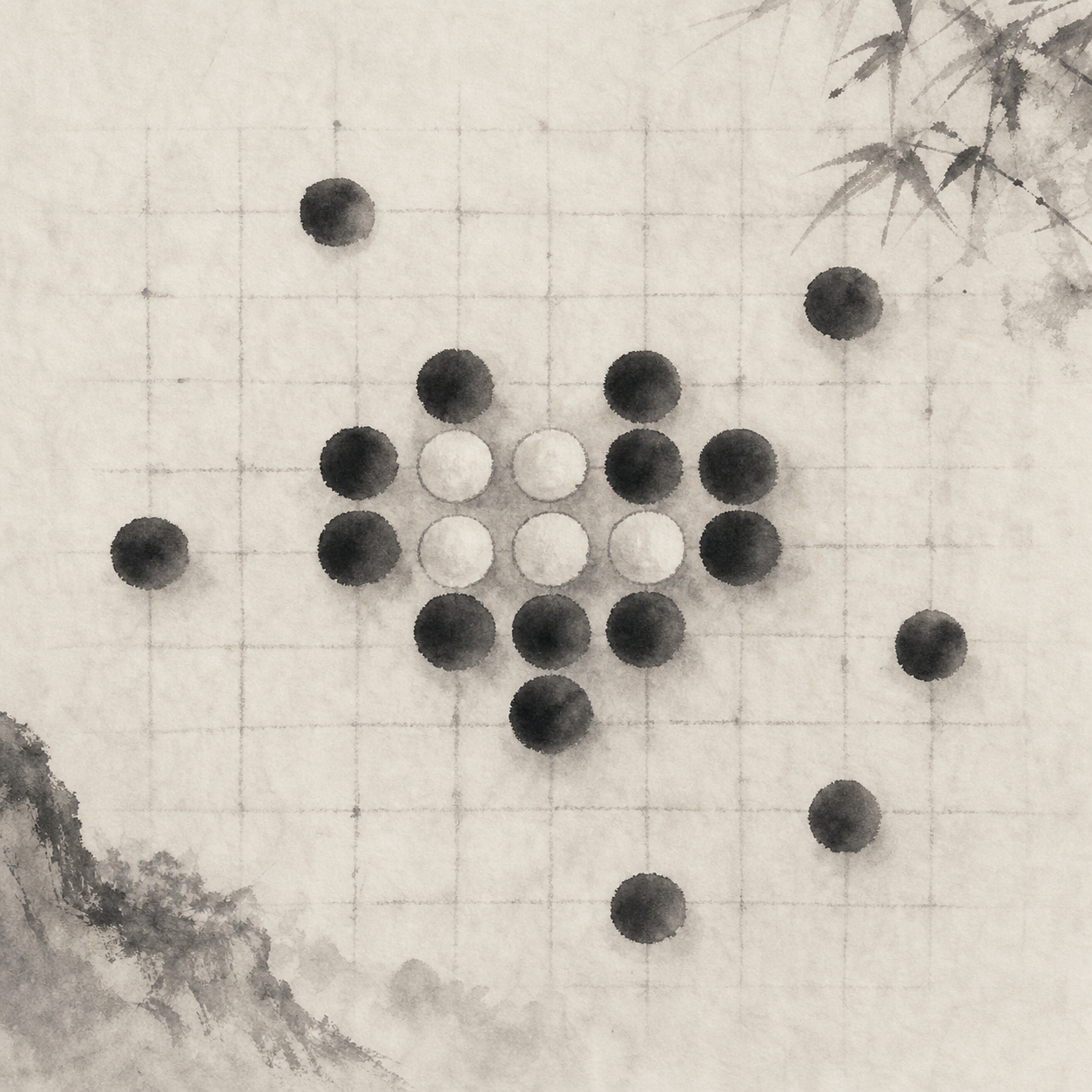
You see that your opponent is one move from five. Then you notice that the two stones in your own center can be flanked and removed. The line is still there. But the position has become lighter. Pente keeps Gomoku’s familiar straight-line goal on the same grid of intersections, then adds capture. From that moment, attack is not only a matter of extension. It is a chase.
Pente Emerged From Oklahoma in the Late 1970s
The usual history of Pente points to Gary Gabrel. MindSports records that he was from Stillwater, Oklahoma, and introduced Pente in the late 1970s. The game became popular in the United States in the early 1980s and was sold to Parker Brothers in 1983.
The timing is telling. The basic idea of five-in-a-row had long existed, and the rule was plain enough: make five stones in a horizontal, vertical, or diagonal line. The variant did not replace the board. It did not turn the goal into a complicated scoring table. It simply allowed two adjacent stones to be removed when they were caught between opposing stones.
The Same Board, Now With Disappearances
If you know Gomoku, At first glance, there is almost no barrier. Players still take turns placing stones on intersections. You still watch the horizontal lines, vertical lines, and two diagonals. You still count nervously to five.
The change lives inside a very small shape: your newly placed stone and one of your existing stones bracket two adjacent enemy stones. The rule’s core is this: when the new stone completes the sandwich, the captured pair is removed from the board.
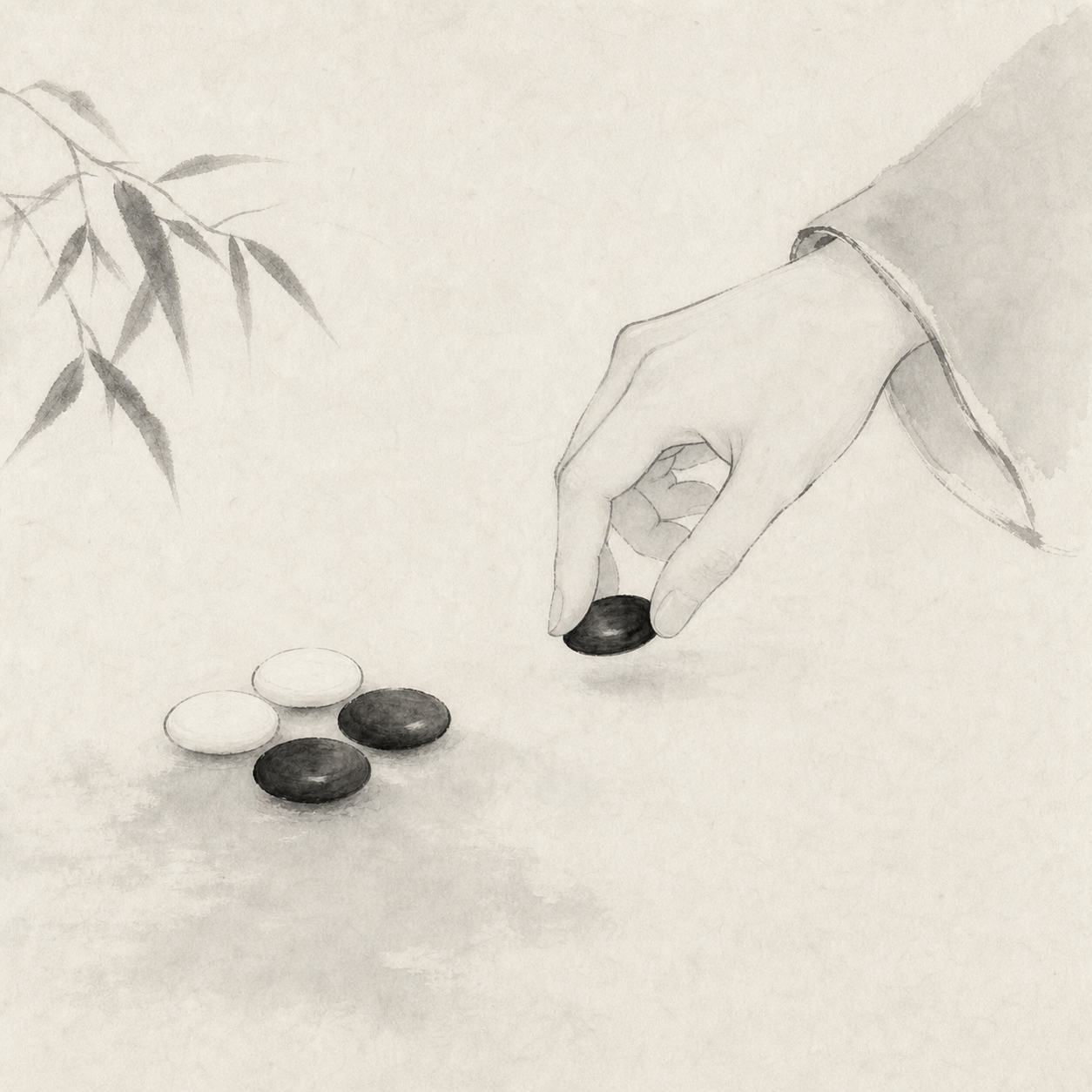
That one move makes the board’s memory unstable. In Gomoku, stones that have been played usually stay where they are; shapes only accumulate. In Pente, a solid-looking pair can suddenly vanish, and the four-move line you just calculated has to be counted again.
Victory Splits the Attack in Two
The game still keeps the five-in-a-row win. Make five stones horizontally, vertically, or diagonally, and the game is over. That goal preserves its family resemblance to Gomoku: center control, open lines, and the order of threats still matter.
The second road comes through capture. MindSports describes Pente as a game that can be won either by making five in a row or by capturing enough opposing pairs. In the common rules, that means five pairs, or ten stones.
So a position can carry two kinds of pressure. Your opponent may not be about to make five, but he may already have captured four pairs. You block his four-in-a-row and still have to ask which of your own pairs can be flanked on the next move. Danger no longer appears only along the line of extension.
Two flanked stones can reroute the game
Capture Turns Bait Into a Formal Tactic
In ordinary Gomoku, sacrificing a stone often means buying initiative or creating a blocking point. The stone itself remains on the board. The capture rule makes bait more literal. You can leave a pair that seems available for capture, draw your opponent to a particular point, and then use the next move to make your own four or set up a counter-capture.
Imagine a diagonal. You have two separated stones, with a critical intersection between them. If your opponent is busy capturing a nearby pair, he may place his stone onto that diagonal. On your next move, you fill the middle point, and the threat of five suddenly becomes plain.
This is where Pente feels most different from Gomoku. Gomoku is like thickening a net, strand by strand. Pente lets the mesh be cut open, and new lines appear at the cut. When you read the board, you ask two questions at once: who is closer to five, and who is closer to losing a fifth pair.
It Does Not Erase the First-Move Problem
When talking about Gomoku variants, it is easy to overstate what one rule change can do. The first-player advantage in free Gomoku has real research behind it: work by Allis and others is recorded in a UCI abstract as proving free Go-Moku a first-player win. That conclusion concerns free Gomoku. It is not a verdict on every five-in-a-row game.
After capture is added, the first player can still claim the center and the first line of direction. The difference is that expansion also exposes pairs. If the second player can turn a defensive point into a flanking point, a simple block can become the removal of two stones.
Its balance comes from that extra channel of counterattack. It does not slow down the five-in-a-row goal. It makes every line carry a possible cost. The faster you spread, the more carefully you must check whether an adjacent pair has a flanked tail.
To Move From Gomoku to Pente, Change One Habit
If you play this variant with Gomoku eyes, you are most likely to miss the safety of a pair. When you see two adjacent stones of your own, do not only ask whether they can grow into three. First check whether one end is already occupied by your opponent, and whether the other end can be filled on the next move.
This habit changes your sense of a good shape. Some open threes look elegant but arrange two core stones as a capturable pair. Some blocking moves look conservative but also cut off your opponent’s capture route. A Pente move often does two jobs at once.
After a game, go back to the first pair that was captured. Ask yourself: did those two stones become adjacent naturally while you were chasing five, or did you simply fail to check both ends? That small review will get you into Pente’s rhythm faster than memorizing a string of openings. In the next game, start by seeing every adjacent pair clearly.