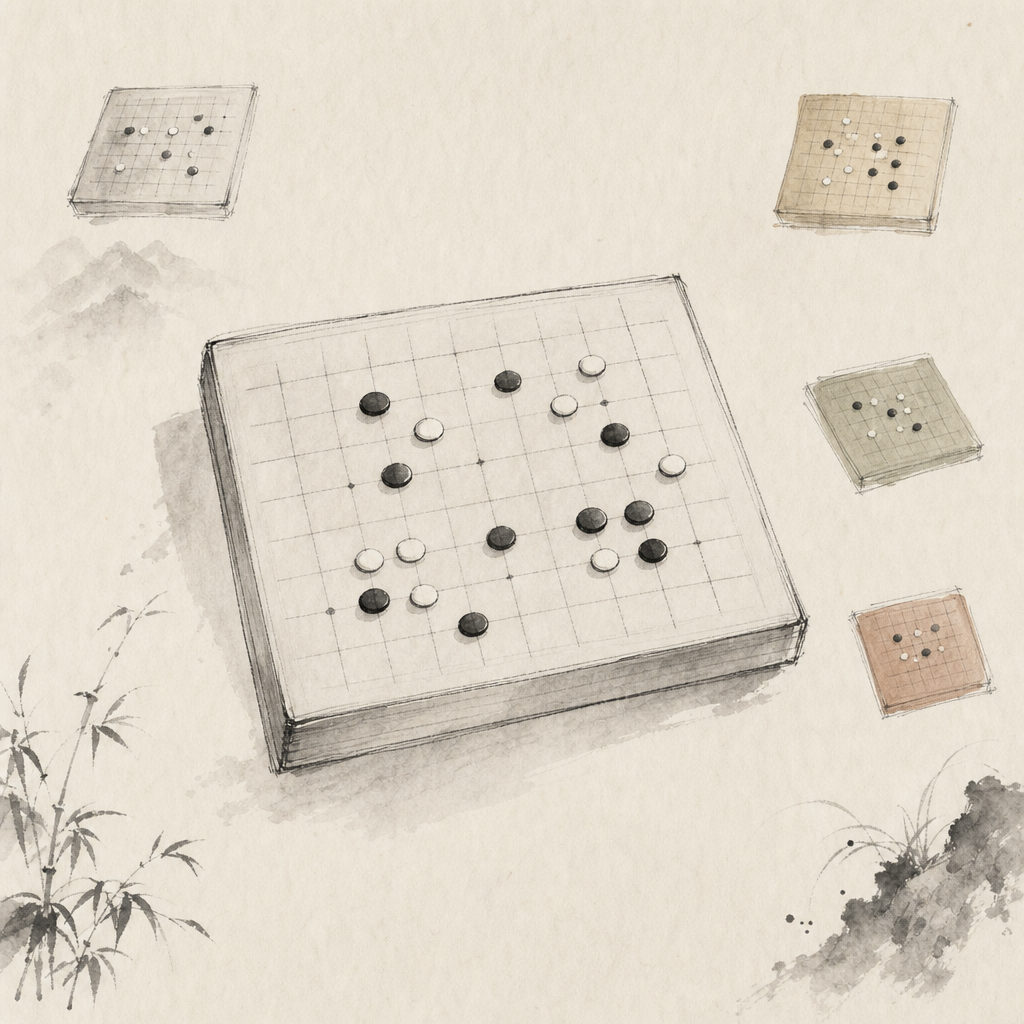
You may know the position: you have clearly seen the open three, and yet before you move, the board keeps pulling at your attention. The lines are too heavy. The base is too bright. The black and white stones seem to float on the screen. Gomoku already asks enough of your judgment. The board should not add another layer of noise.
ThemeTokens Turn Color Into Repeatable Judgment
The process does not begin with whether a board looks good. It begins with ThemeTokens. The base color, line color, stone contrast, shadows, hover state, and last-move marker are first broken into named decisions.
That discipline matters. No adjustment is ever isolated. Change the line color, and the edge of the black stones changes. Warm the base color, and the white stones feel different. A board is a set of relationships, not a background image.
First Tuning: Read the Base and the Lines on Screen
The first tuning is blunt: open the board and see whether it holds. The base has to support the stones. The lines have to give coordinates. The intersections have to be clear enough, but not so forceful that the board starts to feel like graph paper.
The easiest mistake is making the lines too heavy. A heavy grid can make an empty board look sharp. But after a dozen moves, stones, lines, and shadows begin to stack up, and the local position turns muddy.
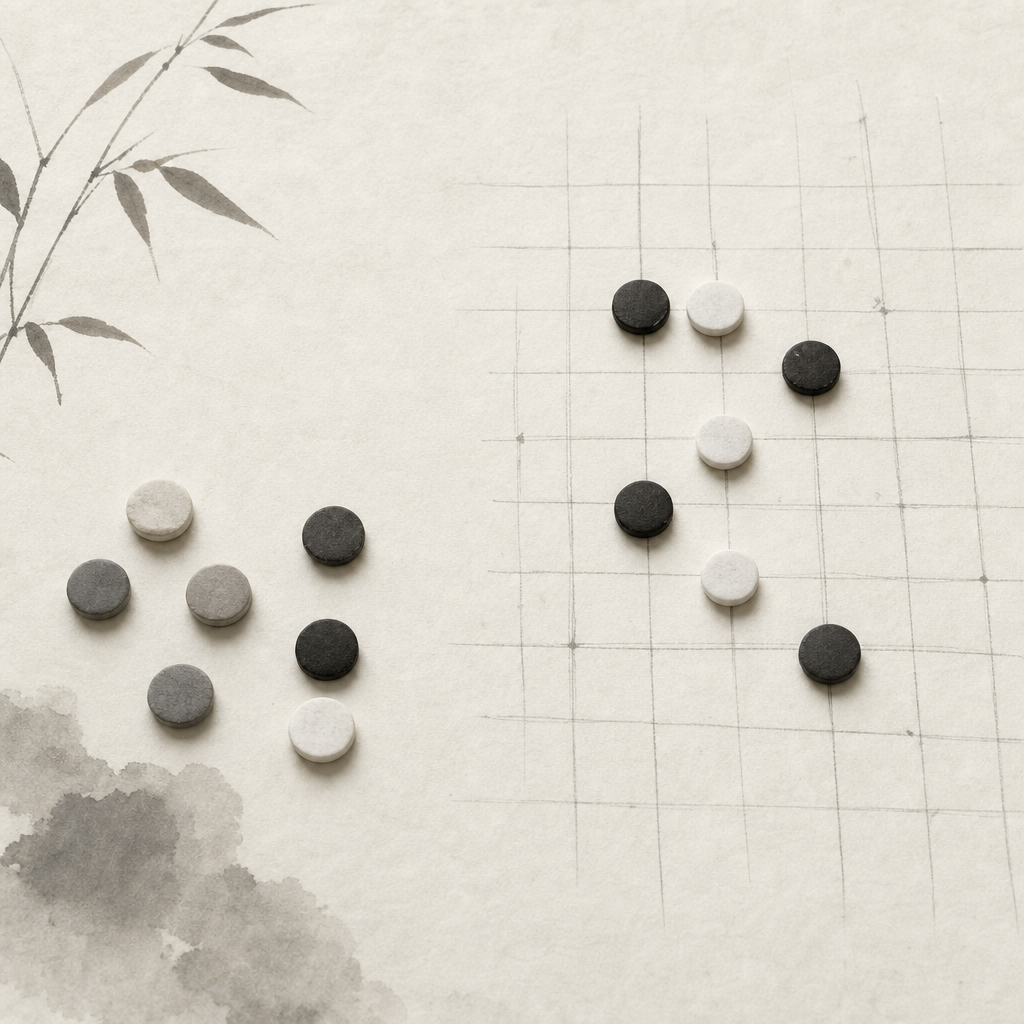
Pay special attention to the sides and corners. Many mockups feel easy in the center and cramped along the edge. In real play, four-in-a-row attacks, defenses against fours, and forcing sequences do not stay in the prettiest part of the board.
The quieter the board, the clearer the judgment.
Second Tuning: Test the Rhythm Inside a Game
The second tuning requires a game. A static image tempts you to tune the board into a handsome poster. The real problems show up on move 15, move 30, and in the moments just before the result becomes clear.
Take the last-move marker. It has to be visible, because during review you need to return quickly to the choice just made. But it cannot glare like a warning sign, or every move will drag attention back to the marker itself.
The hover state follows the same rule. A preview stone needs to be clear, especially on a small screen. But if the hover shadow is too thick, the board begins to feel as if it is hurrying you to move. Gomoku can be tense. The interface does not need to be.
Stone Contrast Is Not Better Just Because It Is Stronger
Black and white stones must, of course, be clear. The problem is that when contrast becomes too strong, the stones look pasted onto glass, and the tactile quality disappears. A well-tuned board should give stones both weight and an edge.
White stones are especially sensitive. They need to lift away from the base without becoming so bright that they break the balance of the whole board. Black stones are not merely dark, either. Their edges, shadows, and relationship to the intersections determine whether you can count a Renju line at a glance.
A very ordinary test helps: place an open three and a blocked three in the center, then scan quickly. If the first thing you see is a clash of colors rather than a difference in shape, the contrast is not tuned yet.
Third Tuning: Step Away, Then Come Back
The third tuning is the slowest. It happens a day later, or on another device, or after opening the board again at night. Many colors feel refined in the moment. Only after some distance do you know whether they will last.
This step checks the environment. A phone, a tablet, and a desktop browser each bring different brightness and viewing distance. Chinese, English, and Japanese interfaces also carry different rhythms of white space. The board has to adapt to those differences without turning into four different personalities.
Some options are abandoned in the third pass. Not because they are unattractive, but because they are too eager to perform. Beauty is a reason in itself. But in Gomoku, the beauty that endures is usually the kind that knows restraint.
Markers and Shadows Should Only Point the Way
The last move, legal points, and win-loss prompts all belong to the assistive layer. That layer is not decoration. It is wayfinding. It should appear when you need it and step back when you are thinking.
A beautiful board first learns to step back.
Three Rounds of Color Protect One Move
Return to that opening position: you are judging your opponent’s double-three threat, and the next move may decide the game. The best board, in that moment, does not remind you how many layers of tokens it uses. It does not advertise how distinctive it is.
It simply keeps the lines clear, lets the stones sit firmly, gives the last move a place, and quiets your eye. Three rounds of tuning are not really about color itself. They are about the distance between color and judgment.
The next time you open a board, notice what you see first. If you see the shape before the interface, the color is already halfway right. Then play a game.